The Landlord

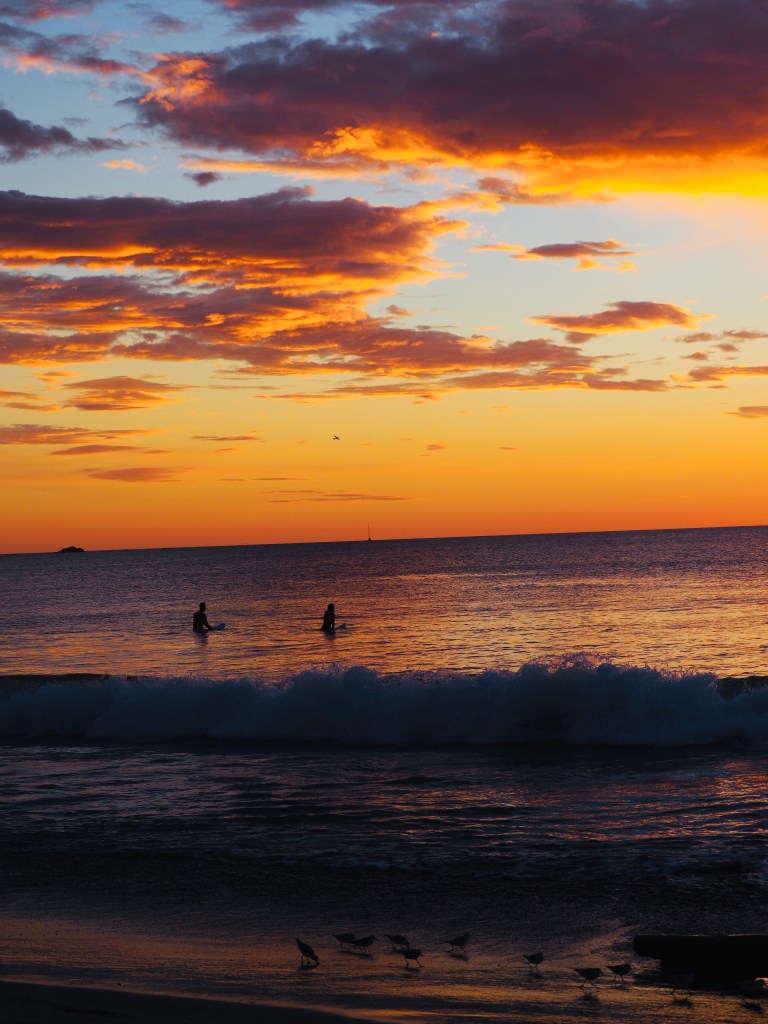
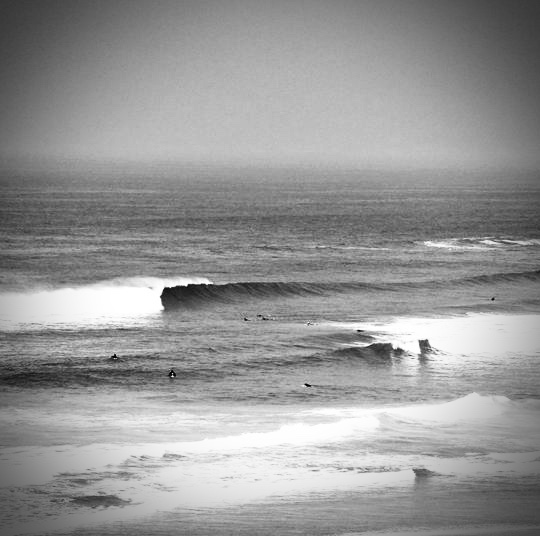
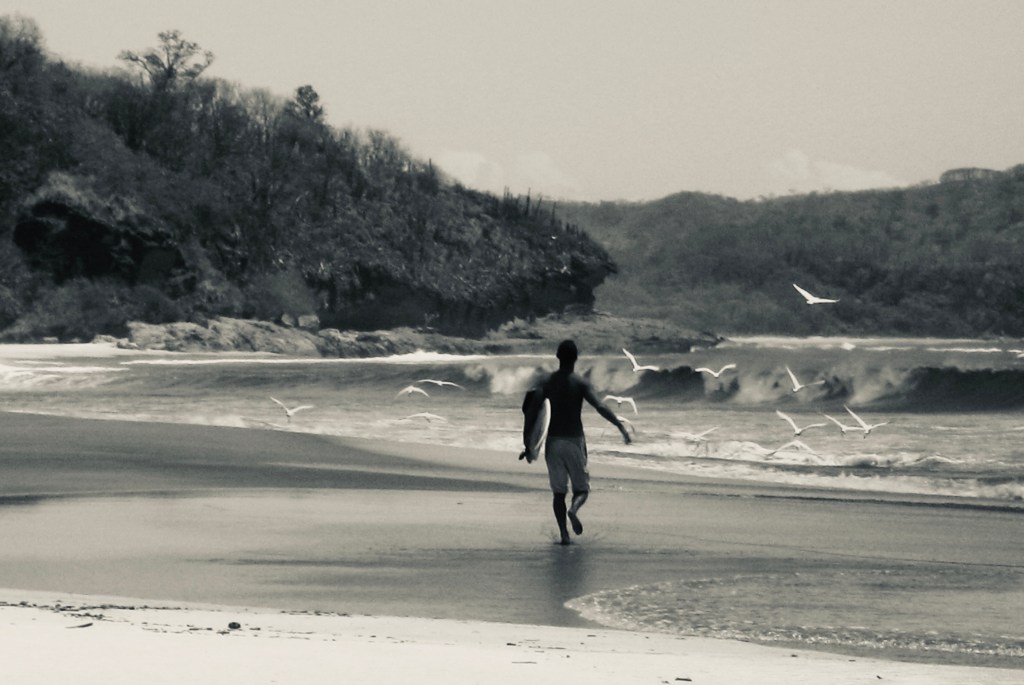
On our second day in Corcovado I wake early, around five am, and go down to the beach to look for nesting turtles before the sun rises.  I walk for a couple of kilometers but see nothing, so I creep back into camp, grab my surfboard and paddle out for a sunrise surf. I make my way through the break and out to deep water, and then there is a moment when the sea softens and quietens, flattening like a mirror as the first rays of sun break over the horizon. I am totally alone in the limitless ocean and it is one of those quasi-religious experiences. It is briefly marred by another round of coughing, and there is the blood again. I spit it out in bright red swirls that float on the water’s surface.  There is no pain and I feel physically fine, it is just like my body has decided to remove some excess ballast. It passes. I float on.

A couple of minutes later a fin slowly breaches the water dead in front of me, very close. It glides along silently for a few metres and then sinks back under the surface. I am mentally far-away in that moment and I watch it with detachment. Dolphin or shark? I ask myself. How amazing it would be if a bottle-nosed dolphin was to suddenly jump out of the water and maybe come to play. I lie down on my board and carefully lift my legs out of the water. I see the fin again a few seconds later, now five meters to my left, gliding smoothly away. It is a substantial fin, not sharp at the tip but slightly rounded, a deep charcoal grey and matte; sunlight does not seem to reflect off it. Then a third time in the distance it breaches again, still on the same bearing, heading away up the coast. I lie and ponder things for a minute, but then the swell picks up and the set comes through. I catch a long ride through many rolling sections, right in to the beach. It is a good enough wave that I decide to paddle back out for more.

I catch another three or four waves until I see Meg on the beach, waving furiously at me and beckoning. I can see that she is anxious and I paddle in hurriedly, thinking that one of the kids had been bitten by a snake. It turns out to be no less of a tragedy: Meg has seen an anteater being savaged by one of the guard dogs in the camp. The dog was pulled off, but the wounded creature has limped away along the beach into the undergrowth by the water’s edges to die. We can hear it panting and rustling in a nest of fig vines that tangle back into the sandbank. I am very keen to see an anteater and we attempt to lure it out with coaxing noises, thinking perhaps that we might nurse it back to health, tame it, adopt it. Unsurprisingly it does not come out.

After breakfast we meet Alvaro, a local guide who we have booked to take us deep into the Corcovado jungle. I tell him about my fin story and he chuckles.
“Dolphin? No! A dolphin is swimming with leaps and jumps. No, no, no. My friend it is a shark that moves in straight lines with the fin like this,” Does a gliding move with his hand. “It is mainly bull sharks we have here, but he will look at you and think you are too big. He is going to the river mouth. A tuna or mahi-mahi is nicer for him. Bueno! It is worse for you if you get a crocodile in the sea moving between the rivers.”

Josh and I check this out on the internet later and got a stern list of shark risk factors: surfing alone, at dawn, near a river and various others. It seemed that I had broken every single rule. Nonetheless the three of us go surfing again that evening, but this time we take Arthur along as bait.

I never got a sense of threat from that smooth gliding fin, rather an insulting lack of interest, as I think back on it. There was no change of course as it cruised past me. We simply cohabited for a moment in the waves.

In surfing slang, sharks have many names: ‘the men in grey suits’ sometimes or the ‘Noahs’ (a cockney riff I suppose on ‘Noah’s arks’). My favourite term though has always been ‘the Landlord’. It has the gravitas that this apex predator is due. We humans are out of our milieu in the sea, we float and submerge ourselves temporarily for kicks, then we return to dry land. As unreliable short-term tenants of the ocean we might get our eviction notice at any point. We must know our place, make sure to pay our dues and never disrespect the Landlord.

Avoid swimming at dusk, dawn or night since some sharks are more active during these times.

Avoid entering the ocean near a river mouth

Avoid entering the ocean with a bleeding wound.

Do not surf, dive or swim alone

“How Common Are Shark Attacks in the Beaches of Costa Rica?” The Costa Rica Star

The End of the World

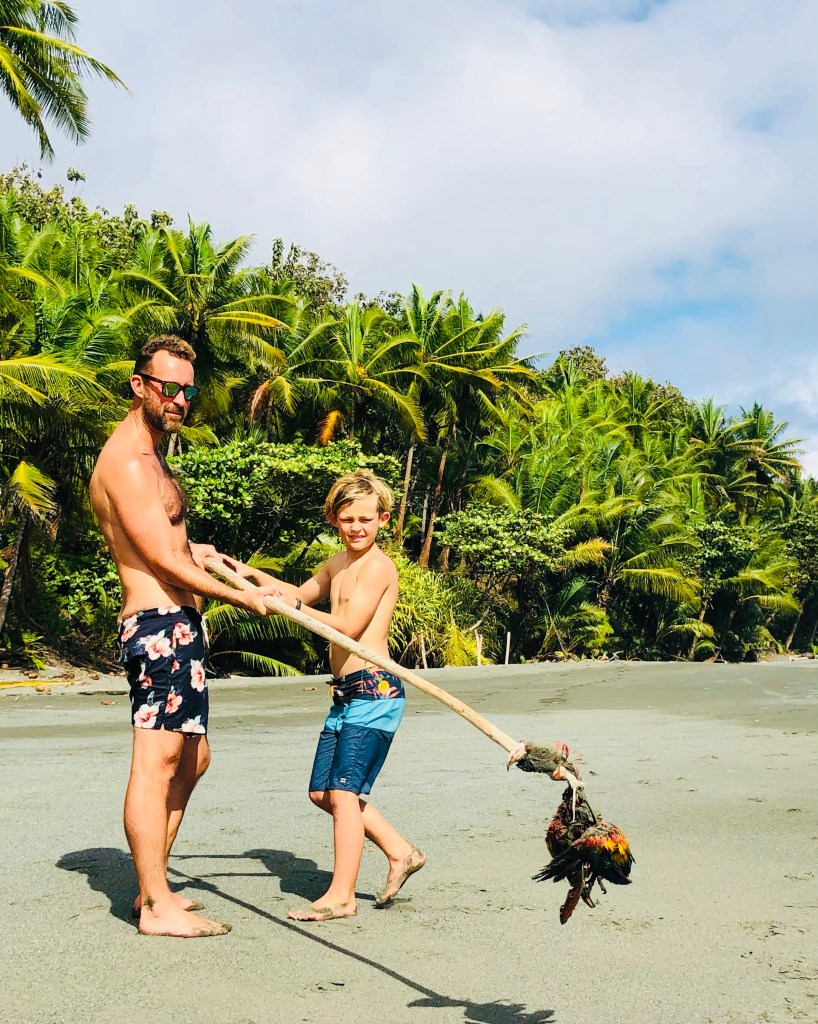
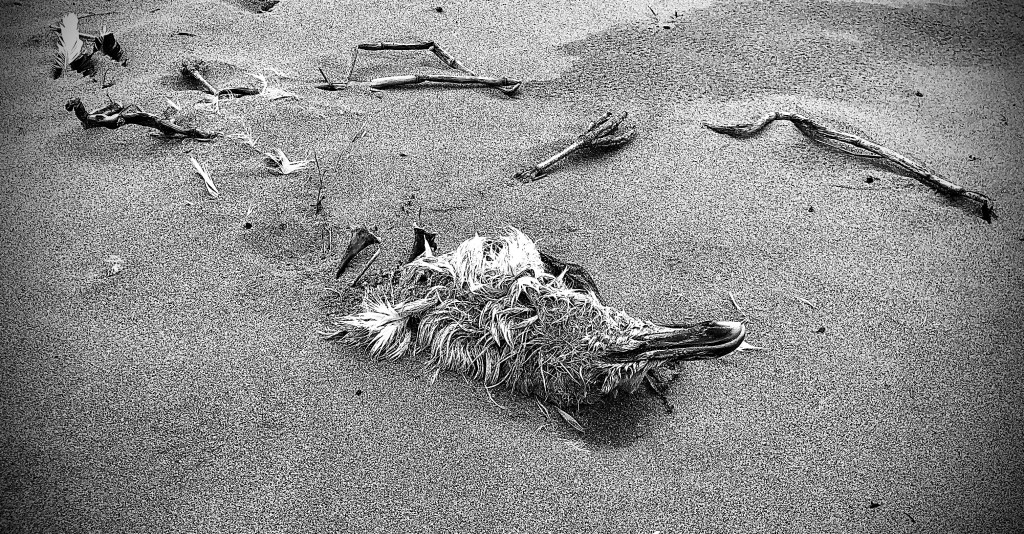
There’s a dead macaw in the sand. Arthur finds him on our first afternoon and calls me over excitedly. He was damming a stream and suddenly he spotted the bird there, propped up on a tangle of roots with wings half-open, reclining. He has clearly been dead for a while and the vultures and coatis have been busy. Much of the upper body has been eaten away but his head is still there, attached by a length of vertebrae. His beak is closed, his eyes are open. We hook a long stick into the base of the skull and pick him up with it; he is surprisingly heavy. We take him ‘flying’ over to where the girls are sitting. Menna loves macaws.

After all the screaming is done, we start to feel bad about the desecration of such a magnificent creature, so we take him back, retracing the trail of vivid red and blue feathers to his final resting place. Earlier that morning I had been walking along the beach in the mist, searching for a wayward son. I was seized then by a coughing fit that came out of nowhere and surprised to find my mouth full of blood. I spat it out, and it made bright red frothy trails on the white sand. Now looking at the confusion of scarlet feathers I am reminded of that secret moment and then I wonder what it would be like to find yourself propped up, dying, on this beach. We place our Macaw upright against a tree, looking out over the ocean. The next morning he is gone, reclaimed by the jungle.

This is a wild land that we find ourselves in. There is nothing for several miles in either direction of us, just an endless sand strip that fades away into cloud and water, a dark line of jungle behind, large birds of prey circling above. Waves smash down on the beach with a relentless roar. It is haunting and obviously beautiful, not like a postcard scene, but in a lonely and savage kind of way.

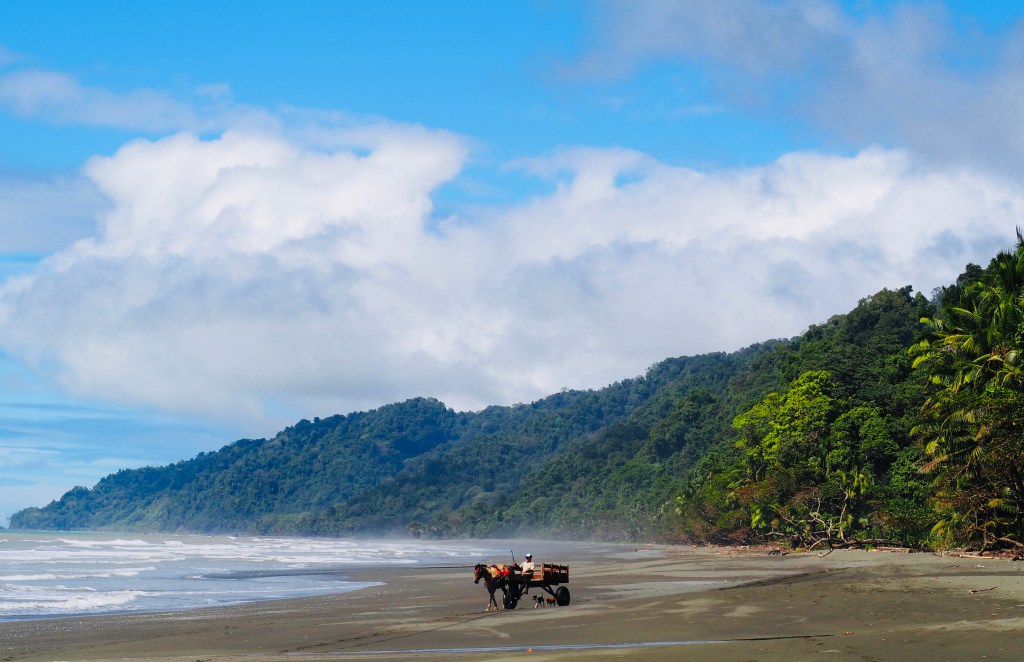
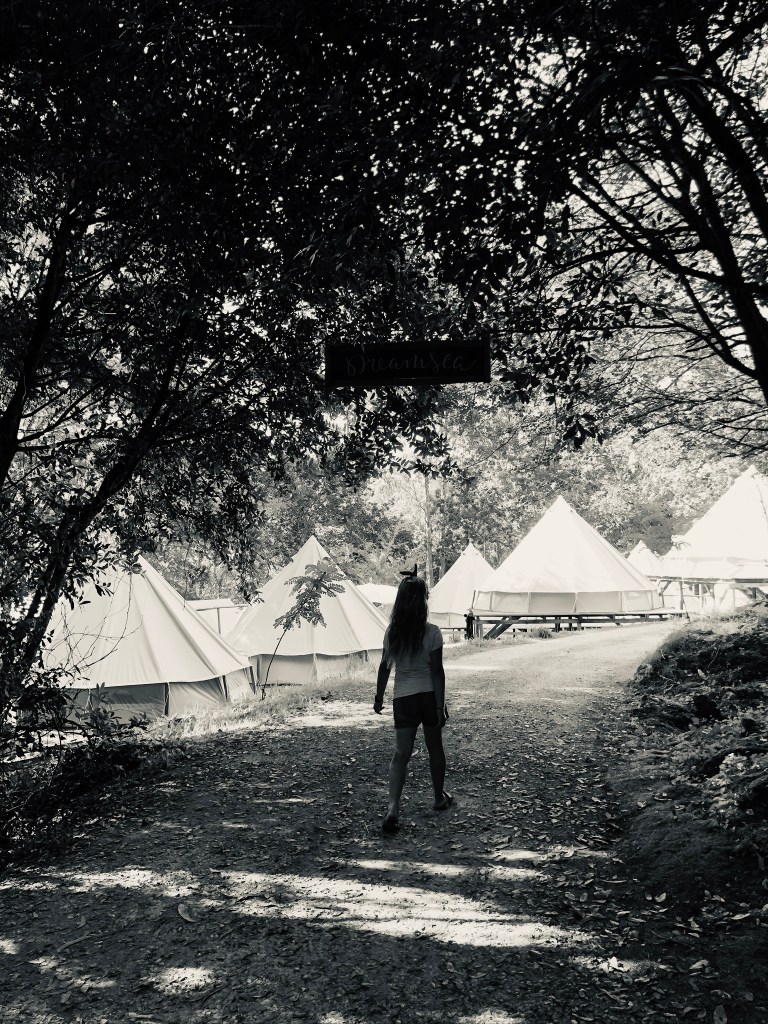
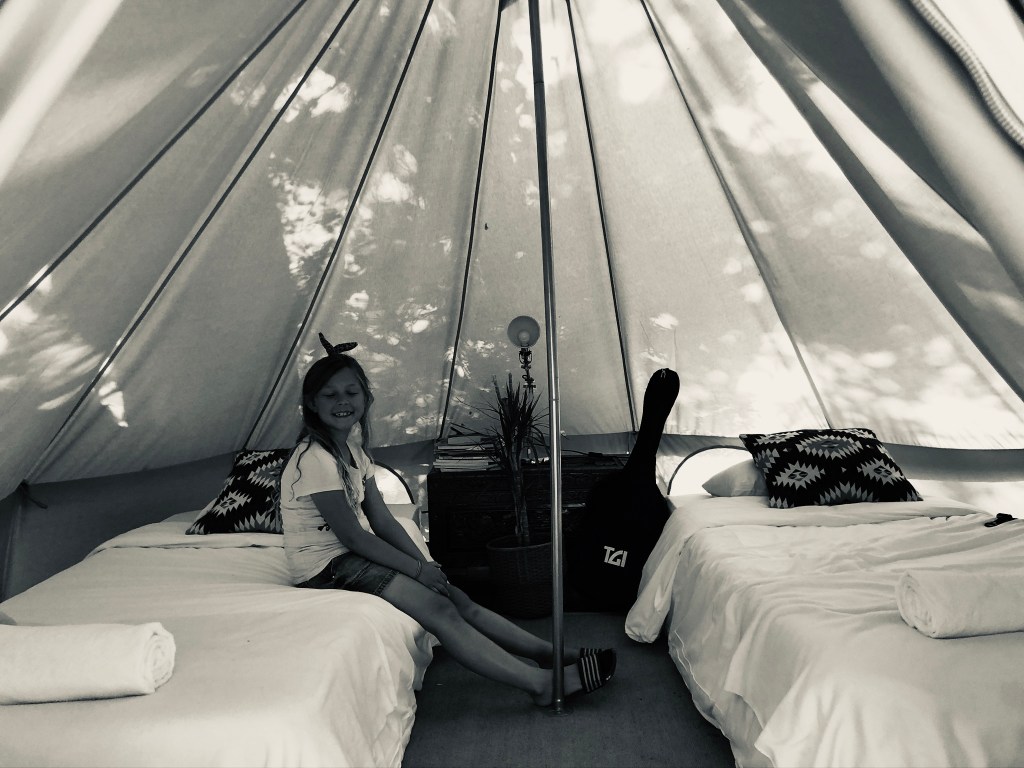
Together with our friends Josh and Meg, and their daughter Marlowe, we’re staying in an eco camp out by the Leona ranger station on the edge of the Corcovado National Park, a place that National Geographic calls “one of the one of the most biologically intense places in the world”. All that separates us from this biological intensity is thin canvas, for we sleep in safari tents under the strangler figs. We must carefully shake out any folded towels before use, we are told, as scorpions or snakes often crawl inside. We seven are the first visitors to the camp since March and it seems that in the interim the jungle has moved to reclaim it: twisted roots and hanging lianas have swallowed the rearward row of tents; the spa cabin is now nothing but collapsed bamboo struts and palm shoots, and has been colonised by Capuchin monkeys; the hammocks are covered in moss and lichen. We have a cheery hotel manager and a cook staying somewhere on site. A food delivery comes daily by cart. The bar is empty.

To get here we had to drive to the southern outpost of Puerto Jiminez, an erstwhile  gold-mining and logging centre, now a dusty jump-off point for eco-travellers wanting to provision before heading into the wilds.  We handed over a large amount of cash there to a chatty big man with a tour-operator’s wolfish smile. He directed us onwards – three hours bouncing over potholed dirt tracks, driving fast against a tight deadline – to make a rendezvous with the pony cart before high tide. We forded several rivers, saw brown water pouring through our engine grills and agreed to forget the car rental disclaimers that very specifically forbade us from doing this. We crossed wooden bridges one car at a time. We stopped to photograph monkeys, coatis, toucans, caracaras picking ticks from oxen. We reached the end of the dirt road and abandoned our vehicles besides a disused airstrip in Carate, and in the driving tropical rain we set out on foot for a further five kilometres along the beach to find our camp. We were late and we missed our rendezvous with the cart driver, so we left our luggage piled up in a palm frond shack, not knowing if we would ever see it again. 

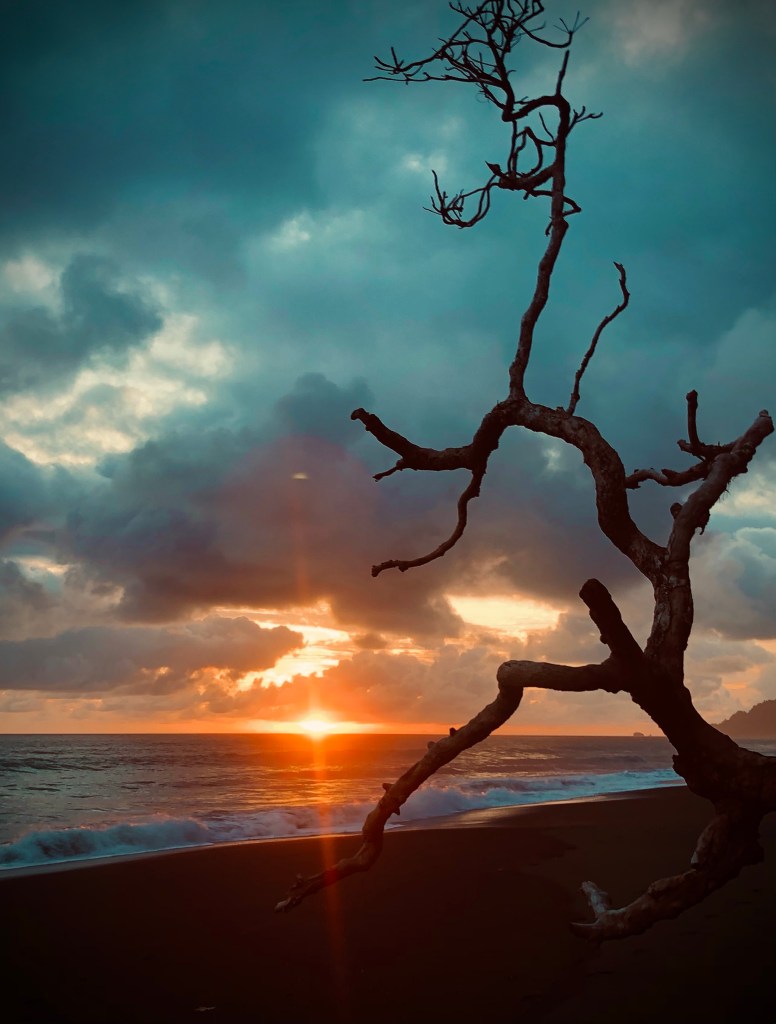
Now we are here at the end of the world and as the sun goes down, everything bleeds into crimson: red-gold stains of sunset, a swirl of scarlet feathers, the veins of my eyelids lowered against the glare, secret blood streaks in the sand. There is single macaw that flies low across the beach, squawking, and I wonder if it is the surviving member of the pair. These birds are said to partner for life. She is calling out to her mate perhaps, wondering where he has gone.

When the eagles are silent, the parrots begin to jabber

Winston Churchill

Welcome to the Jungle

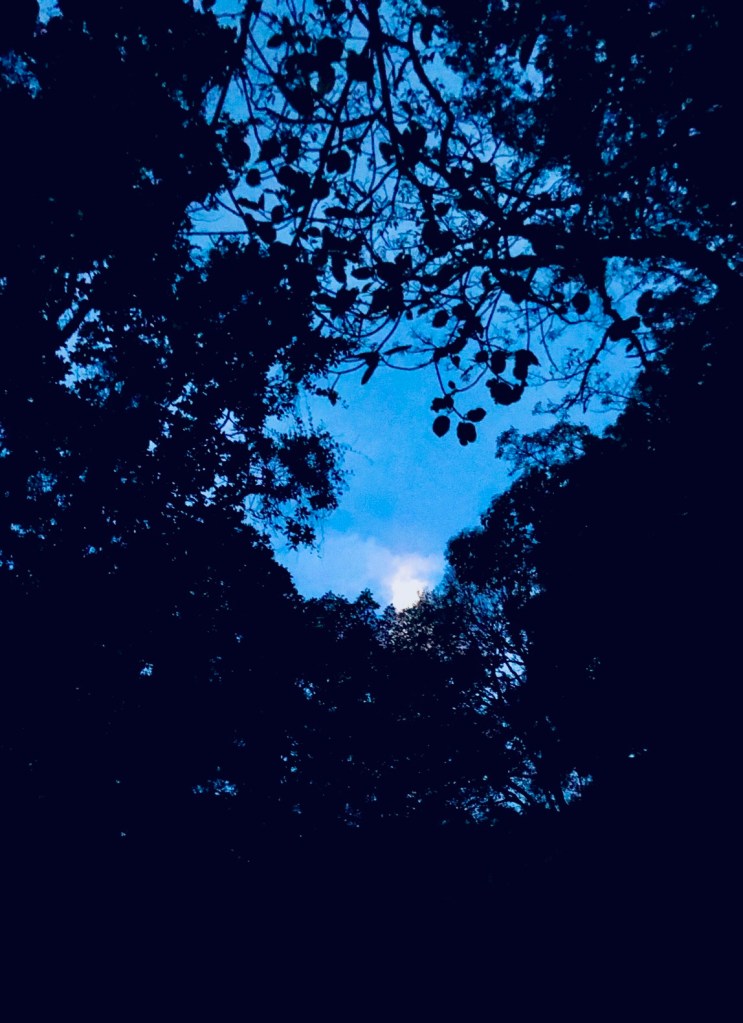
Arthur and I are somewhere in Los Quetzales cloud forest, high on the mountain face. We are starting to wonder if we have made a mistake. A jungle after dark is a scary place, full of whispers and insinuation. Spider webs brush across our faces and we have no idea how large or how venomous are the weavers. Roots twist and curl under our feet – or are they snakes? Things fly at us out of the darkness. It has been raining most of the afternoon and the path is slippy, the undergrowth around is thick. Our head torches cast thin beams straight ahead, but the light bounces back off wet leaves and the shadows behind have the glistening fluidity of ink. Every time I look towards Arthur he dazzles me with his torch and I lose my night vision.

This is our first foray into the forest, and venturing out at sunset was misjudged. The girls turned back a kilometre ago and now Artie is starting to get that quaver in his voice that says that his courage is failing. But we are men! We don’t admit fear or acknowledge our mistakes. Misadventure is a burden we must bear. We are still on the trail at least, or I think we are.

“Do you think we should turn back soon Dad?” It is the opening I need.

Happy to go back if that’s what you want…”

“Is it what you want?”

“Well, I could go on a bit. But I don’t want you to be scared.”

“I’m not scared! I just feel a bit tired. Hungry I mean. Hungry and tired.” Next to us in the undergrowth something large suddenly rustles and I jump.

“Jaguar!” I shout. It is intended as a joke but I get the volume wrong and Arthur leaps like a gazelle. His sudden movement startles me, and then we are both running, slipping, slithering our way back down the trail, through the spider webs and over the snakes. We are both hungry and we are tired, but we are not scared. It is time to go home.

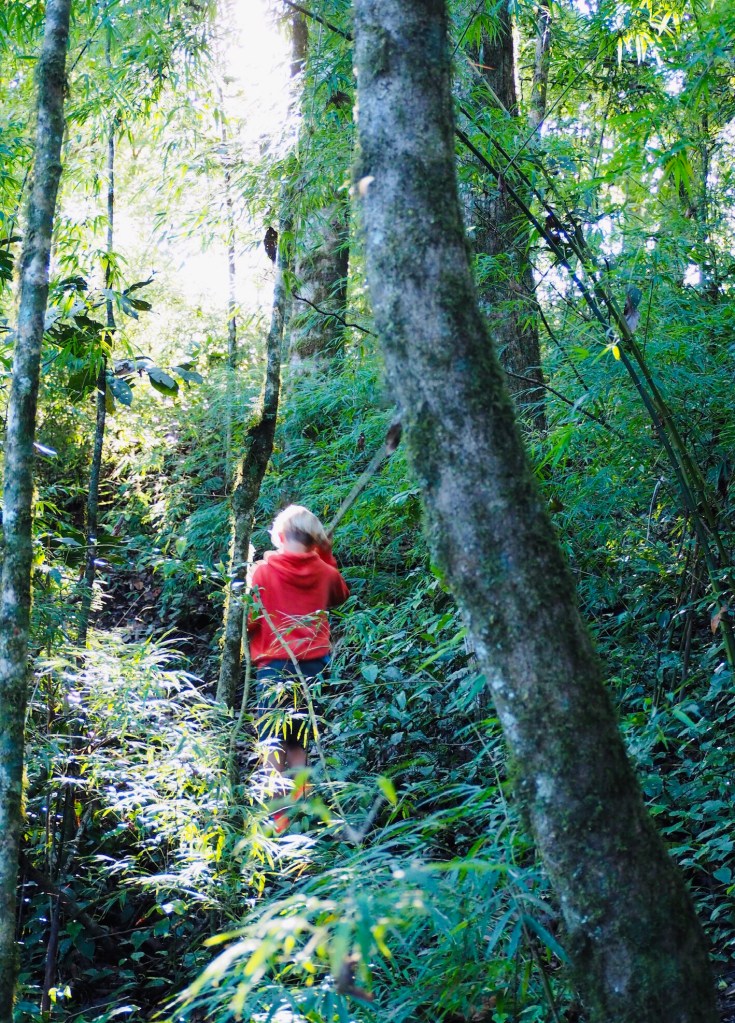
We take the trail again at 5:45am next morning. Walking through the forest at sunrise is a whole different experience. Although once again we are in near complete darkness when we start, it is not so terrifying. We can feel the house lights are being gradually raised, black turns to grey and then to drab green. Olive notes show through then mossy tones, it gets brighter, deeper, until finally around us is every shade of green imaginable. At a point we know that the sun has hit the canopy because the leaves are glowing and painted in impossible colours and some have gold lining. The bird song gets louder and wilder. There is a ticking humming, buzzing that seems to rise from the forest floor. We come across gullies and streams, deep clearings with mossy floors, pockets of mist, sudden sunbeams slanting through the trees. We see a toucanet, hummingbirds, a flock of large black and white birds. There are always movements in our peripheral vision.

After about an hour hiking we emerge from the forest at the top of the mountain and into the sunlight. We find ourselves in coffee and avocado fields. A huge valley stretches out below, vultures and eagles circle above. We walk back down the mountain like heroes and have rice and beans for breakfast.

This is the start of our jungle life. By the time we leave Cedrela Eco Lodge two days later, Arthur and I have done the 5km jungle trail four times. We are hungry for more off-grid adventuring. When Menna and I were last in Costa Rica fifteen years ago, our focus was firmly on surfing, bars and beach life. This time around we are chasing nature not waves.

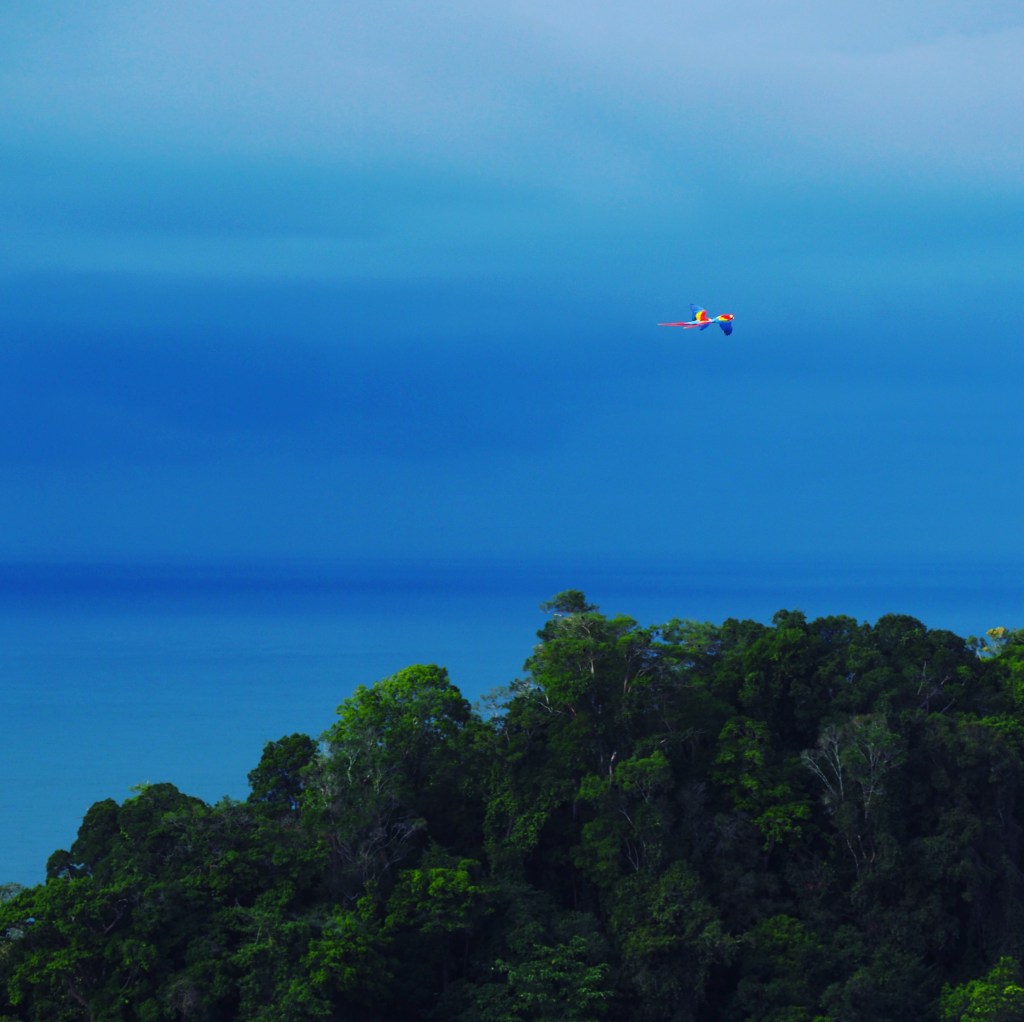
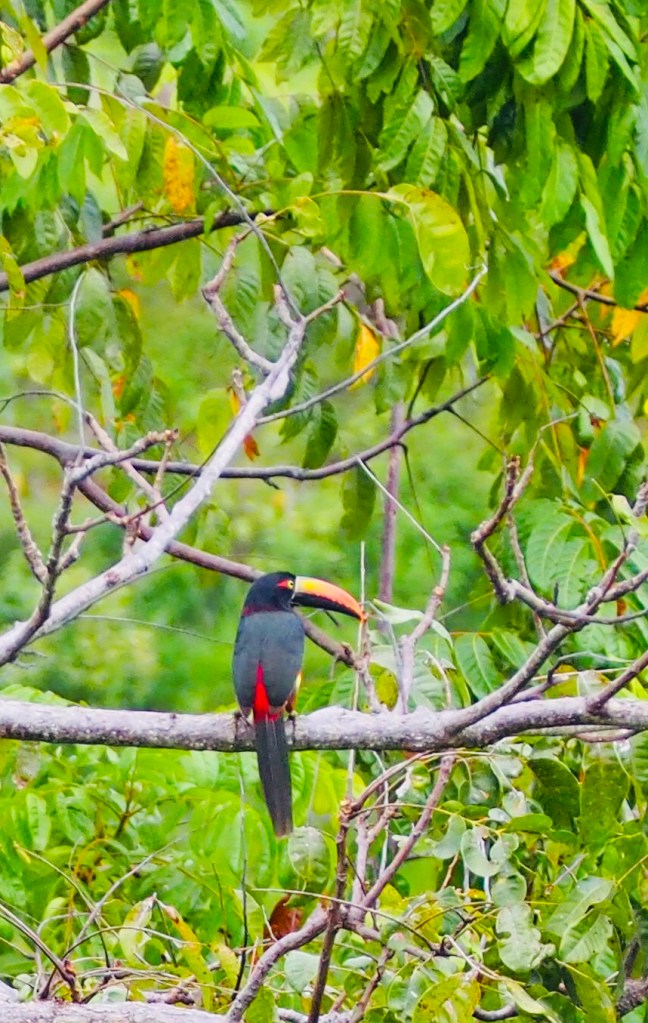
We move from the highland cloud forests of Quetzales down to the humid tropical jungle of Manuel Antonio and see monkeys at last – capuchins and squirrel monkeys – a huge emotional moment for the kids. We meet a tribe of iguanas on a deserted beach, a ranger points out the deadly fer-de-lance, Costa Rica’s most venomous snake, coiled on the edge of a path we have just walked. Fat agoutis scurry past us like dog-sized hamsters. The skies are alive and the kids are constantly spotting new birds, thumbing through their field guides to call out bright yellow kiskadees, hawks on telegraph wires, red tanagers, cinnamon hummingbirds, a pair of lineated woodpeckers. Then – raising the stakes – a pair of macaws blazing a rainbow streak against a misty blue evening (Matilda), a flock of toucans lunching on a fruit tree (Arthur).

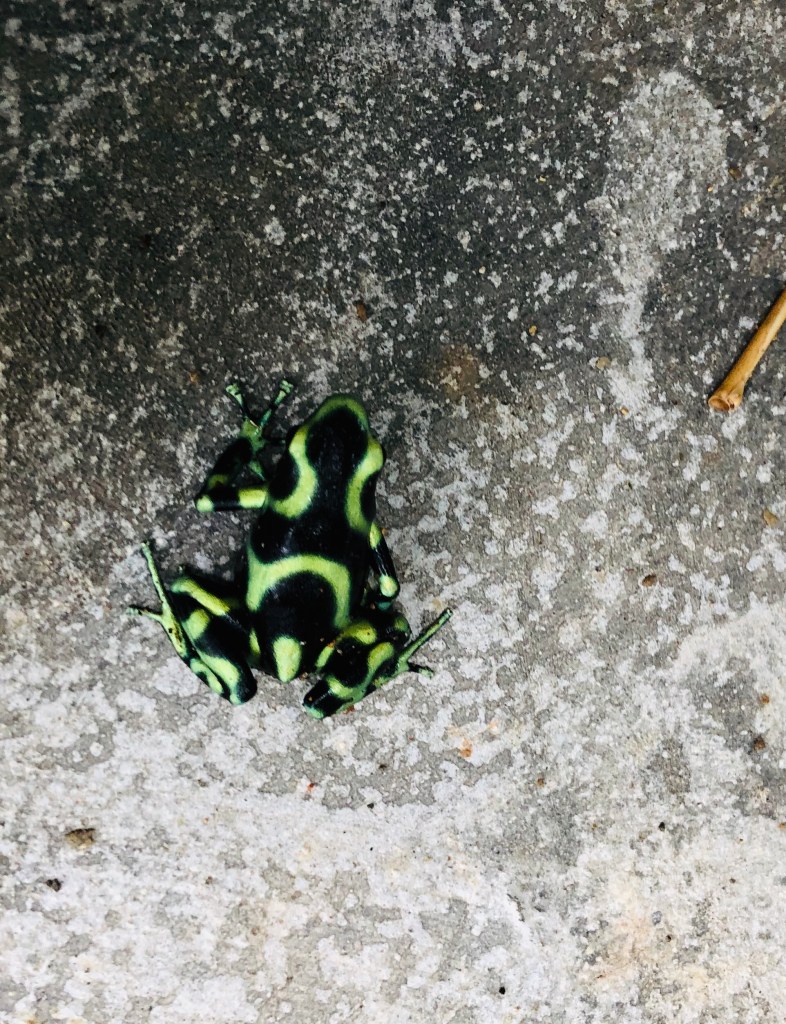
We move on to Uvita where we stay in a ramshackle tree house up in the forest and get up close with the darker side of nature. There are scorpions in the beams, we see a poison dart frog on the terrace, a crocodile head surfaces in the lake, huge spiders give Matilda nightmares. We surf on black sand beaches and see more macaws flying against the forest backdrop, blood soaked and screaming murder.

‘More,’ we shout after two weeks of gorging ourselves on nature, ‘Iguanas no longer cut it, monkeys are commonplace. We need bigger game!’ Where are the tapirs and sloths, the anteaters and pumas? Where are the jaguars? We are forest experts now, hardened to insect bites, tuned into to patterns and shapes against the foliage. Our footfall is muffled, we communicate with hand signals, we dress in khaki and strap things to our belts. We need to get into real wilderness.

In the Osa Peninsula, at the southern most stretch of the Pacific coast, there is one vast untamed tract of proper primary rainforest that is said to contain sixty percent of all the biodiversity of Costa Rica and this is where we will head. We need to go to Corcovado.

Welcome to Gran Hotel Costa Rica

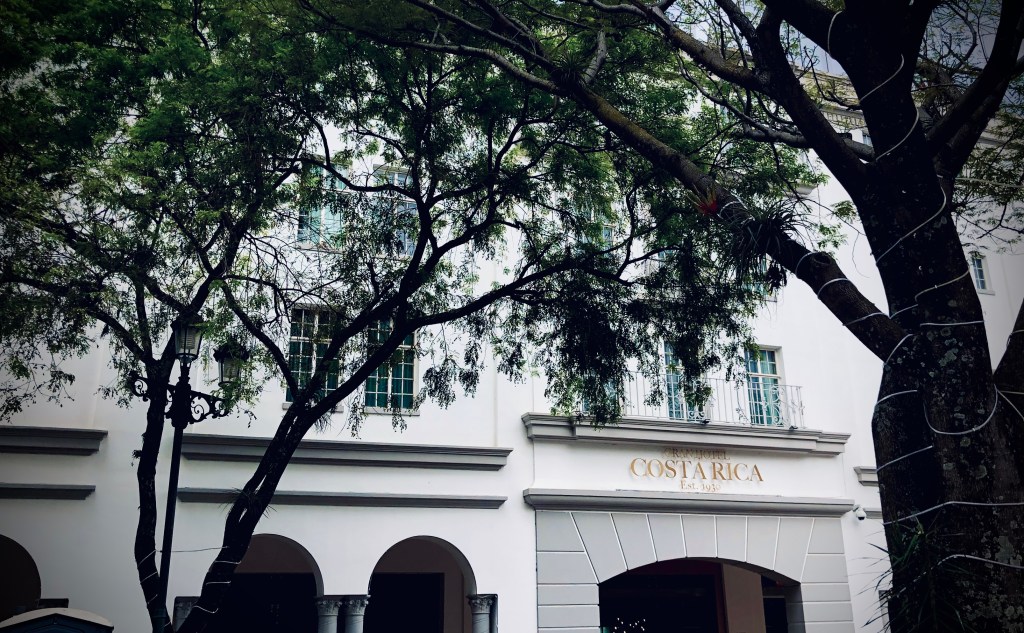
For the first two nights of our trip we stay in the Gran Hotel Costa Rica, an old haunt of ours in downtown San José.

This place is full of nostalgia for us; it is where I took Menna straight after she landed in September 2005. I had already been in country for three months at this point; wisely using that time not only to tour the land and find us a house to live in, but also to shave off all my hair, turn brown, lose ten kilos, lose my shoes, lose my manners, start wearing vests with local beer slogans and generally go native. Menna found it difficult to recognise me as I stood grinning at her in Arrivals, she later told me. She felt uneasy and lost. She imagined she had been kidnapped by a Mexican refugee.

¡Hola muchacha! Hey, you real pretty… Wanna ride in my car?

It was also here where we spent our last night in Costa Rica – happily restored by this point to a state of harmony and mutual recognition – and where we returned one set of good quality cotton sheets, now slightly frayed, which we had borrowed a year before and used in most of the cheap hostels throughout Central America.

The Gran Hotel Costa Rica has now been taken over by the Hilton chain and is recently refurbished. There is a slick new cocktail bar on the top floor now, but I’m sure it is the same tired old pianist who sits in the background, coaxing out another mournful rendition of Yesterday. The hotel is a lot smarter but I feel it has lost something of its ramshackle colonial charm along the way. I wonder if this is a sign of things to come, whether the fifteen years since we had last been here may have brought a kind of progress to Costa Rica that we might not find entirely welcome.

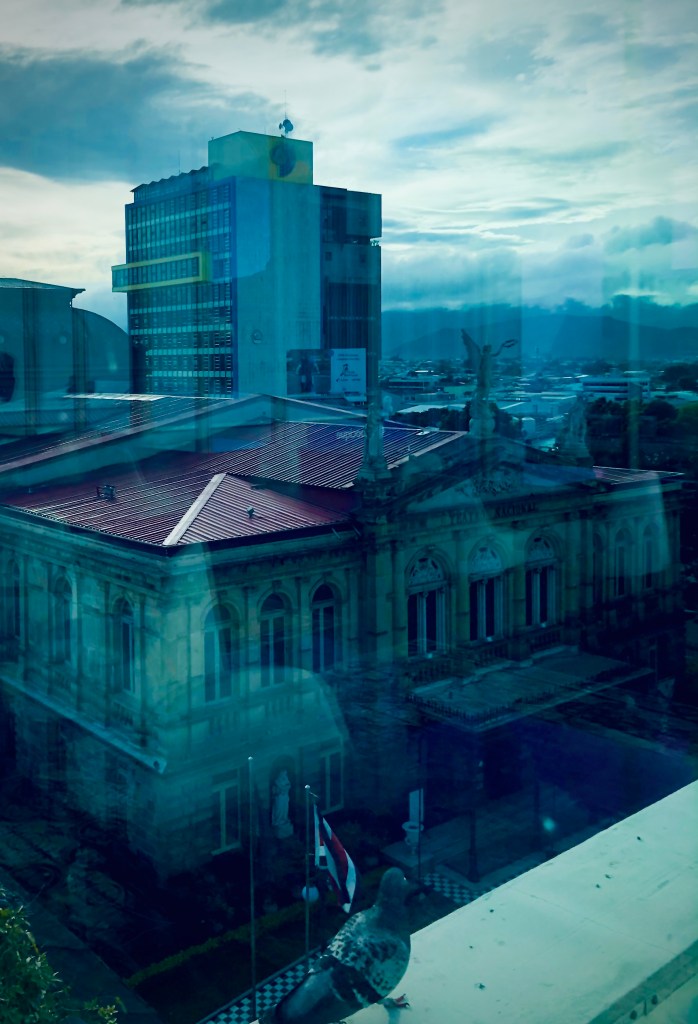
I look out of the window of our hotel room as the sun sets. At this moment the city is painted in a soft, forgiving light. The mosaic floor of the Plaza de la Cultura stretches out in front of us, then an ornate church, the Teatro Nacionál, a concrete tower block. I look past the shop lights and neon, beyond a sea of corrugated iron roofs, through barbed wire and electric cables and away to the cloud-topped mountains that surround the city.

I know the forests out there are teeming with nature in all its many forms. I can imagine the shifting, slithering, scuttling aliveness of it all. There will be furtive movements in the shadows, swinging shapes in the canopy, sudden bird calls, huge strangler figs silhouetted against the sky. Exotic bacteria are fizzing in the waters; snakes, frogs, sloths and howler monkeys hide among the leaves; jaguars slip through moonlit clearings; leeches wait to suck out our blood. It will be humid. There will be ancient layers of fungus and mud and leaf silt underfoot. All the sludge and the glory of the tropics is just there, outside our window, on the horizon.

After a couple of days in the city we all feel that it is time to head into the wild. Artie straps his new bush knife to his belt. We pick up a hire car, buy a map, pack up our room and check out. Wanting to set a good example for the children we do not borrow any sheets this time.

The jungle looked back at them with a vastness, a breathing moss-and-leaf silence, with a billion diamond and emerald insect eyes.

Ray Bradbury

Tropical Thunder

The thing that really hits you when you arrive in the tropics isn’t the crazy sights and sounds so much as the feeling of the place. A warm damp blanket wraps itself around you the moment you step off the plane. The air is thicker; it sits heavy on your skin. There is a smell too: musky, humid, slightly rotten perhaps. It says that this is a place of fertility but also of decay. The very atmosphere is teeming with life, but it will sap you and make you lethargic. You move slowly here, you must fight your way through an environment laden with micro organisms, with heat and entropy. You must live out the dog days.

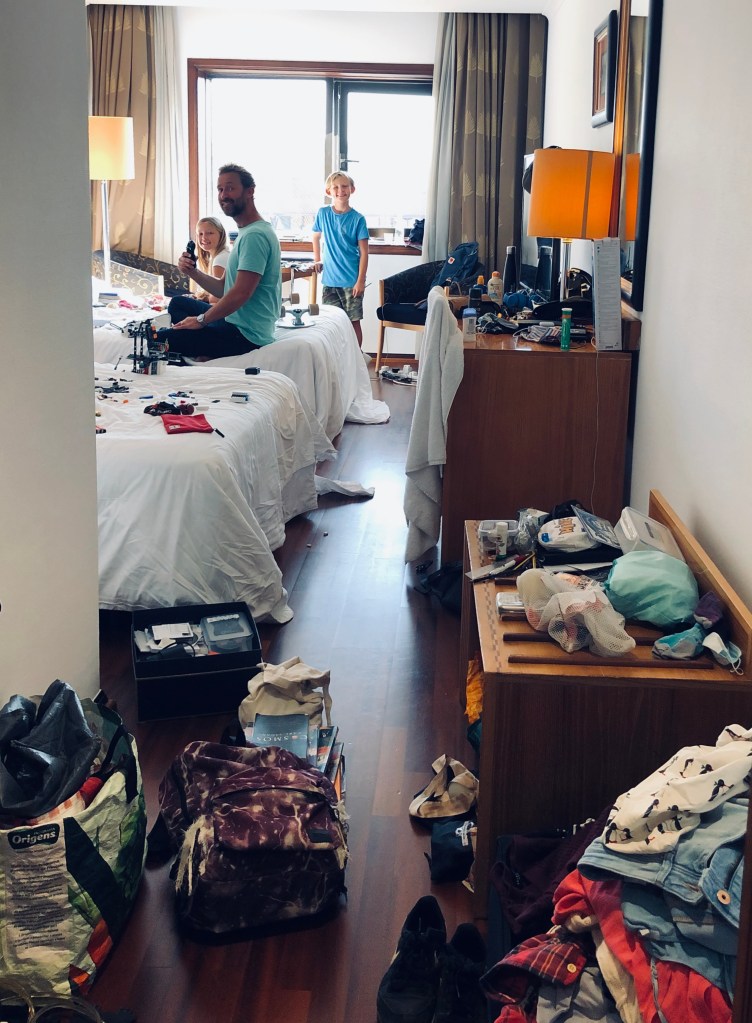
We are already dog tired when we arrive. The lead up to this trip has been a nightmare of logistics, planning and bureaucracy; skills that don’t come naturally to us. We flew from Madeira to Lisbon, holed up in an airport hotel for 48 hours, disgorged our life possessions into our budget family room. We made piles of things to come and things to leave and like shifting sand dunes they rose and fell by the hour.

We did bag-loads of laundry. We disposed of clothes, pots, pans, shoes, a spare surfboard, packs of pasta, half-full bottles of chilli sauce, olive oil, whiskey and aftershave. We struck a deal with a guy called Pablo to store our car for six months in a marine warehouse among the unsold speedboats. We conducted hushed phone conversations and tapped laptops late into the night while the kids slept beside us. We had a sudden panic when we realised Costa Rican immigration would require proof of onward travel and we only had a one-way tickets, so we spent frustrating hours on a badly designed website trying to purchase cheap coach tickets to Nicaragua. We spent more hours trying to upload insurance policies to a Costa Rican immigration portal, fill out covid declarations on a Spanish health portal, book our surfboards onto an Iberian travel portal.

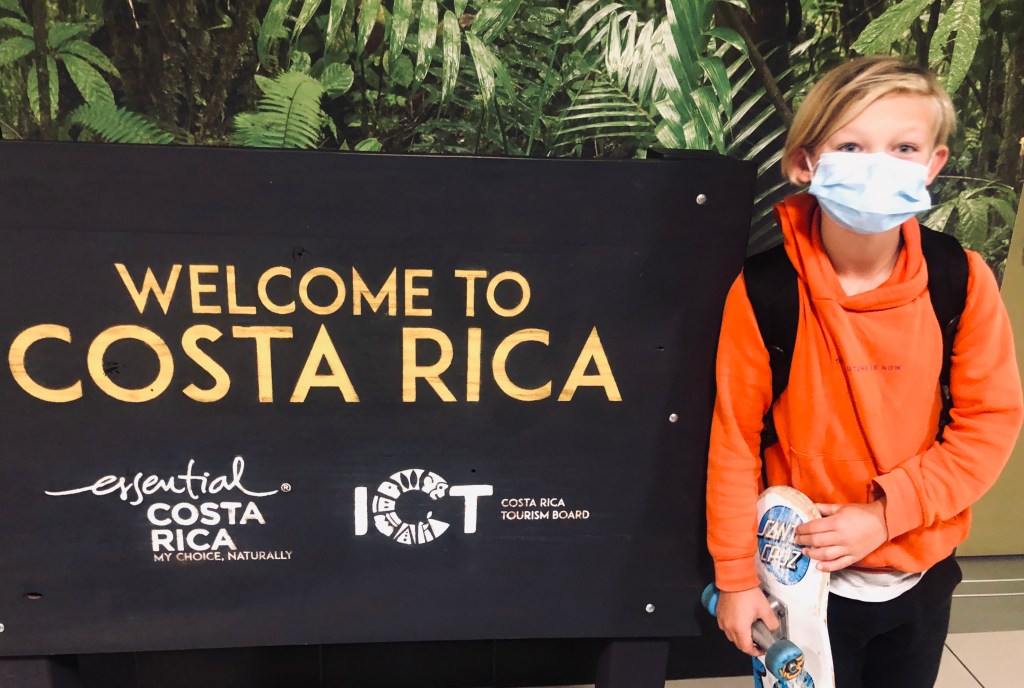
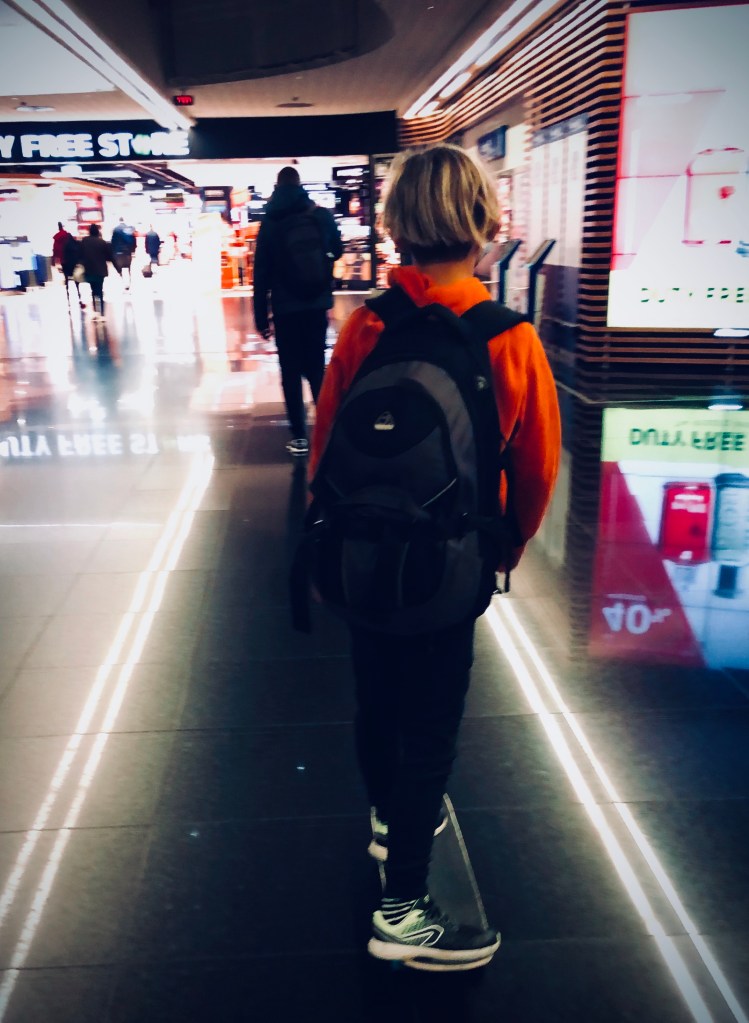
Then came the trip itself. A 4AM rise for our first flight from Lisbon to Madrid. Then the layover – eight dull hours in a deserted airport where most of the shops were shut down. Arthur and I were carrying our skateboards in hand luggage so we amused ourselves by buying a Go-Pro camera and filming an epic skate video until we got busted by security and threatened with ejection from the airport. The twelve hours from Madrid to San Jose really dragged, we were stuffy under our masks, trapped on a decrepit Iberia plane that offered no hot food, alcohol or anything much really.
“No hay cerveza señor. Es por Covid” bored shrug. We heard that a lot. Es por Covid – a catch all term for anything unwilling or unwanted, anything you can’t do or can’t be bothered to do, a conversation killer.

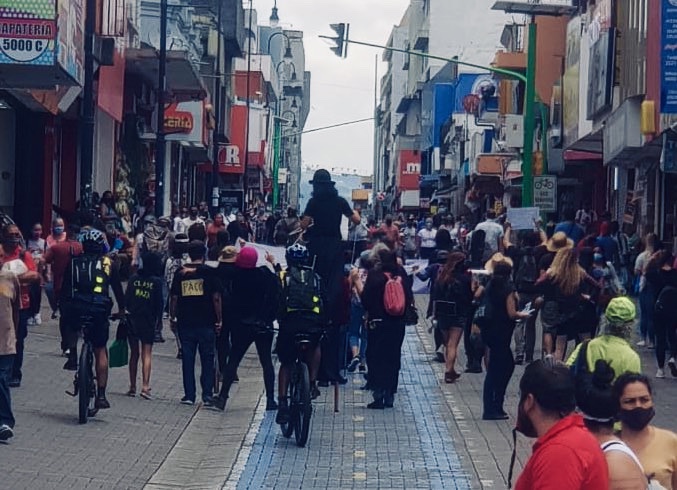
But now we’re here: San José, Costa Rica. A rambling, unlovely, low-rise town that has all the energy, diversity and frenetic activity that you would expect from a Central American capital. Our hotel sits above Avenida Central and here we can see the region in microcosm. Most the business happens out on the street: there are lottery sellers with their talismans and lucky numbers; touts with bus tickets offering routes anywhere right up to Mexico City and beyond; street artists clowning around; clusters of mestizo women in traditional Guatemalan dress sitting with their textiles laid out in front of them on sheets. Old Indian men with creased faces squat down, trilling bird calls on ceramic pipes; sellers of plantains and pig hide stroll around shaking packets in our faces. Behind the action there are shady guys with missing teeth and prison tattoos who sit on doorsteps and stare at us.

The shops here are open-fronted and amazingly eclectic or amazingly specific – one store seems to specialise in a mix of flip-flops, car radios and push chairs, while another sells only watch straps. We go into a hunting shop to buy Arthur a bush knife and are offered tazers and pepper spray, ‘perhaps a machete for sir…’. Many shops have a DJ in the doorway, mic in hand, blasting out pop and static, shouting at ladies and crooning the high notes. Everything is loud here, everything is bright. People grab you by the elbow as you try to walk. There are butchers with tinsel entwined around cuts of meat. There are grocers with mad fruits that I have never seen before.

There is one thing that unifies this chaos: Christmas is coming to San Jose and it is a serious matter. From the nut seller with the dirty Santa hat to the giant inflatable elf above the auto store, everyone has made an effort. Garlands, streamers, tinsel, fairy lights, Santas and festive skeletons are out on display. While the decorations are varied and extreme, it seems that everyone agrees there is only one Christmas song that is worth playing, so one may as well put it on repeat. It is José Feliciano’s Feliz Navidad, a catchy jingle approximately five minutes long and with a grand total of five different words. After a few minutes the kids are swaggering down Avenida Central belting it out. We have arrived.

Feliz Navidad

Feliz Navidad

Feliz Navidad

Próspero año y felicidad

Feliz Navidad

Feliz Navidad

Feliz Navidad

Próspero año y felicidad…

Island Madness

When I was younger I spent a year on Réunion, a volcanic island out in the middle of the Indian Ocean. I remember it as a place of mighty green mountain-faces and cloud columns, battered by ferocious waves and patrolled by Great White sharks; full of creole superstition. I was young back then and impetuous. I got myself in some trouble and left the island with a broken arm and a hostile crowd at my back, my name bandied around on local radio.

I am a respectable man now but there is something about the cliffs and mountains of Madeira that is very similar. It brings back memories of that wild year and makes my heart run faster. Last time I was here, in the grip of island madness and suffering from blood loss, I accidentally proposed to my girlfriend on a mountain pass. Now I am back with her once again and our two children.

Madeira gives us a typical island greeting. We land into a thick sea mist and drive blindly across the island in fog and darkness, late-night reggaeton playing on the car radio, kids sleeping in the back. Overnight the mist becomes a squall and we wake to drumming rain and the banshee howl of the wind. When we venture out for breakfast our car is nearly blown off the cliff road. ‘Come to me!’ the Atlantic shouts at us far below, pounding the rocks in anticipation, throwing up spray as our wheels skid on the roadside. We have other plans though and we drive on; we eat breakfast in a warm bakery on the mountain top, then return to our house to do some half-hearted schoolwork and pace out the day. 

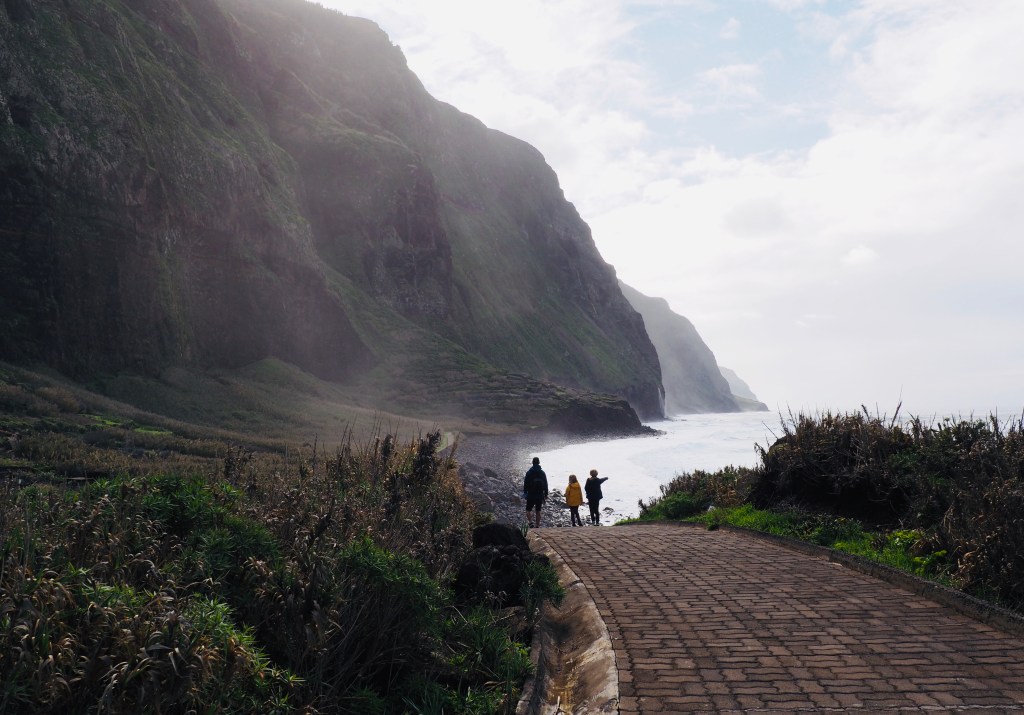
By nighttime the storm has passed and the next day is absolutely stunning. We are high on a cliff, with ocean below us and mountains behind. A series of vertical escarpments curve around the headland like folds of green corduroy, each ridge slightly more faded than the one before until they melt away into haze and shadow. Kestrels hover over the gorge.

Some way down below us the village of Paul do Mar is a series of pastel bricks tossed down at hazard behind the sea wall. It is only about three kilometres away as the crow flies, and so we decide to stroll down after lunch, using the rambler’s trails that zig-zag down through the vegetation. For the crow a 25% gradient is just wind and freefall, but we however are chained by gravity. We set off on the hike full of excited chatter, but soon we are blowing hard and conversing in grunts. The views are amazing, but our legs are properly shaking once we get to the bottom – and that was just the walk down. It requires a cool-off period, some beers, passionfruit mocktails and a serious pep talk before we are ready to attempt the return leg. We make it home though and Matilda doesn’t even moan once. Encouraged by this we drive off to a waterfall, then on to a lighthouse for sunset.

This sets the tone for our week in Madeira. There are too many beautiful things to see and it feels like we are racing against time, trying to capture the island in a week. We march to the rhythm of invisible drums. It is a novel way to travel after months of lazy meandering down the Portuguese coast. The frantic pace becomes a game. How much can we do in a day? How many sights can we see? Schoolwork becomes shouted quizzes that take place in the car as we traverse the island.

We spend a day in the capital, Funchal, bombing down vertiginous streets in strange sledges pulled by goat-like men in straw boaters. We go swimming off the quay and dress up for a colonial tea in Reid’s Hotel for a special Matilda treat. We do a 10km hike to a famous waterfall in the interior and try to swim under it, but it is too glacial to stay in that dark mountain pool for more than a few minutes. We spot the mighty Madeiran Buzzard. We take a cable car down to a deserted ghost town in the northern tip of the island and we eat a picnic on the rocks, then get drenched by huge waves as we try to paddle. We climb up the kind of cliff path that would give Indiana Jones second thoughts, scrambling over rockslides and slithering along wet ledges where all that lies between you and the abyss is wind and fear.

Arthur and I go rock-climbing in the cliffs in the south and Arthur astonishes our guides with his monkey abilities. I don’t astonish anyone, except perhaps by not injuring myself, but the challenge of man against rock speaks to something deep in my soul, and I resolve to do daily strength exercises in future and climb El Capitán with Arthur before he is eighteen. Straight afterwards, still soaked with sweat, we hike up the highest peak on the island and Matilda treats us to a glorious meltdown at the summit.

Amid all this motion I find some hours one morning to hide myself away and have a long chat with a lovely lady from BA. Then at lunch I am able to casually mention to the family that I have bought us one-way tickets to Costa Rica next week. It is a complete bombshell and it sends everyone into disbelief then squealing and dancing. I am puffed with triumph at my own largess, the modern day hunter-gatherer of airmiles and companion vouchers.
‘We are going to Costa-Coffee Rica-pica!’ the kids sing as we rattle over mountain passes and along cliff roads in our pathetically under-powered rental car.

They are distracted now, their heads far away, but as we drive along every curve brings a new wonder and I start to wish I had held back the news until later. I can’t help thinking that even the majestic Costa Rican cloud forests may not top this wild and beautiful island.

Fly Time

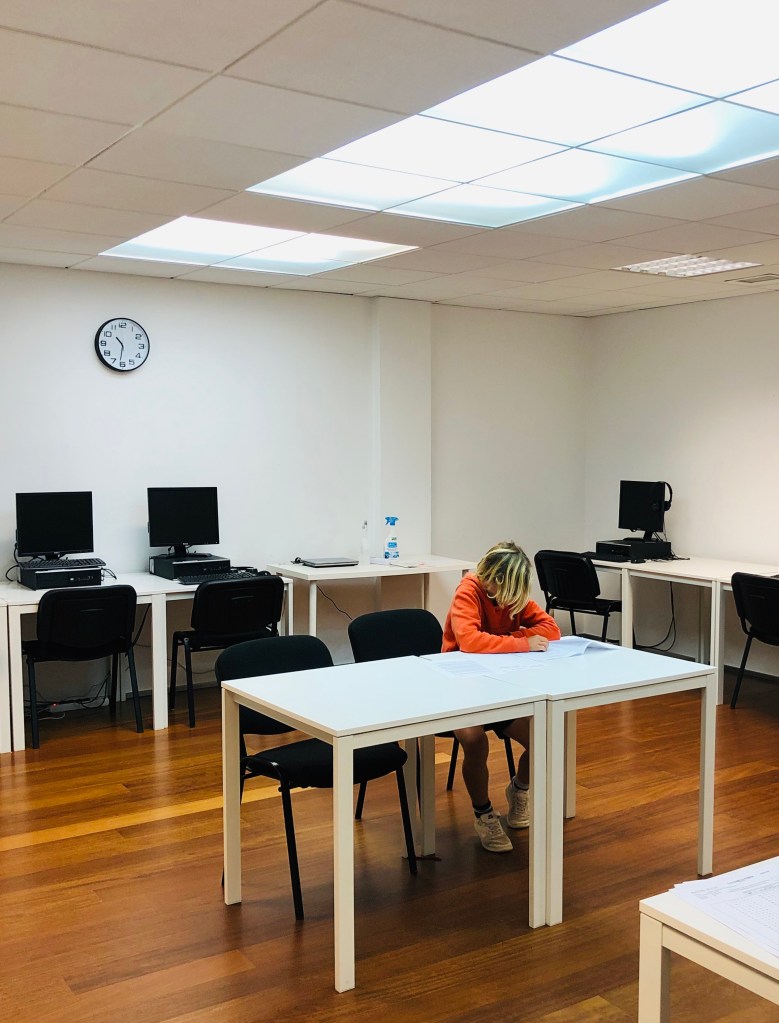
We have travelled back to Lisbon so that Arthur can sit his 11+ grammar school exam. He is supposed to be taking it back in London, but we have pleaded with the board to allow us to sit the exam in Portugal so we don’t have to face UK quarantine. They eventually conceded that these are indeed exceptional circumstances and so we have found an English institute right by the casino in Estoril where, for a small fee, they have agreed to invigilate him.

We stay in a quirky guesthouse where the décor is an interesting Eastern-whimsical-meets-gritty-boxer mash-up. It is called Lucky’s Guesthouse after the famous Lucky’s boxing gym and it is run by an weatherbeaten pair who are eccentric and charming. Francisco checks us in, talks nonstop, shows us many photos on his phone and rustles up duck for dinner, while Rosa is clearly the artistic one, that is to say she floats around in a beret, smoking, drinking and chatting to elderly acquaintances who keep popping up. I do lots of empathetic bonding with Francisco – as one hardworking henpecked male to another – but my backslaps and mock punches leave him confused.

Among the windchimes and stone buddhas in the garden is a glass conservatory which has been equipped with mats, a ring, gloves and punchbags. I try to get Arthur into a jujitsu class the night before his exam, to use up some of that testosterone and adrenaline, but he is nervous and tense and he balks at the at the last moment, goes all panicked and wild-eyed and refuses to enter the dojo. Instead we play Monopoly and everyone goes to bed early.

Arthur sits his exam and it is not the ordeal that he has feared. We are probably more nervous than he is on the morning. We have a secret treat lined up for afterwards which requires a bit of cover story.
“As a reward Artie, let’s drive into Lisbon and go shopping. You could use some new pants right?”
“Grunt.” Eye-roll. “Can I play on my Kindle while we drive in?”
“Of course you can buddy. You’ve deserved it.”
“No maths apps? No spelling tests?”
“Not a single one.”

We skirt right around Lisbon but the kids don’t notice this, and we stop in a very grimy satellite town for lunch. Menna and I can’t find anywhere that we dare eat in, so we break a long-standing rule and go to McDonalds. The kids are so elated that this may as well be the special treat in itself. Back in the car, lethargic with nuggets and milkshakes, they plug themselves straight back into their Kindles.  They don’t even notice when we pull up in an empty stretch of wasteland by the motorway, rather than the shopping centre they are expecting.  Surprise!

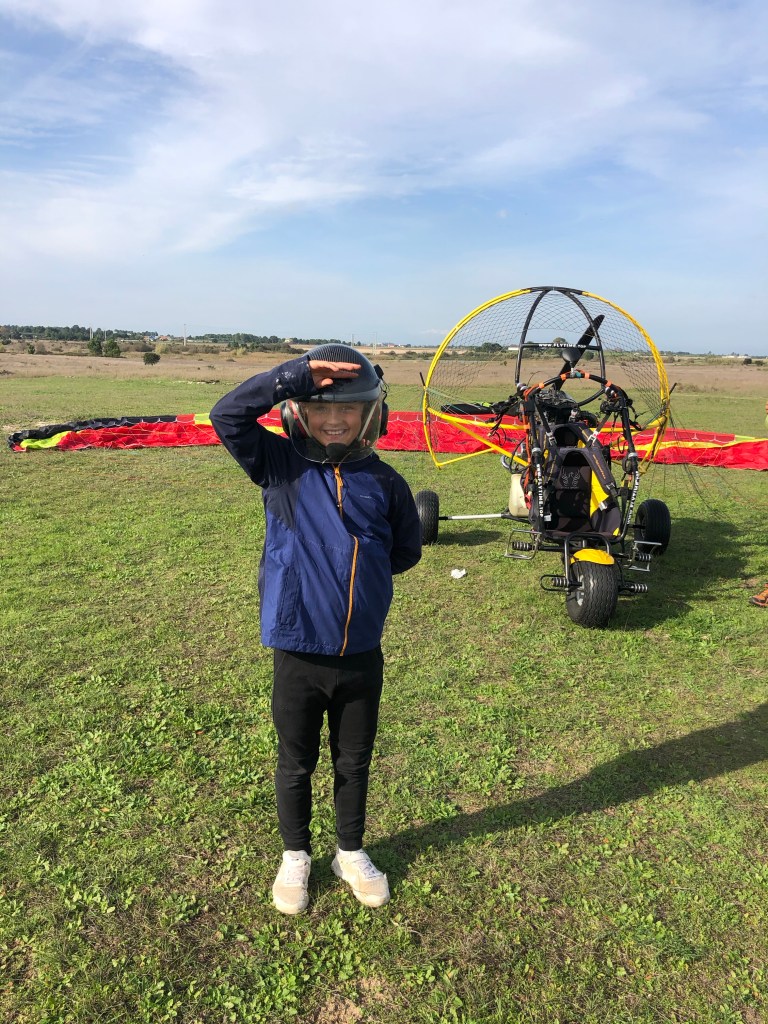
There on the scrubland, waiting for us, is a strange contraption, something like a dune buggy with a huge propeller on the back and a parachute stretched out behind it. Arthur isn’t yet old enough for the sky-dive I tried to book but I have found this compromise instead. We are going power-paragliding.

We introduce ourselves to our pilot, Eduardo, a taciturn man of the skies. His English is poor but his ultralight-aviation credentials are written across his craggy suntanned face. I throw various pleasantries at him but his washed-out blue eyes are away somewhere in the distance, scanning the horizon, reading cloud movements. Eduardo is a gyrocopter giant, I tell the kids, a maestro of microlights, the professor of paragliding. We are in safe hands.

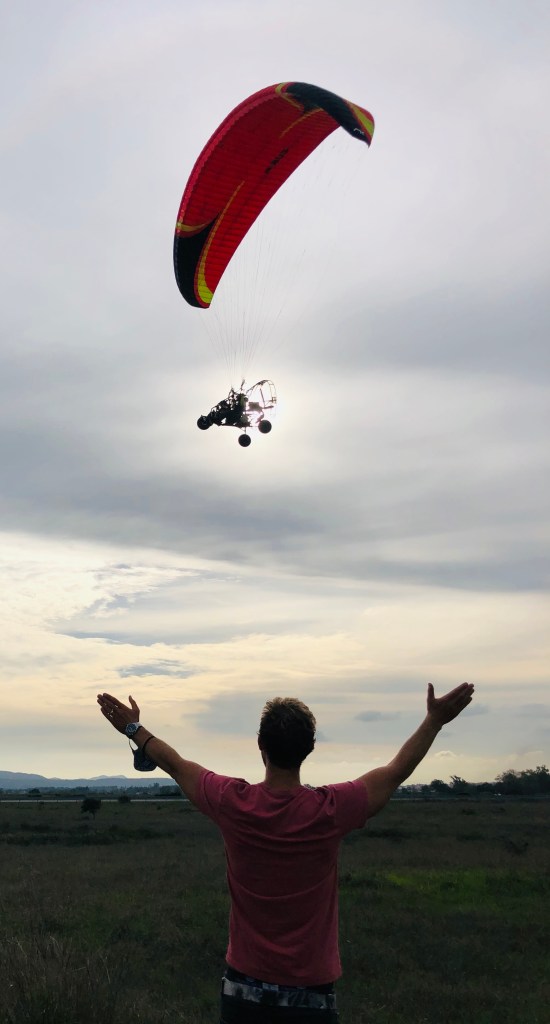
As guest of honour, Art goes first. Eduardo in the air has a playful side which was somewhat absent on the earth. He climbs up and immediately puts the craft into a screaming descent, throws Arthur around in some pretty extreme loops before cruising off for a twenty minute tour of the local countryside. Once they’re back on terra firma, Arthur staggers out grinning and shaking. Matilda is up next, huge worried eyes staring helplessly out of her aviator helmet as she is strapped tightly in. The pilot promises to not do any scary tricks, but he can’t resist one low swooping buzz right past our heads so we have to duck. I can see Matilda’s little hands gripping on for dear life.

It is my turn last of all, and although I’ve now seen Eduardo’s routine three times and I’m mentally prepared for his antics, I am still caught out by how visceral the whole experience is. Take-off is a whine of propeller, a sudden bumpy lurch, a hop, a heavy bounce and then we’re swinging up like a pendulum beneath a canopy. We climb up thirty metres or so then immediately bank hard and swing around in three near vertical loops. The G-force is intense, my heavy helmeted head is pinned back on the headrest and I feel my slack cheeks wobble. My stomach rises and wonder if I am going to spray Eduardo with Big Mac. It passes and I am able to enjoy the long diving run that we embark on next, watching the ground rush up at us with a strange sense of detachment. Over the next few minutes Eduardo pushes his craft to the limits and it is terrifying and exciting. I am shouting out all sorts of rubbish.
“Wow! Crazy G-force man! Awesome. Vector nine-zero. Bogeys ahead!”

Then we are cruising. The drone of the motor is a low constant that fades into the background. The fields and towns are far below and the hills around Lisbon are lit up in the afternoon sun. Far away there is a castle on a hilltop and Eduardo plots a direct line for it. There is a moment when I suddenly have a cold reality check – I’m floating 100m above the ground in a go-kart strapped to a kite – but this soon passes. I flip up the visor, the wind stings my eyes and makes me cry a little but it feels good.

“Request fly-by!” I shout at Eduardo when we circle the castle, “Buzz the tower!” but I get no answer. I guess he never watched Top Gun. Actually, who am I kidding? Eduardo probably did the Portuguese voice-over.

Soon we are back on the ground and I step out of the machine, tuck my flying helmet under one arm and slip my sunglasses on. Mission complete. The aviator has landed. Arthur and Menna come running up across the turf, shouting. It is the hero’s welcome I deserve.

But no. While I was off flying dangerous missions, Arthur has found a shard of porcelain in a rubbish heap nearby that he has chipped into a dagger shape, then in some angry snatching game with Matilda, he has managed to slice his finger right to the bone. He is weeping and spurting blood everywhere, Menna is chasing him around with antiseptic wipes, Matilda has run off in shame and hidden.

“Mustang, this is Voodoo 3.” I say, “The remaining MiGs are bugging out.” It makes no real sense but it feels right. Then we patch Arthur up and go and find a steak restaurant for dinner.

You Don’t Need a Weatherman

Another month passed somehow as we meandered our way down the southern coastline of Portugal. Without the anchor points of the school dropoff or work, we were subject to some pretty surreal distortions of time. Some days were featureless and stretched out like old chewing gum, but then everything flicked into double-time and we couldn’t cram enough stuff into the hours we are awake. ‘What did we do that week after Aterra?’ I asked the kids, but whole sections of our recent past have compacted into a series of fragments and we can’t tease them apart, only watch the showreel and listen to that crackling soundtrack. And it’s bloody Bob Dylan of course.

Inside the museums, Infinity goes up on trial / Voices echo this is what salvation must be like after a while / But Mona Lisa must’ve had the highway blues / You can tell by the way she smiles.

A week in Vila Nova de Milfontes was disappointing. After many frothy recommendations from fellow travellers we were excited when we arrived, but our AirBnB was small, dark and expensive; we were in a boring suburb and we had to drive twenty minutes to find indifferent surf. The streets were too rough to skate on. On one beach trip we lost our beloved old Nikon camera, an inexplicable disappearance that puzzled us for days. We went standup paddling on the river mouth and got caught up in a gale so Arthur nearly got swept out to sea and was very shaken. We saw a man dying in the aftermath of a motorcycle accident. 

I ain’t a-saying you treated me unkind / You could have done better but I don’t mind / You just kinda wasted my precious time / But don’t think twice, it’s all right.

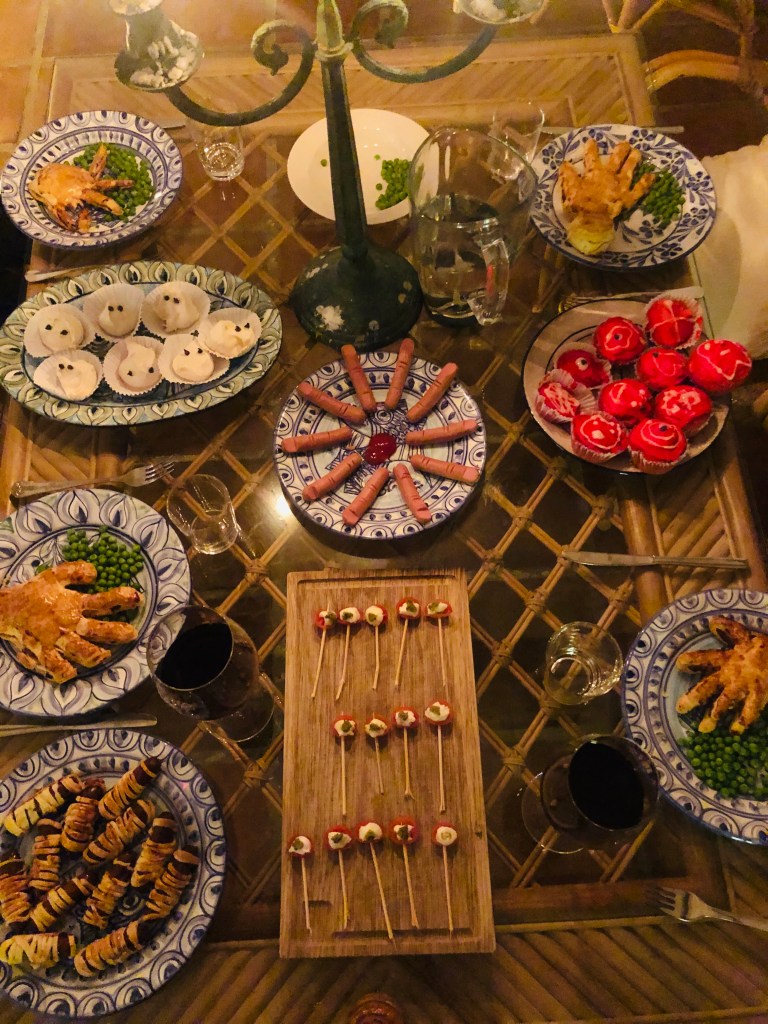
Near Aljezur we found a crumbling old sun-baked mansion, perched on a hill that overlooked the sea on one side and estuary plains on the other. It was full of eccentric African ornaments and Swedish books and it flooded whenever it rained. We loved it. We extended our stay for over two weeks there. Menna and I dusted off old memories from a weekend break we took near here a decade ago and bored the kids with them (“Look children! That’s where we sat and drank vinho verde – or was it port honey? – and watched the fishermen come in!”). We threw a lavish Halloween party for all the family, that is to say, the four of us, project-managed ferociously by Matilda. The organisation took her nearly a week, what with all the baking (severed-hand pies!), inventing complicated spooky games (spider web dash!), choosing the perfect film (Adams Family!) and it culminated with everyone ‘sleeping over’ in our bedroom. We were all tucked up by nine, which is how our parties generally end these days.

Ain’t it just like the night to play tricks when you’re tryin’ to be so quiet / We sit here stranded, though we’re all doin’ our best to deny it.

We hit the bottom of Portugal and turned the corner onto the south coast. Salema was a pretty little town that seemed to have been packaged up for winter hibernation. We walked the empty streets and spent some time observing a colony of stray cats living a enviable life on a abandoned mattress behind the recycling bins. Our nearest proper surf break was Zavial, a fast hollow wave that jacked up suddenly on a shallow sand bank to create perfect turquoise barrels. It was fantastic to watch and dangerous to surf. We went on a boat trip and standup paddle boarding with our friends Josh and Meg and explored the coastline from the sea. A section of porous sandstone cliffs, full of caves with shell-fossil walls and twisted stone columns rising up out of the waves. The boat trip turned into lunch, into dinner, into a birthday party that went on until nearly midnight. (Midnight! I know right?) I had my first proper hangover of the year next day. A night or two later the whole family awoke to intense strobe light in the early hours. We thought must be some malfunctioning streetlight, but it turned out to be the most epic electrical storm going off right above us. It felt like the world was ending.

Well, I’m livin’ in a foreign country but I’m bound to cross the line /
Beauty walks a razor’s edge, someday I’ll make it mine

As we drifted along, it felt like our time in Portugal was winding to an end somehow, but our future beyond was still misty and worrisome. Lockdowns were looming, but not just here, everywhere we looked. Menna and I had long muttered arguments on beach walks about where we could go if things got bad. Africa was dangerous, Australia was shut, South America was sick. We expended ever more energy into loving Portugal and some days we thought that maybe we could winter here and it would be ok. We would find a remote house on the clifftop and stock up with winter provisions, surf huge cold Atlantic waves, watch lightning strikes out at sea, go for wind-blown walks in the early light. These stone houses are built for summer but we could find one with a wood burner and we would huddle around it and read the Greek myths aloud to the children while the viral armageddon raged outside.

A worried man with a worried mind / No one in front of me and nothing behind / There’s a woman on my lap and she’s drinking champagne …I’m well dressed, waiting on the last train.

Yurting Real Bad

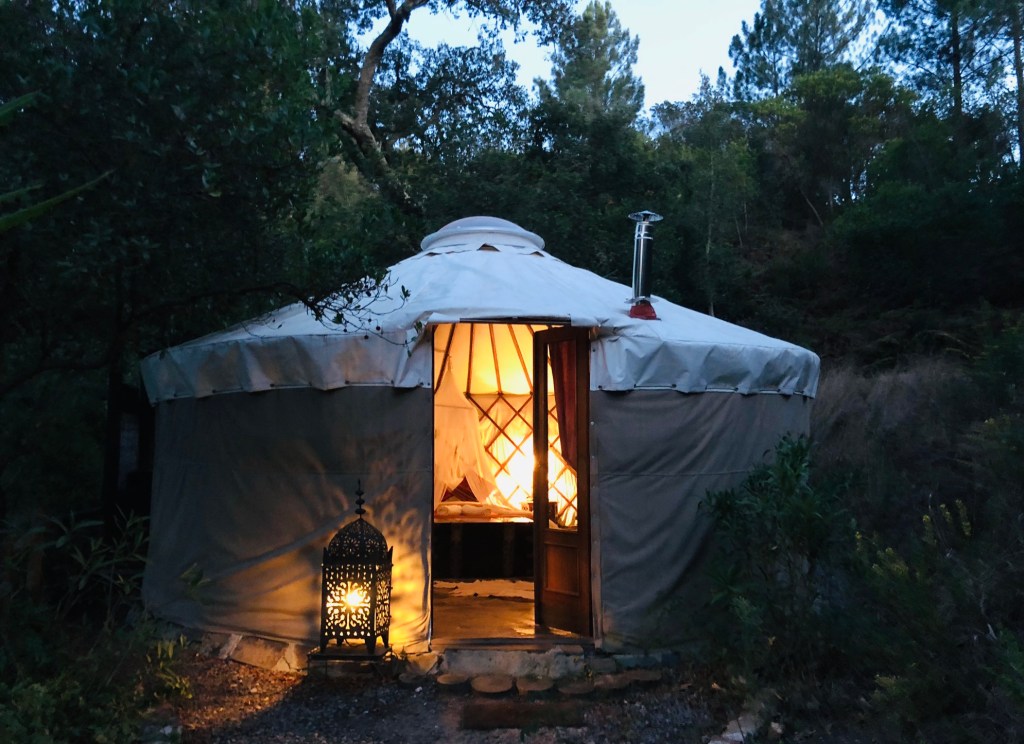
We are staying in a yurt. It is decorated like a Mongolian warlord’s tent with animal skins on the floor, carved wooden chests and iron candlesticks. A claw-foot bath sits outside under the stars. All the beds are draped with gauzy mosquito nets that look like a fairytale to Matilda but look ominous to me.

The kids are spinning around and Menna is jubilant. She has a thing about yurts and has been trying to engineer this for months, overcoming a wall of passive resistance from others in our party (me). Now she has been vindicated.

Our yurt sits nestled up above the tree-line overlooking a small valley. Outside we can see wigwams and cabins, gazebos, other yurts, outhouses with sawdust loos. Artful lighting illuminates key features in the dusk. Flaming torches reflect across the lake, willow trees are uplit with soft yellow spotlights, candlelight marks out the paths. There are peacocks shrieking, moving around like satin shadows in the twilight. It is a beautiful scene, though strangely devoid of people for such a grand site. It feels like a festival where they forgot to book the bands but no-one turned up anyway. Except us.

“Isn’t this wild?” I say, and no-one knows that I am secretly referring to the sort of wild that drinks from your ankles and buzzes.

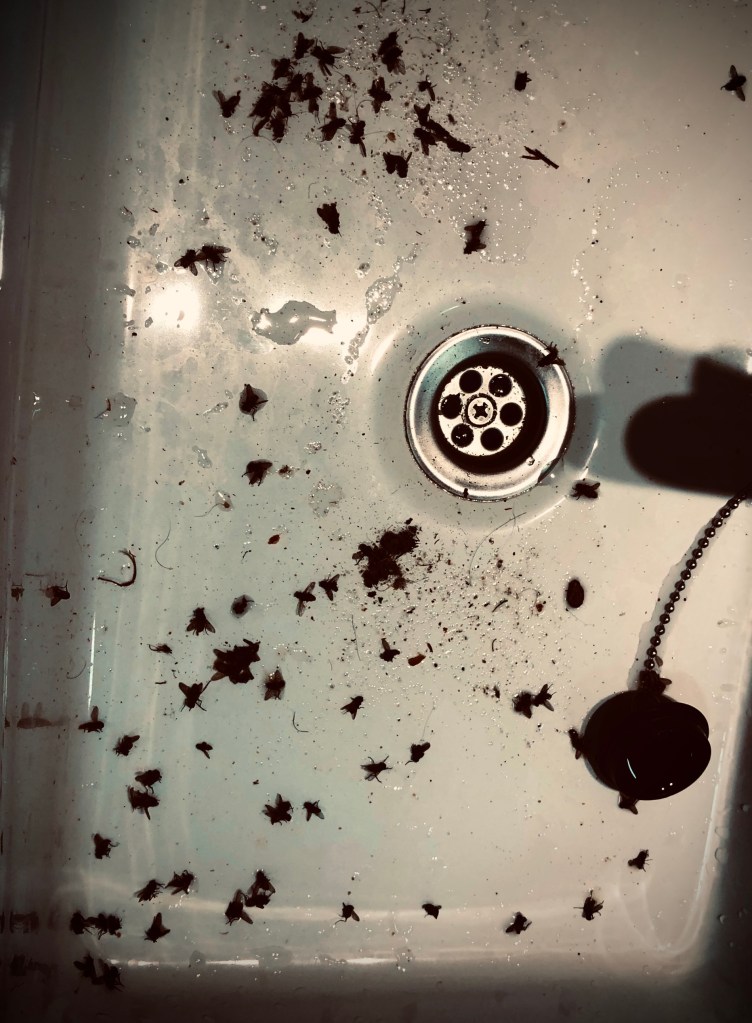
And this is true. October has brought rain and insects. The kids have circular mosquito nets that provide good protection, but the one that hangs over our double bed is comprised of four overlapping veils that inevitably come open as we toss in the night, so it lets mosquitos in then traps them inside! I kill twelve on our first morning, fat and ripe with our blood. Throughout the week we hear them whine past our ears, so we slap our faces in the darkness, hoping to catch one. One morning I wake up with insect legs and blood smeared down my cheek, proving that the strategy isn’t always ineffective.

We have arrived at the campsite the day after a staff wedding, our receptionist tells us as we check in, and consequently everyone is a little discombobulated. She is an Amazonian woman, tall and strong with high cheekbones and extensive tattoos and she doesn’t look at all discombobulated. Later we find out that she was actually the bride.

Through various conversations and clues over our stay we sketch the outlines of the event: a humanistic ceremony; the camp staff released from their duties to go wild; a small but committed contingent of international guests braving quarantines to attend; crazy decorations; extravagant outfits; several days of partying. Our imaginations shade in the missing texture: shamanistic vows, peacock feathers, bonfires and bongos late into the night, nude dancers emerging from the lake, copious psychedelics, Goa trance, tears and mascara stains. We used to go to parties like that, I think wistfully.

As we walk around over the next few days we find mementos of the great wedding scattered throughout the site like the relics of a lost civilisation. A plywood archway covered in peacock feathers lies overturned in the dust; a bottle of tequila sits among the cinders in the fire pit; hundreds of footprints swirl around the amphitheatre; in a far-off outhouse in the woods I find an enigmatic lipstick heart scrawled on the mirror while strange powders are smeared around the sink. A feather boa lies coiled around a eucalyptus branch.

There are no other guests for most of the week and so we eat with the staff each night, or rather ‘volunteers’, for as well as looking after the guests, they do eco work around the site for food and board. The wedding came right at the end of a busy season and everyone is tired and emotional. It feels rather fin de siécle. There are small flare ups at the table in Italian or German. Gardeners down tools and drape themselves over the sofas to smoke spliffs and mutter to each other. A blind dog hustles for scraps under the table. We lie next to a pair of volunteers down at the lakeside beach. They are having a long and indignant conversation in German and as I doze I hear fleisch emphasised heavily, salat and veganer.
“Someone put meat in the vegan salad. Total nightmare!” I whisper to Menna knowingly. There is a mutiny on Thursday when the chef refuses to fire up the pizza oven and I think it will go to blows, but alas no. It is typical for the Nicholls to arrive just as the organ fades to silence and the drapes are thrown over the carousel I think. This year has been a bit like that.

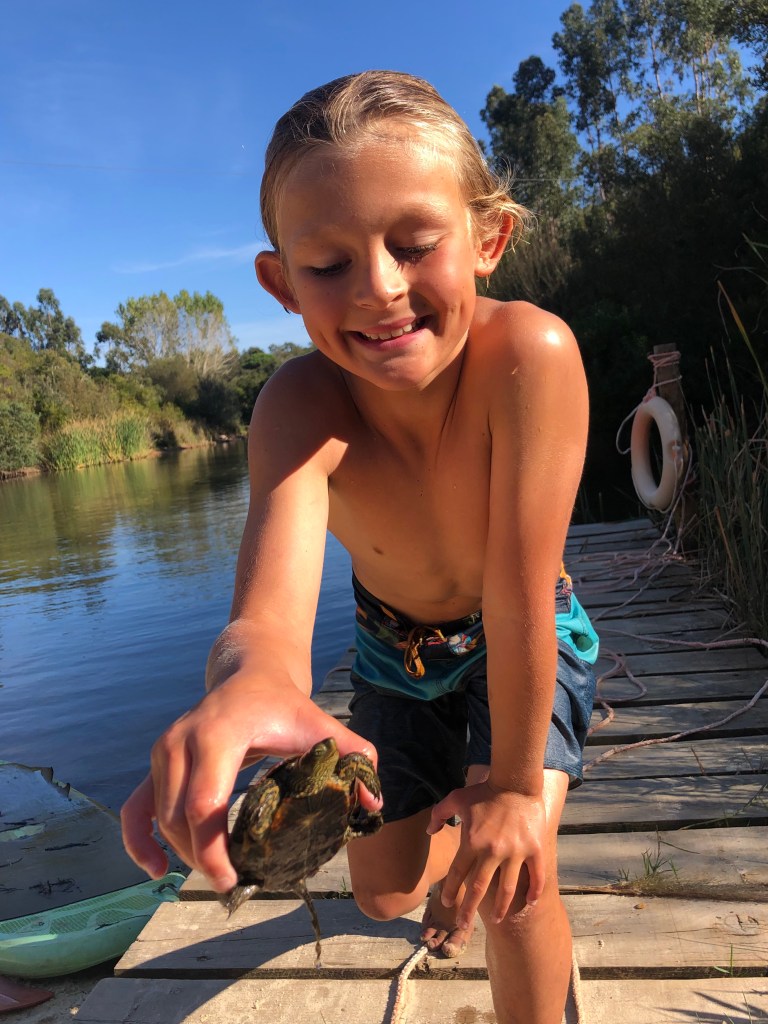
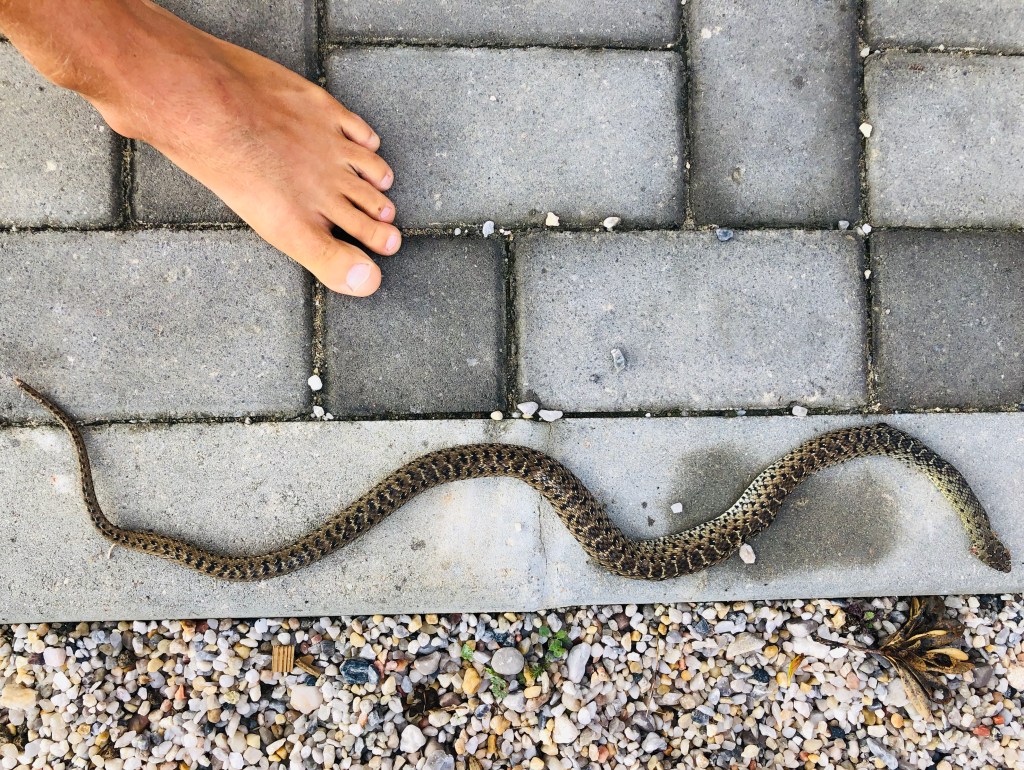
While I am watching the staff for drama, the kids are spotting nature. The peacocks move in an intricate hierarchy on the ground. Up in the air there are buzzards and flocks of blue-winged jays, even a hoopoe looping through the trees. Menna claims to see a turtle in the lake, which I secretly doubt, but then Arthur goes and actually catches it, and brings it back triumphantly for everyone to see. We find a dead snake on a forest run. I walk headfirst one evening into a thick web and come eyeball to eyeball with the hugest spider I’ve ever seen, and I properly scream like a six year-old child. It’s wild.

Atlantic Highway Blues

After a month in Baleal it feels like autumn is closing in. We decide it is time to head south. The purpose of this year isn’t to live comfortably in a modern condo for months on end, it is to find adventure dammit. We are getting fat.

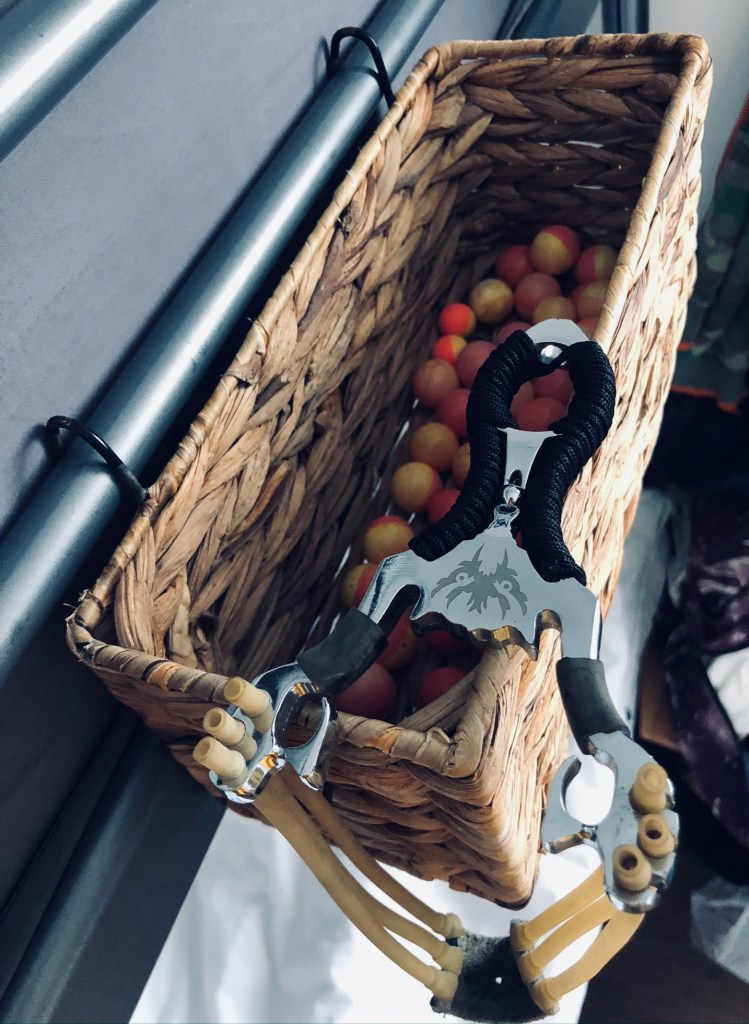
We spend a couple of nights in Azen Cool House, a chic guesthouse parked incongruously in the middle of a paintball and treetop climbing course. We lie by the pool while rifle shots and the screams of the wounded echo over the matting fence. I catch Arthur and Matilda sneaking onto the range in a commando crawl like a little pair of feral war orphans looting the battlefield. They are on a mission to collect intact paintballs which they will later fire at various (inappropriate) targets with Arthur’s catapult.

Arthur is below the minimum height to go climbing, but there is a slack line, archery and a giant basement rumpus room where he expends some of his considerable energy on the punch bag. I get the gloves on and spar with him for a while. He is getting worryingly strong now, all muscle and sinew, and I am feeling old today. My injured shoulder snags when I threw a left hook. I manage to land a couple of good blows anyway to give him a message then I slink off, feeling like the old grey alpha wolf who knows that his days at the top are numbered.

We eat a Sunday fish lunch in a quiet restaurant on the cliffs by Praia Magoito. I don’t have cash to pay the bill so the proprietor gives me a lift up the hill to the nearest bank. As we drive he tells me a sad tale of empty tables and rising costs; of fine sea bream thrown away uneaten. This place would have been packed on any Sunday last year he says, indicating the empty square. All his family members are working free shifts now to get the restaurant through the crisis. I think of all the melancholy restauranteurs up and down Europe at this very moment, standing in empty dining rooms, polishing glasses perhaps or twisting napkins in their hands as they look out on silent streets and forlorn town squares. Johnny Cash growls a soundtrack to my reverie: There’s nothing short of dying, that’s half as lonesome as the sound, of the sleeping city sidewalk, and Sunday morning coming down…

Next day we move on to Costa Caparica and stay in a graffiti covered hostel where local kids come to smoke weed and play banging Detroit techno in the garage. It is in the sketchy end of town and we are advised to completely empty our car, which is a total ball-ache, particularly as we are only staying for one night.

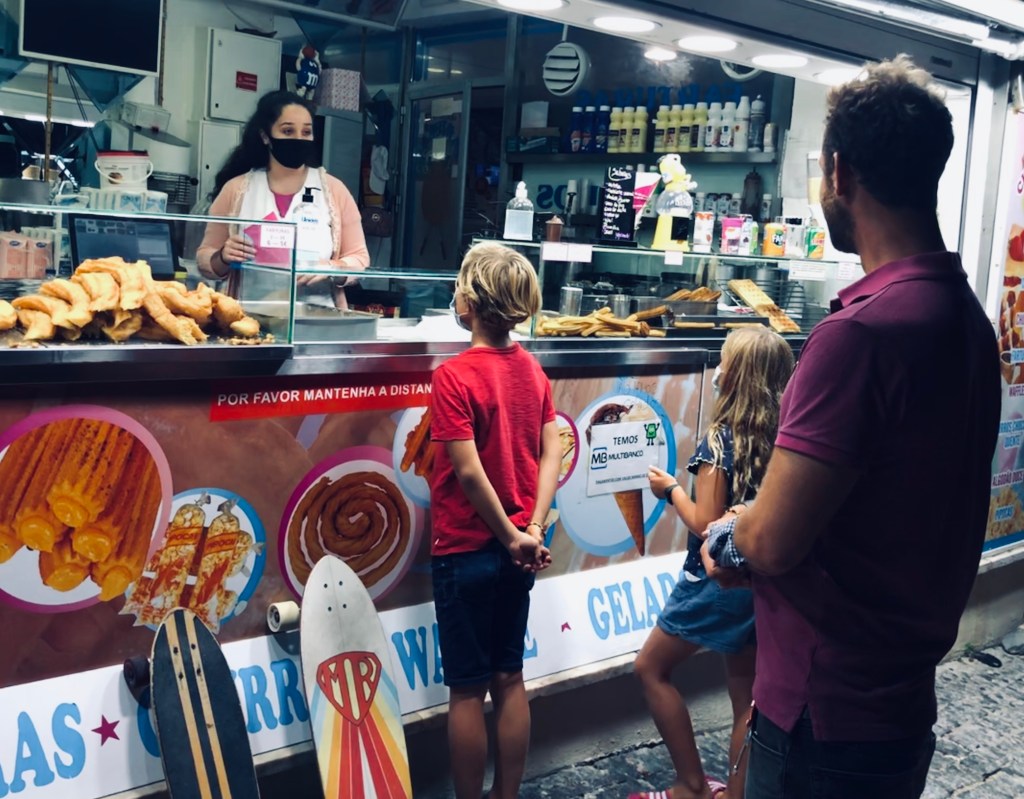
We take our skateboards down to the boardwalk. It is a public holiday (Republic day!) and sunny. The world is out on promenade. There are Lego apartment blocks that loom over the esplanade and in the distance we can see the misty silhouette of abandoned fairground machinery. There are bars and restaurants made from shipping containers placed up and down the seafront, so we mooch for a couple of hours then try to get dinner, but everything mysteriously shuts down around seven. There is only one place left open and the waitress there is so incompetent that we give up and walk out after half an hour of trying to catch her attention. We find ourselves some dinner eventually and then get the kids hot churros as a treat. We go back to our shared room in the hostel and watch Twins, getting slightly stoned on recycled marijuana smoke.

At three in the morning Menna’s godfather dies after a long illness. For perhaps an hour she paces around our room, whispering to family members in the darkness. She spends most of the morning in tears.

Arthur and I go for a surf before breakfast and I have two collisions with the same girl. The first time I go left on an indifferent wave and she takes a right, so we meet in the middle. No harm is done but ten minutes later I am paddling out through the set and she wipes out right in front of me, gets rolled in the barrel and her board (a rather elegant wooden single-fin) comes flying at me. I roll to avoid it and it smashes down just where my head had been, and the fin sinks deep into my deck. She has about a second to make an apology before we both get hit by the next wave and then a few more after that. I am left with an ugly axe wound right in the centre of my brand new surfboard and have to grumpily paddle back to shore.

Menna is sad, I am grumpy and the kids take the brunt of it. I grill Arthur mercilessly on syntax in a café-based homeschool session and Menna and Matilda both end their lesson sobbing. We head back to the hostel to pack, parking our car outside on the narrow street so I can load it. Occasionally other cars arrive and they mount up onto the pavement to inch past, until the driver of a Citroen Picasso decides he doesn’t want to do this, and instead honks me to move. I haven’t got the surfboards strapped down yet and I gesture for him to squeeze past, but no, he really doesn’t fancy it. I point again and offer to direct. He refuses. We argue and I call him a shit driver. I hop in the car and reverse up in order to tuck in further and I end up hitting him. ‘Now who is the shit driver?’ he asks me as he rings his insurance company. He possesses a far better command of English than I had credited him for.

We catch up with an old friend in Melides for lunch. This means we have to put our calamities behind us and crank up the smiles.  Joe has a beautiful little house up in the hills and a brand new kitten that a local bartender left on his doorstep last night.  He plans to open up a yoga retreat soon on his land, or a standup-paddle rental bar in the local town. Or both. Once the bank comes through with the funding that is. Joe is an entrepreneurial type but it’s a tough time to be launching a small business in this environment. I remember that ghostly cohort of sad restauranteurs and wish him luck.

Berlenga

The far-off island that we can see from our roof terrace is Berlenga. It is a shadow on the horizon right where the sun sets; misty, distant, often hidden. Over time it has worked its way into our imagination: it is a fantasy place, an enigma. The kids are sure there are pirates there. We catch ourselves gazing at it – particularly Menna, when she’s in one of those wistful moods.

We head there by boat one day, after some early morning haggling on the Peniche quay. We travel in a rib to be precise, light and buoyant but with a ton of horsepower. With its inflatable hull and lack of keel, it feels like the wrong sort of vessel to tackle the unexpectedly large and brutish waves that greet us when we swing round the headland. The captain seems to know what he is doing though and we smash our way bluntly over everything that the sea throws at us, airborne at some points with engines whining, before skidding down into dark troughs where the sun disappears and the spray feels very cold. Matilda squeezes my hand throughout the journey, and lets out keening cries like a little storm petrel. There are no other signs of life upon the ocean.

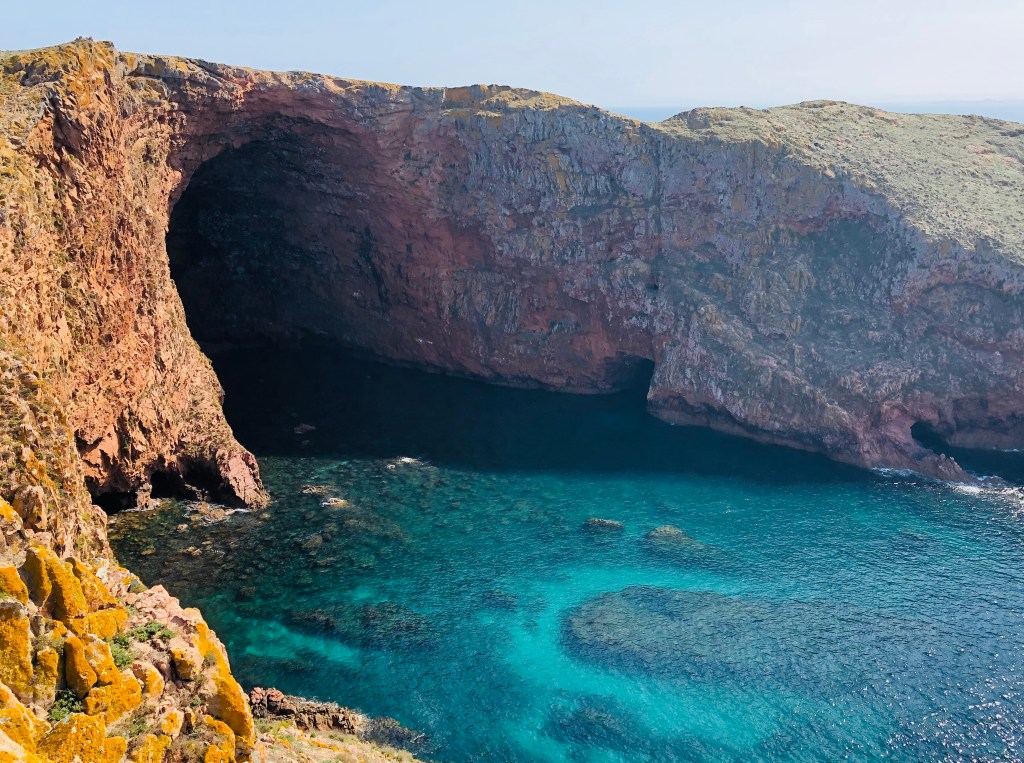
After an hour the vague shape of Berlenga solidifies into a rocky mass in front of us. Cliffs soar, the sun steadies, and the grey of the ocean lightens into a post-card aquamarine. We putter into a bay where a ramshackle cluster of white cottages and a taverna are strung up the cliff road and the rocks are draped with fishing nets, lobster pots and buoys. We clamber onto the dock all damp and unsteady and lurch off to explore the island.

We’ve done this trip the Nicholl way – which is to scorn all of the organised tours but then to forget to do any of the research ourselves – so there is a period on the quayside where we march backwards and forwards waving our phones in the air to find signal and load a map of the island. In the end we give up and stride out to navigate by visual clues. The standard island symbols are all present here: a fort, a lighthouse, some ruins, the ubiquitous clifftop church. This much we can see without Google’s help. It turns out moreover that there is also one of those tourist information boards halfway up the mountain road. Peregrine falcons nest in the cliffs it says, and there is a huge cavern in the Northern rock face – a Catedral. Best of all though… pirates! It turns out actual pirates were here, ransacking the monastery, butchering monks and generally having fun.

We cover the island in a couple of hours, snacking on salt crackers and pomegranate seeds like true buccaneers. Berlenga is a windswept and rugged place, handsome from some angles but very forlorn. It is how I imagine the Falklands to be, only without the puffins. There is very little vegetation though there are plenty of epic rock formations. We see a lot of bird skeletons and Arthur is able to scavenge various interesting bones for his collection. We find the cathedral cave, which is truly awesome, but we do not sight any peregrines.

The highlight of the island is the fort, where you can read stirring accounts of the Spartan-esque heroics of twenty Portuguese soldiers who held off fifteen Spanish warships and a combined force of two thousand men in 1666 (though a little later digging shows that they simply surrendered once they ran out of ammunition). It is the Portuguese Thermopylae and we are honoured to be there. The Portuguese don’t have a lot of military victories to celebrate, but like the Scots, they savour their heroic defeats.

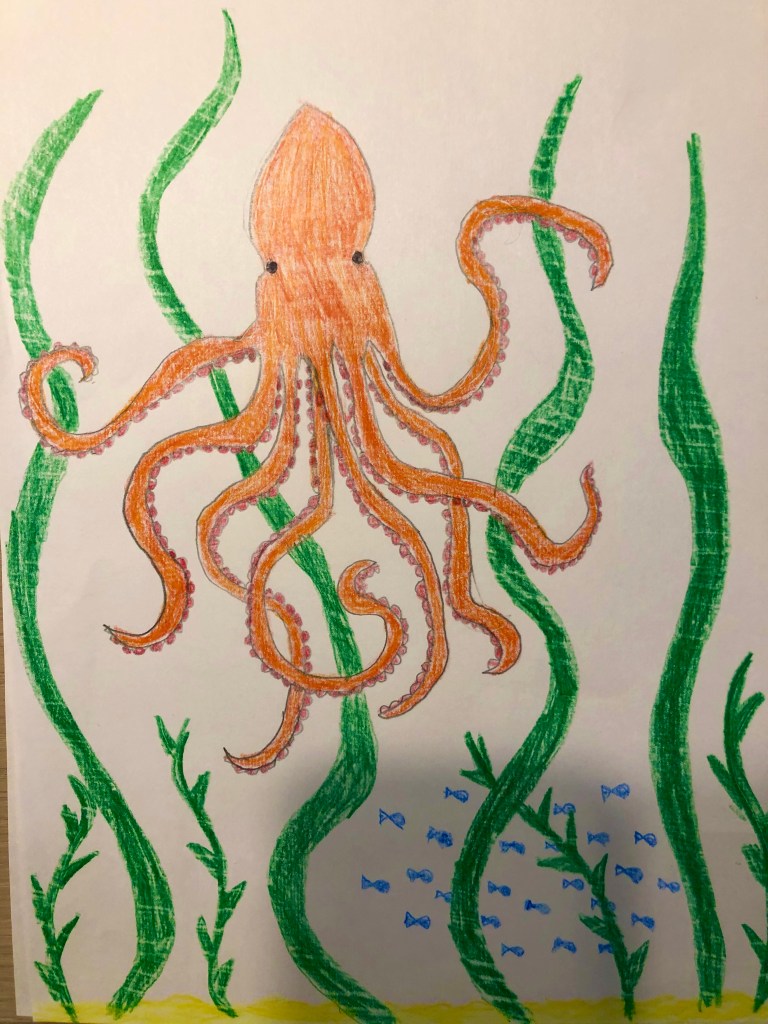
The fort is an imposing structure, jutting out to sea but joined to the mainland by a stone walkway that zig zags over some very clear turquoise waters. We picnic here and spend some time snorkelling. We see lots of fish, some crazy underwater geology and then Menna spots a huge octopus. We follow him along, pointing and making excited whale-like snorkel sounds to each other, while he changes colours, squirts ink and finally folds himself away into a crack in the rocks to be rid of us.

With rash bravado I have opted not to bring my wetsuit and despite the sun I get very cold floating in the Atlantic waters. I drag the family out of the sea and march them back over the cliffs to catch the afternoon boat home.

A bare-chested chap in Hawaiian shorts is the Berlenga harbourmaster. He greets incoming boats, ties mooring ropes and bosses around a pair of barefoot urchins. His belly taut and rounded and he has a fine black moustache which gives him authority. We watch him explaining some important unloading procedure to one of his underlings when he astonishes us by throwing himself off the pontoon mid-sentence. It is a neat dive and he enters the water with barely a splash. Some seconds later he re-emerges on the slipway at the far end of the jetty, walking slowly and majestically up the ramp and it is like a messiah is rising up out of the sea. Best of all, he resumes his conversation as if nothing has happened, although he is now quite some distance away and has to shout. Arthur and I are deeply impressed.

On the way back the waves are with us and the ride is noticeably smoother. The boat is pumping out house music. We plane along the big rollers until we reach the port at Peniche. Then our captain decides to give us all a virtuoso finale. As soon as we are level with the ‘4 Knots. Speed Restriction’ sign on the harbour wall, he slams his throttle forward, revs up to maximum and slaloms his way through the breakwater at high speed, tipping the boat hard up on its side through several sharp curves. We are horizontal at points, thrown one way then the other and only our seatbelts stop us being ejected into the water. Everyone screams and an elderly Dutch couple look like they’re going to have a heart attack. It is a bizarre manoeuvre and I’m not sure if it is intended to generate tips, demonstrate his helming skill or as a anti-disestablishment ‘fuck-you’ salute to the port authorities.

Once inside the marina the captain kills his speed and glides smoothly into his pontoon slot. He cuts the engine, turns off the music and says nothing. We all turn to look at him but he is inscrutable behind his sunglasses.

We disembark and head off into Peniche to look around the prison, but it is shut on Tuesdays.

SOMAD

Almost all of our time in Spain and Portugal had taken place during the summer holidays, and so when school term rolled around again in September it really disrupted our carefully constructed lack of routine. Menna and I had to call an emergency meeting on the evening before term started to take stock and build a plan.

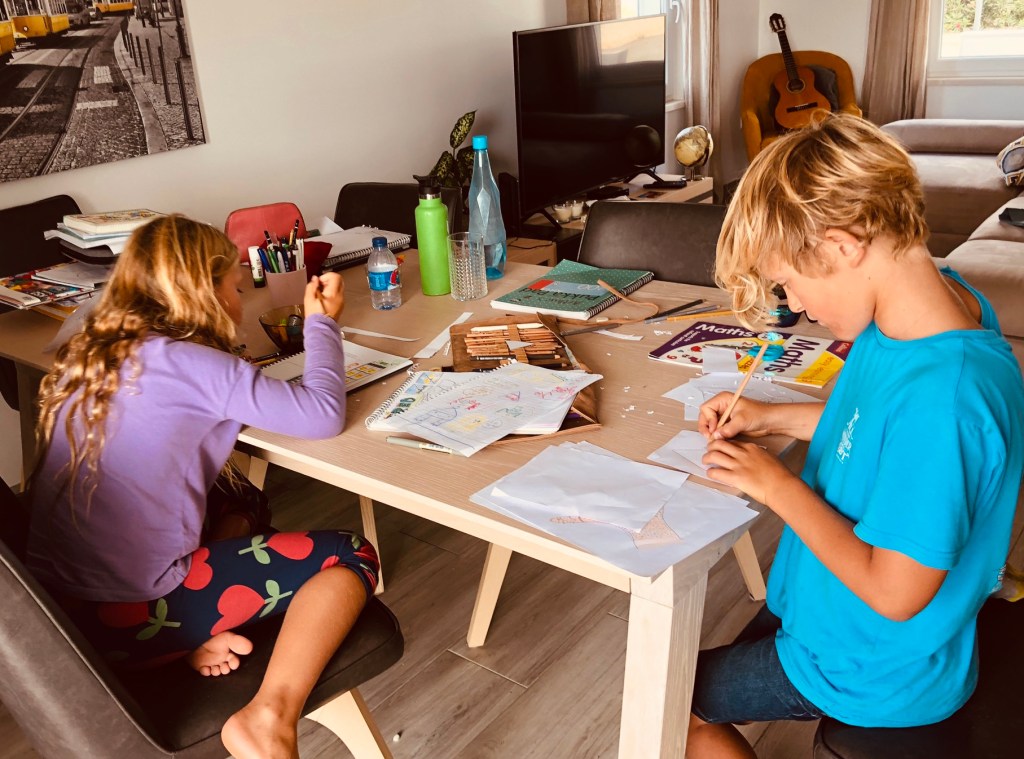
We had some resources (various maths and English books, stationary, old exam papers, downloaded versions of the curriculum), we had amazing grandparents, generous with time, ready and willing to support via video link. One of Menna’s many jobs is as a senior lecturer for a london medical school, so naturally she would be headmistress of our little school and do the bulk of the teaching, while I would work on various side projects and pop up occasionally with esoteric and unsuitable ideas.

We will make this so much more fun than real school, we exclaimed, bubbling with good intentions and red wine. On top of the normal curriculum, the kids could learn astronomy, languages, philosophy, sculpture, bushcraft! With a few hours of dedicated coaching each week, Arthur will totally ace the 11+ exam he is due to sit in November.
“We’ll call it SOMAD! The School of Mum and Dad…”

And on the first week it goes pretty well. We cover core subjects first thing while the brains are fresh, then we switch to project work. The novelty of the situation brings attention and enthusiasm from everyone. We cover fractions, refraction, prefixes and prepositions. We design a renewable energy strategy for our last campsite, Terra Sangha. The research and schematics are impressive, energy high, collaboration strong. The children present their ideas to a virtual audience that we have roped in on Friday evening. They are proud of their work.

Amazingly quickly the excitement wears off though. There’s a strange sullenness that creeps into the air on a Monday morning. A petulance in the voice. Slumped posture, fidgeting, window-staring. Tears might appear mid-lesson. Our gentle, well-modulated teacher voices falter and harden.
“I’m sure you never cry like this in real school!” We hiss.
“This isn’t real school.” comes back the sulky response. Emotions flare up rapidly and suddenly the air is heavy with barely-restrained shouts that might be unleashed at any point.

I realise that part of the issue here is the unease of redefining our relationships for those few hours on a weekday morning. From being easy-going parents we suddenly flip into being teachers. Where does this sudden new authority come from? How should the kids adapt their attitudes and responses? Our tolerance levels suddenly flick down into a much lower setting. We have unrealistically high expectations and we are instantly critical. We judge the kids on their ability to absorb what we are telling them; we judge ourselves on our ability to impart knowledge. All are found wanting. The kids probe us for weaknesses. It feels like this really matters, and that removes all levity from the proceedings. We become like two Victorian schoolmasters.

“No Matilda, I’ve told you this so many times. If you can’t take away from the tens, then you have to borrow from the hundreds column. Will you listen!… No, look. Now there needs to be one less in the hundreds. Cross it out and write it on top… No! Write it there… THERE! Now you have to add that to the number in the tens, Oh no – don’t just stick a one in front of it… I tell you what, just give it here. I’ll do it. Ah, that’s better. Now look how easy that was. I’m just going to do the next one too…”

“Arthur, if you spell ‘hopeful’ with two ‘L’s ONE more time, I swear I will make you write it out a hundred times! …LOOK! LOOK! You did it again! Right! That’s it my boy. …Well, yes, I know that says ‘meaningful’, but it’s still the same ending and you spelt it with two ‘L’s, just right after I told you! One hundred lines. ‘All words that end in ‘ful’ are spelled with only one L.’ – write it out.
Well, no, yeah, Ok, that’s the exception. Good point! But ‘full’ is a whole word, it’s not an ending… No! I am not writing it out 100 times. I know my spelling! Do NOT be cheeky with me!”

“Isosceles is the pointy one right? Hey, Menna, help me out. It’s the thin pointy one, isn’t it?“

Eventually after a few weeks we find our groove – well, a groove anyway. We chill out and stop caring so much. It’s only education after all. They’re bright kids, they’ll catch up. Arthur can do a B-tech in skateboard design, if such a thing exists. If Matilda doesn’t become a doctor, she has expressed a desire to be a baker, or run a leggings shop. Lesson plans start to become a little more fluid, that is to say they mainly get made up on the day.

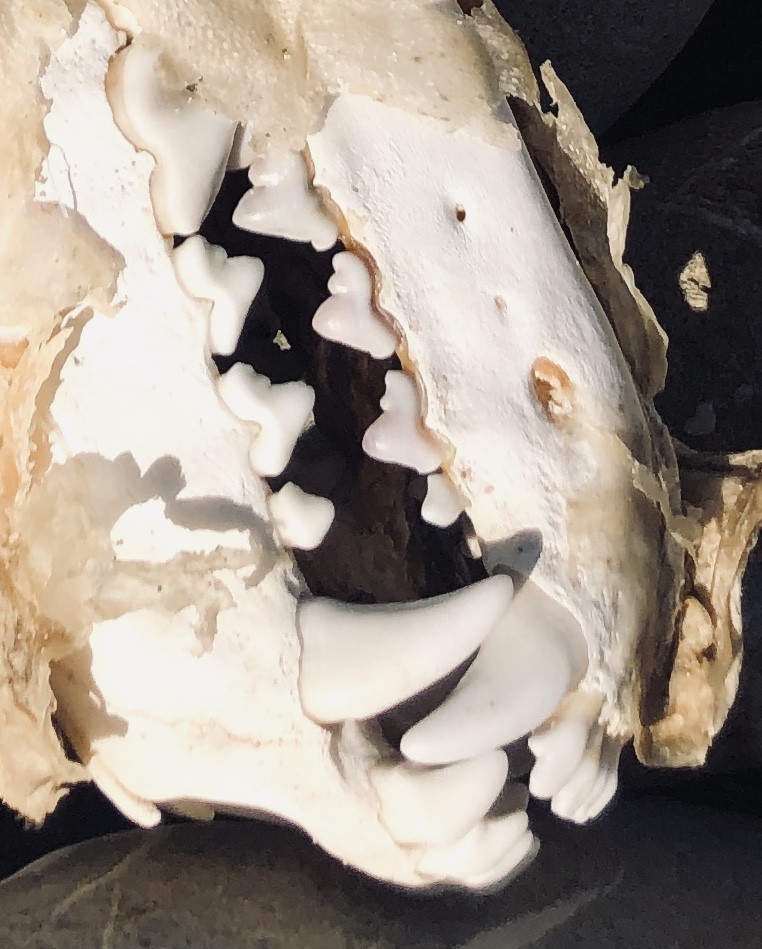
Fast forward another month and somehow homeschool has morphed into the freewheeling non-curricular event-driven education that I had always dreamed of. We find a dead snake and bring it home to observe it decompose over the course of a week. Arthur embalms a dragonfly in a jar of hand sanitiser. We get a workshop in fluid dynamics by a local surfboard shaper. We see a live octopus while snorkelling and go on to study its lifecycle in depth using Netflix. To support Matilda’s project on teeth we extract the incisors from a dog skeleton we find washed up on the beach. We identify the zodiac constellations. We understand the atmospheric conditions that cause swell. One Grandpa does daily maths tuition, the other Grandpa does poetry workshops, the Grandmas read literature and host art sessions.

And for pretty much everything else, we have downloaded an app.

Anybody there?

The family dynamic has changed as our travels have progressed. The kids have grown up, and we are no longer as protective over them as we were back at home. We push them out into the world to explore: ‘Take your bikes and check out the place for us,’ we say when we arrive in a new town and want to unpack in peace (or have a siesta). We want them to build confidence and independence over this trip, to learn initiative and be at home in a variety of situations. Sometimes they get terribly mouthy though and I wonder if we have gone too far.

We are all a little socially hungry at the moment. Coronavirus means that the flow of travellers that one normally meets on this kind of trip has dried up somewhat. When we stay in a campsite there is a vibe and perhaps some fleeting friendships can be made over that week. Camping long-term is hard work though, and in any case the season is over now, so we mainly stay in rented houses, inserting ourselves for a week or so into some residential area of town where the locals have little interest in hanging out with tourists. Having kids with us, we don’t go out drinking and partying much in the evenings, which closes the door to many chance encounters.

It’s not all barren. Menna meets local girls in her yoga classes, I chat to other surfers, we exchange stories with tourists when we drop into the surf hostels for a drink and to use the skate ramp. Random baristas get a quick life history together with our coffee order.

We don’t see many kids around though, certainly not English speaking ones now term has started and all the sensible international parents have repatriated themselves. Arthur plays football on the beach with local Portuguese kids, getting along as boys do, without needing to exchange any words. Matilda struggles.

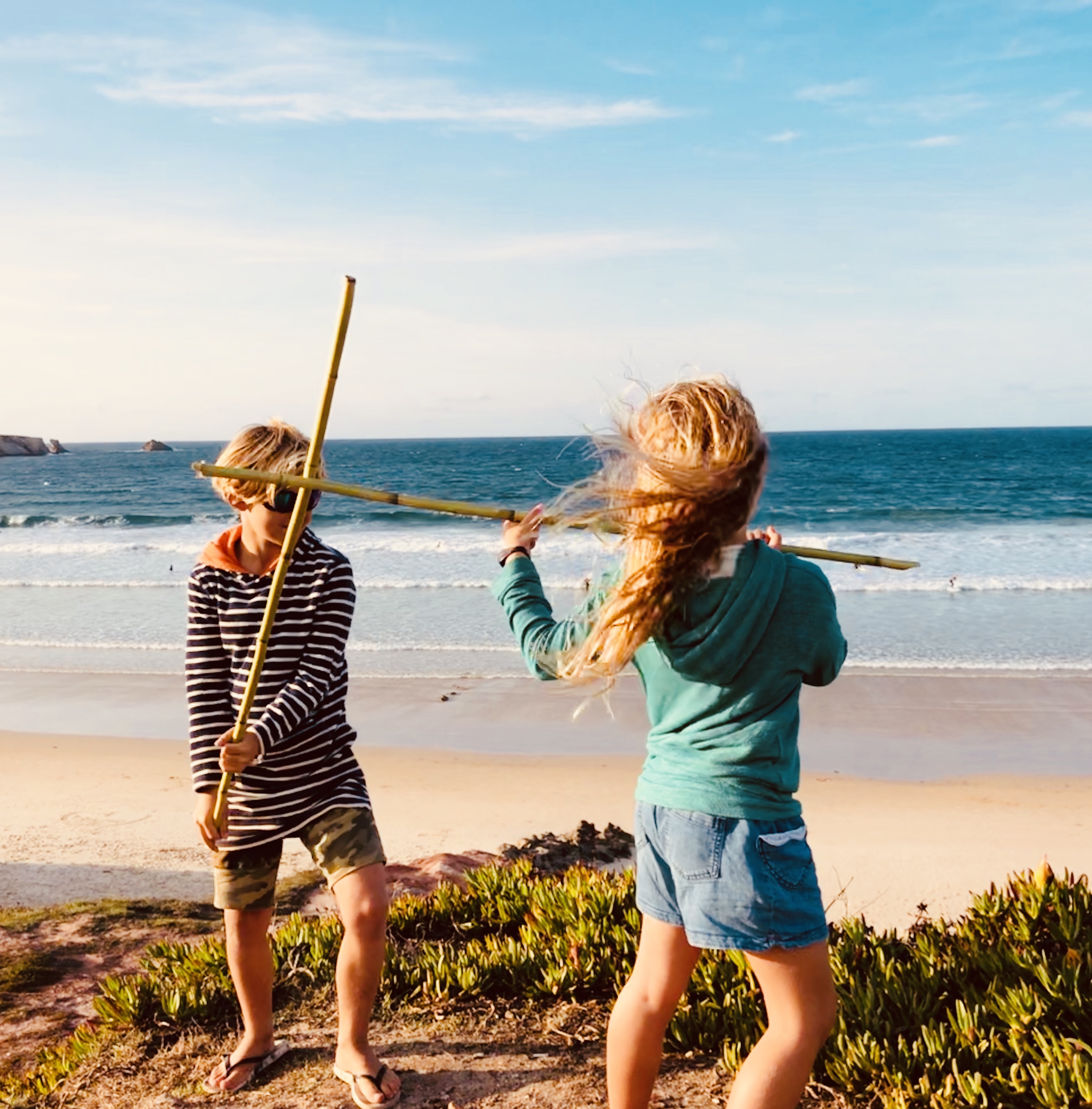
So what does this mean? Well, us Nicholls do pretty much everything together. We go surfing, we go on walks, we go on sightseeing trips, we play games in the evening, read books out loud and have film night twice a week. I wind up the kids, play silly pranks on Menna. She tells me off and the kids laugh at me. Menna and Matilda bake bread and cinnamon rolls and go running together on a Sunday. Arthur and I skate around town and have mock fights with bamboo sticks that occasionally get serious. We have all our meals together and argue over what music to play during breakfast.

Arthur and Matilda are inseparable now. They have strange catchphrases and songs they have invented, imaginary games that last for many days. Even when they are arguing furiously and hate each other, they still hang out together. Menna and I have the evenings. We spend long hours discussing life, what we will do in the future and planning the next stage of our travels. We concoct wild visions of the post-apocalyptic future once Covid has decimated 90% of the population. We watch horror films on Netflix.

We have been gathered up, shaken around and thrown on top of each other, and generally we have found it fine – until suddenly one of us has had enough and throws a tantrum. Then we rant and rave for a while, go off for a walk then come back chastened and wanting forgiveness.

This is travelling after all, it’s what we signed up for. It’s intense.

Down from the mountain

We left the mountain and went back to the normal world. Back to electricity and phone signals and running water. Back to the sea.

We strode down like heroes. Forged of iron, unwashed, streaked with warpaint of river mud, shins scabbed up and parasitic trophies lodged deep in our livers. We had been put to the test up there in the rocky scrublands, far away from civilisation. We had confronted our demons and reevaluated our guiding principles; a lonely company bound together, hiking upwards through rocky scrubland, sticks in hand, using stars and the lichen on treetrunks to find our true north. We had seen snail tracks meandering on river rocks and we had read something there of our own true nature. Our children had changed. Arthur could now slip silently into a muddy pool and emerge several minutes later with a crayfish squirming between his teeth. Matilda was a little less scared of spiders.

We missed the ocean and its breezes though and also, dare I say it, the convenience of modern digital life. It seemed as though driving back into Baleal was a kind of celebratory homecoming, even though we had only ever spent three days there. It was the first time on this trip that we had returned somewhere and this time we were going to stay put for a longer period. Throughout July and August we had spent no more than a week in any single location. It was time to halt the never ending packing and moving, arriving and departing, loading and unloading the bloody car. Perhaps the kids could even meet someone their own age. In a moment of zeal we tried to enroll them into a local Portuguese primary school but the bureaucracy was prohibitive.

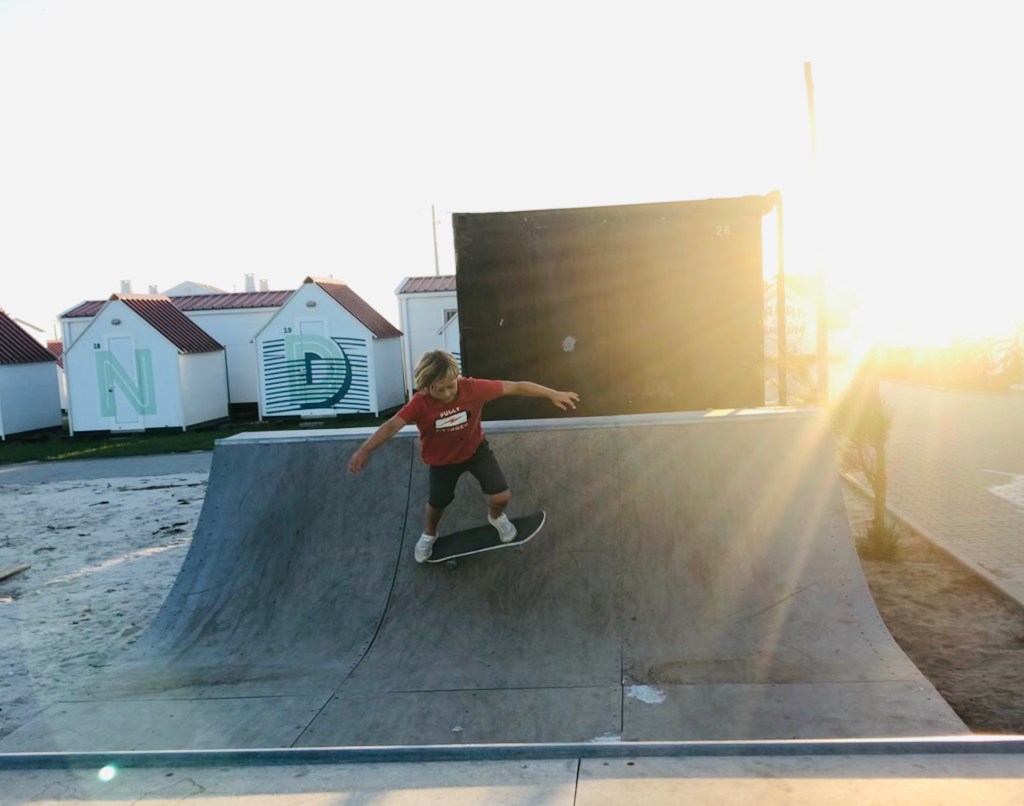
So that is what we did throughout September. We stayed in a nice apartment full of gadgets that seemed like the height of luxury (a gas barbecue, hot showers, a dishwasher!). We walked through bamboo plantations to get to the sea. We met locals and surfed every day. Menna signed up to a yoga class and then pilates too. The September term started and brought with it an unwelcome new routine of homeschooling – the twin evils of discipline and structure. Matilda got a new bodyboard, I got a new surfboard. We skated up and down the empty road outside our front door. We visited the walled castle town of Óbidos and the misty island of Berlenga. Arthur learned to drop in on the quarterpipe skate ramp down at the nearby hostel. We did long walks across the cliffs northwards, or over the dunes to Peniche. We marked sunsets out of ten from our roof terrace.

In short we lived a fairly normal lifestyle, and of course we got bored. Before long Menna and I were right back in the realm of anguished late-night conversations about the purpose of this trip, the definition of adventure, the meaning of life, the pursuit of happiness. Dangerous destinations started to get thrown into the mix: Costa Rica, Kenya, Mexico, South Africa, Morocco. Our dreams were of deserts and reef breaks and scarlet macaws.

It was time to head south.

Away from it all

Our stay up in the São Mamede plateau was the closest yet to how we had imagined this year to be. Off the beaten track. Out in the wilderness. A simple life, miles away from the rush of the city – both physically and figuratively. It was an antidote to those moments of regret and mournful rhetoric about our altered plans (but we should be beside tropical waterfalls right now!) The self-pitying mindset is insidious and Portugal is an epic place.

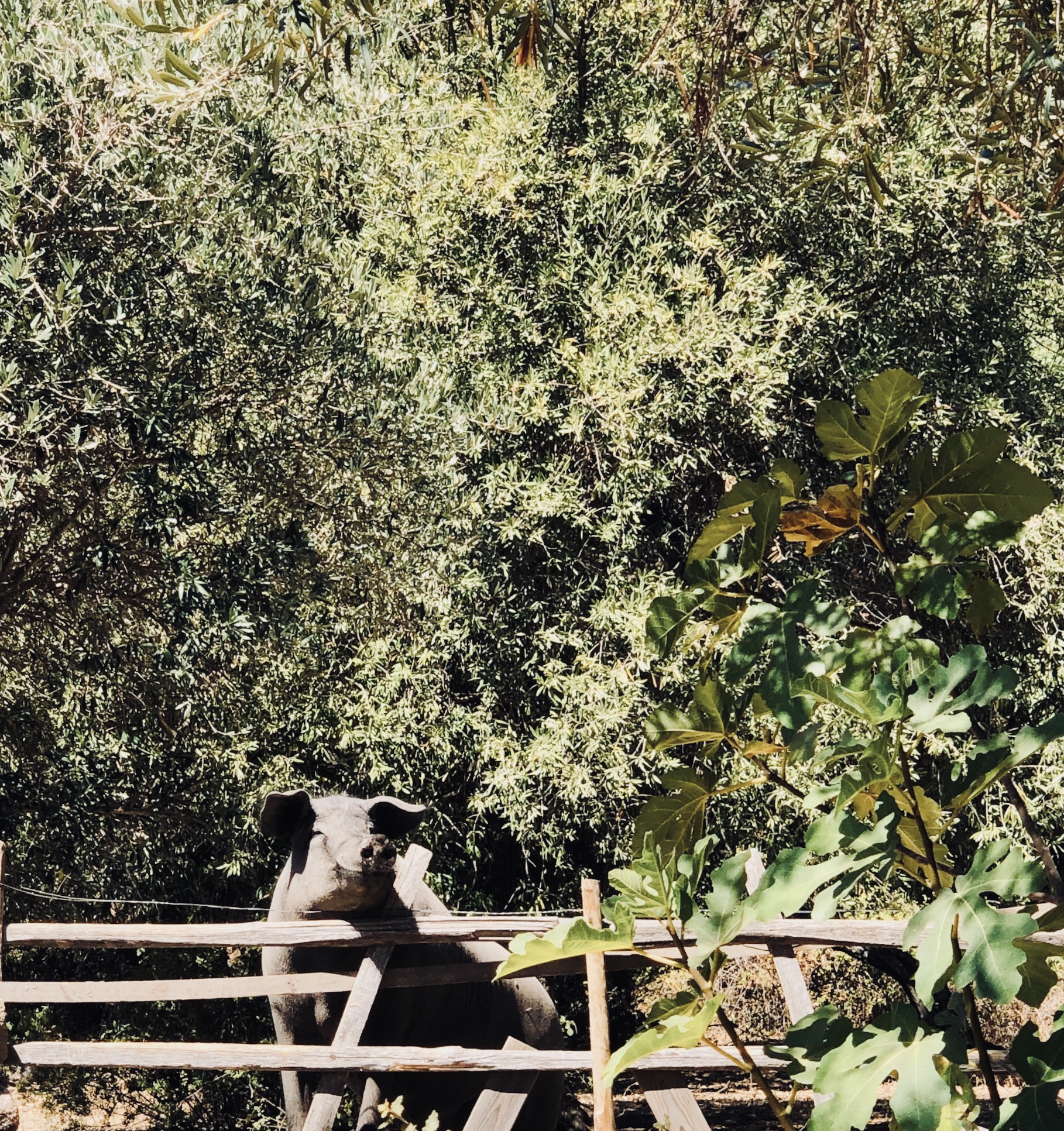
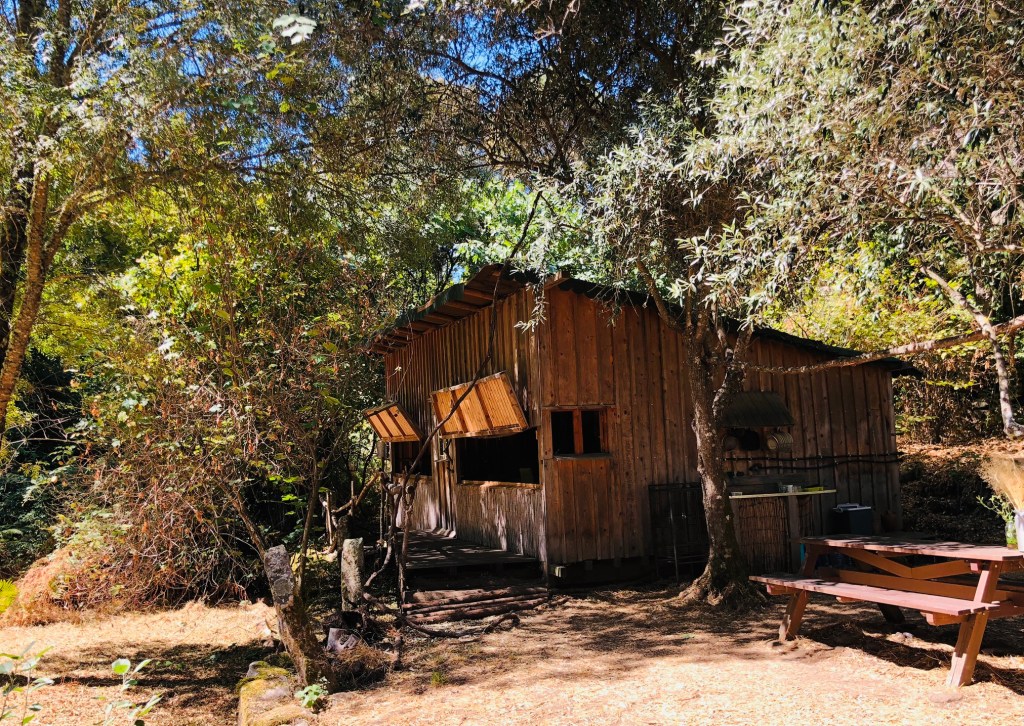
The Terra Sangha project still felt in the early stages but was underpinned by a conscious attempt at slow living, traditional farming, sustainability, a rejection of digital life. It was a rugged and beautiful place, and it clearly took some work to maintain. There were olive groves, walnuts, figs and lemon trees to tend, terraces to clear, rutted paths to pave, irrigation channels to divert, log buildings that needed building. In one dusty terrace Ben had cleared a sparse vegetable patch where tomatoes, courgettes and pumpkins grew along with a few hardy flowers but full self-sufficiency still felt some way away. There were dogs, chickens and donkeys roaming around, and a fat pig called Madam Chestnut who captivated our children with her greedy charm. I couldn’t work out at first how she fitted in with the vegetarian eco vibe, but she was a long-term resident, not a food source, a survivor of the pig farm that once stood here. She reared up on her gate and grinned at us whenever we walked past and soon had the kids eating out the palm of her hand – only it was the other way around. Clever pig!

Aside from the domestic animals the place was teeming with hidden wildlife. There were the rooting marks of wild boars under the trees and we heard that pine marten and otters tracks could be found in the soft mud down by the river (though we didn’t see any). Porcupine quills and snake skins lay tangled in the scrub. We saw no traces of the Iberian Lynx but it was out there somewhere. We imagined a nighttime procession of creatures slipping and slithering down from dry hillsides to find their way to the river. Behind Ben’s farmhouse was a watching spot, a flat stone shelf by the water where he had an old mattress underneath dream-catchers, candles and other esoteric paraphenelia. He told me he had seen kingfishers there, hoopoes, egrets, a rare stork, golden orioles.

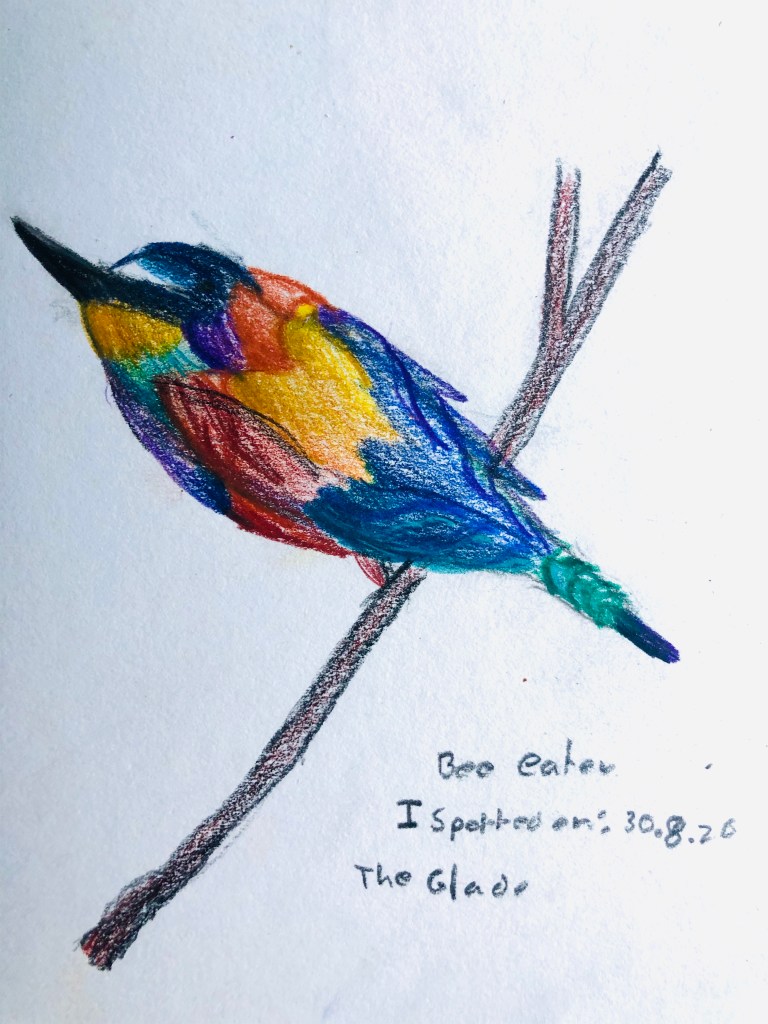
One day we drove out on a reconnaissance mission. Matilda called in an early sighting: red-green-orange swirls, gliding around and eventually solidifying into a flock of bee-eaters (or perhaps a cannonade of bee eaters). They perched for a while on a telephone wire overhead and we hung out there on the roadside beneath them, eating figs from a nearby tree and watching them through binoculars. Half a kilometre later we had to pull the car over again, as three Bonelli’s eagles (or golden eagles even?) emerged from behind a hillock right next to us, and wound their way up on the thermals, followed by maybe twenty huge griffon vultures, indistinguishable from eagles themselves but for their long necks. For a few minutes the sky was full of these huge tawny birds circling above our heads, and we were frozen there in awe, maybe a bit scared of talons and hooked beaks, like prey transfixed. We watched in silence as they drifted lazily upwards, until as tiny specks they were blown far away over the plains.

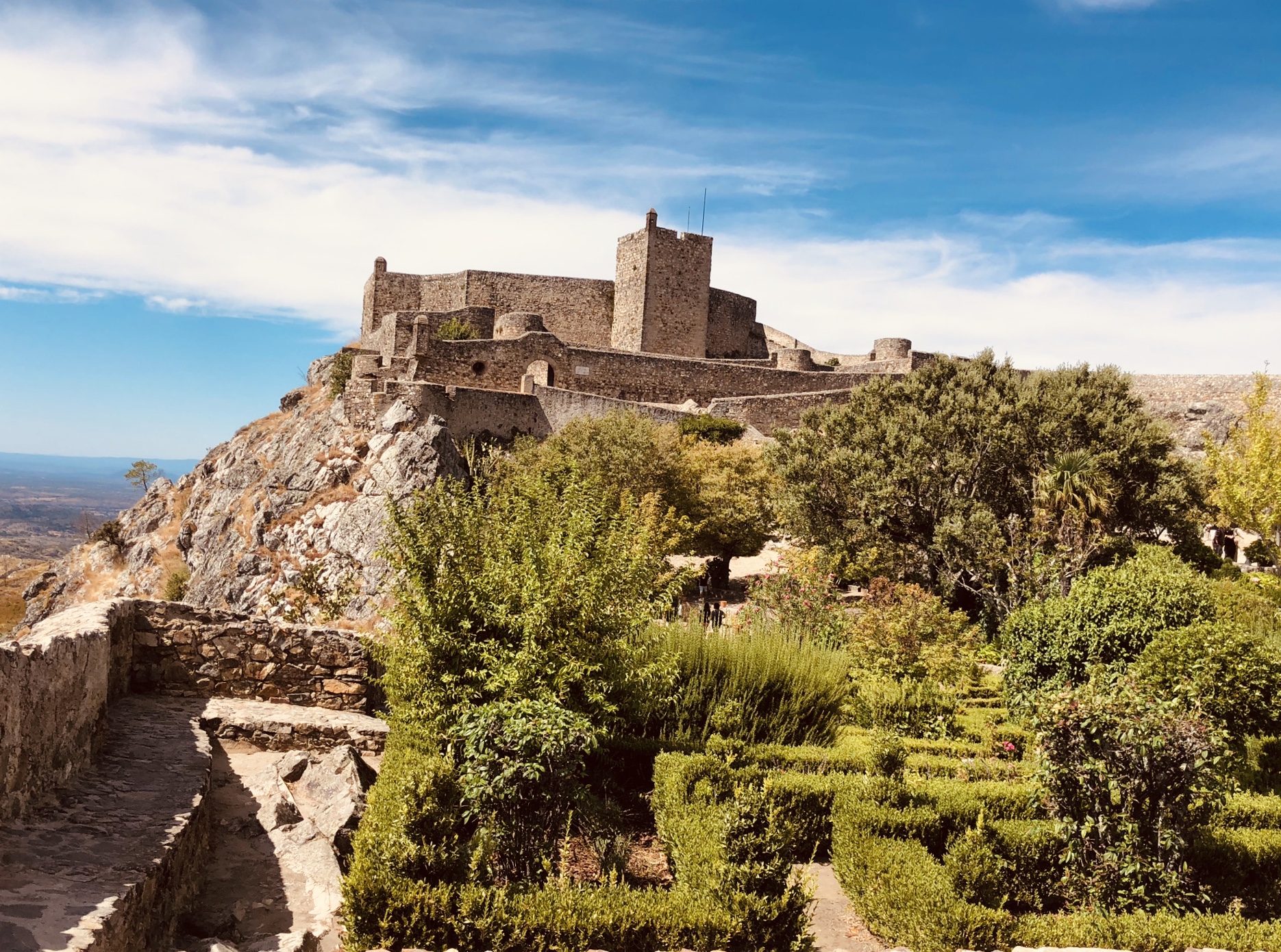
We drove on that day to Marvão, a mediaeval town perched high on the mountain top. It was a maze of glaring white houses, steep cobbled streets, a ring of churches and an old Moorish fort at the peak. There are layers on layers of historical masonry in this part of the world and this was another epicentre. Marvao was a breakaway rebel enclave in the ninth century, revolting against the moorish Emirate of Córdoba. It became a strategic stronghold through the Christian Reconquista, the war of the Spanish Succession and several exotic sounding wars I’ve never heard of (The Fantastic War! The War of the Oranges! The Peninsular Wars!). Away on a far off peak we can see another white mountaintop town, Castillo de Vide, flashing it’s battlements competitively at us. Perhaps there is a string of these fortifications all the way down the border, grimly holding back invaders.

High on the battlements of Marvao we found ourselves with views that stretched for hundreds of kilometres in every direction, and there again, against the hard blue sky, we picked out eagles patrolling the plateau below. We had been talking about how these stone ramparts were over a millennium old, but now it felt like this symbol of military power was undermined somehow by those overlords of the skies, circling, watching, enforcing their more ancient dominion over the land below.

Our week at Terra Sangha was over in no time. It was a proper adventure. Rough living. A fend-for-yourself kind of environment that suited us just fine. Crockery and cutlery were in short supply, there was no means of refrigeration, the water was suspect. The clean bedsheets waiting for us had disappeared from the washing line. The solar panels were out of action and we had no power. Although the website alluded to sunrise yoga classes, vegetarian dinners served by candlelight with homegrown ingredients, none of this seemed to be available and we found that we weren’t bothered. Instead of organised activities there were endless woods to explore, mountains to climb, a river that you could trek up for miles and stone ruins to poke around in. There was a a stone citadel where you could play guitar and watch the stars. The simplicity was part of the charm. Terra Sangha was a primeval place that and to have too many comforts would have diminished the edge.

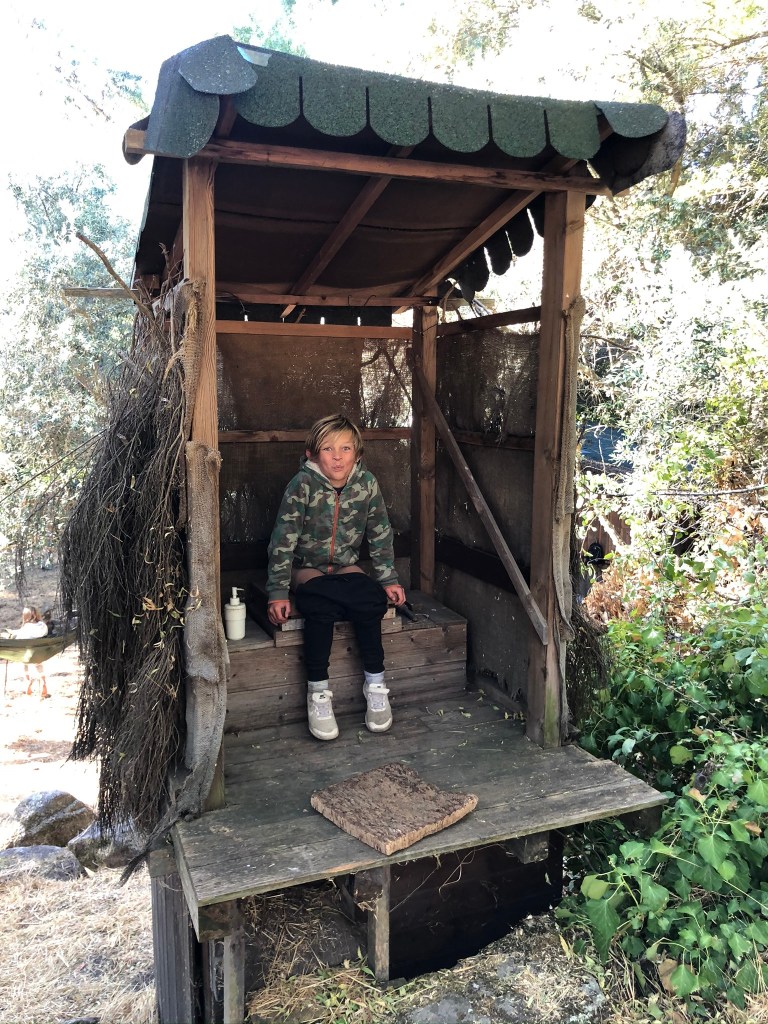
There’s nothing like answering a call of nature as nature keeps on calling all around you.

Stone and Water

We spend several days exploring Terra Sangha and the mountains around. We climb up ancient terraces that are carved into the hillsides and buttressed with lichen-covered stonework. Further walls criss-cross the land like a maze and the ghostly outlines of old, old buildings can be seen in certain clearings. From the hills above we can clearly trace the foundations of the Roman and then Moorish settlements that must have dominated this landscape for miles around. This was once the heart of a thriving civilisation, but nothing beside remains, only a stone farm with a few outbuildings, some olive groves and a couple of wooden hunting lodges that now house occasional travellers like us. Poking around under the ground we find pottery and iron fragments that we think might once have been arrow heads.

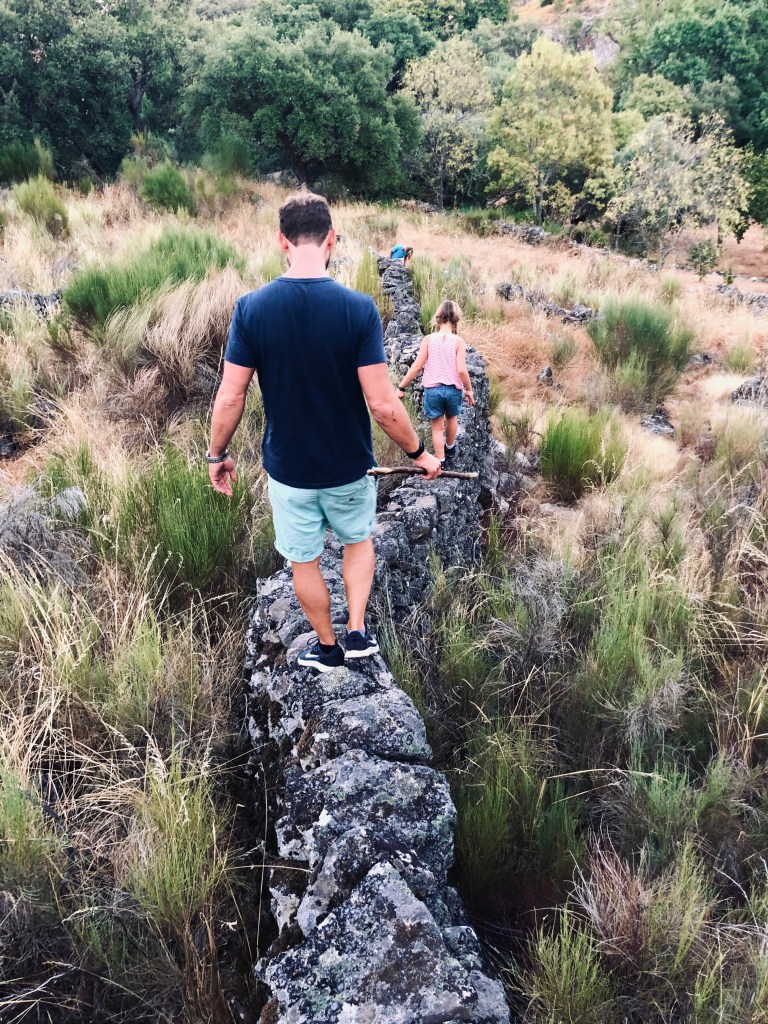
When one evening we climb the mountain behind us to watch the sunset, rather than risking snakes in the the bracken, we balance our way upwards on top of one of these creaking ancient walls. It is a simple thing of dry balanced stones with no cement, and clearly hasn’t been touched in centuries, but is so carefully fitted that four of us in succession pass up safely with barely a stone moving.

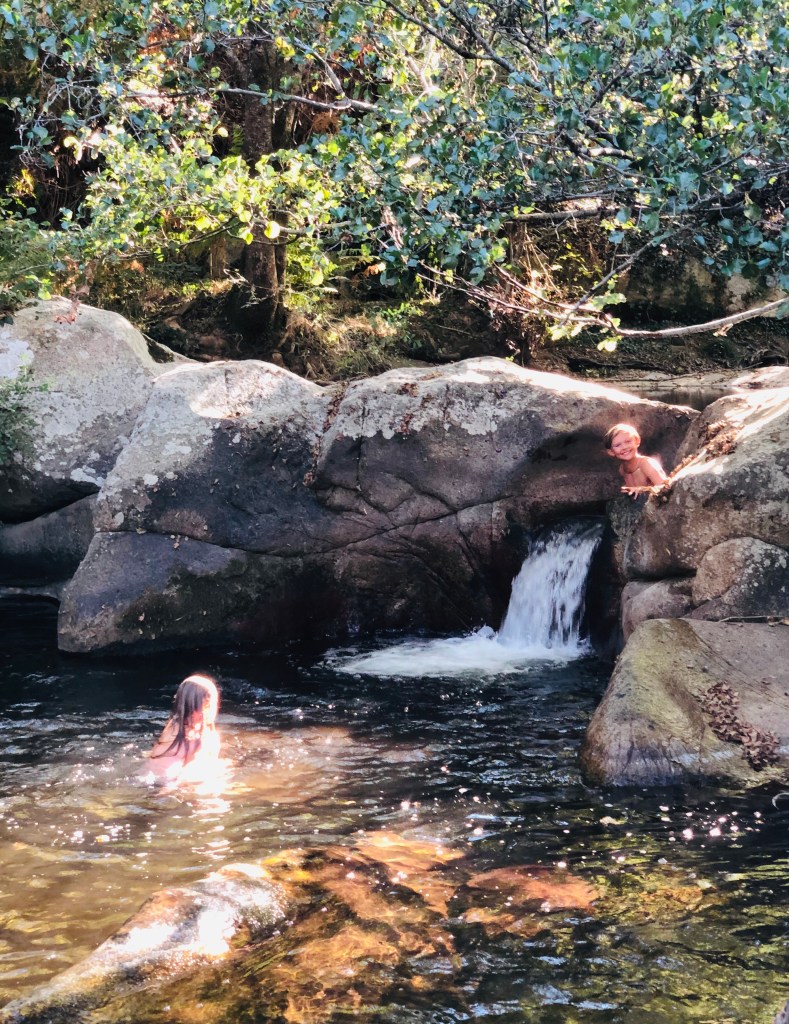
In this dry land we become obsessive about water, and from our cabin, the chatter of the river is a siren call. We find shade down at the river, we swim there to cool off, we use it to chill our milk and beers, we make complicated dams and stone towers. Arthur is in his element here and irrepressible as a water rat. He splashes, hangs from trees, throws stones, catches lizards and chases dragonflies, carves a bow, whittles arrows, makes elaborate snares in the bushes, diverts water into a series of fish catching pools. Matilda meanwhile sits on a sunny rock and sings to herself.

Our cabin has an outside tap with water that is pumped directly from the river.
“Don’t worry. The water is filtered,” Said Ben when we arrived “and the pressure is pretty good right now because I’ve just changed the filter.” He turned the faucet with a flourish. It hesitated, shuddered, coughed out a spray and then subsided to a dribble.
“So we can drink it then?”
He thought a while. “No-o. I wouldn’t advise you to drink it. It can be drunk. But I don’t think your insides are ready for it.” Looking at our worried little faces. “Don’t worry though. We’ve got a spring on the site. You can fill up bottles from there. It’s very pure.”
“Oh right. A mineral spring. Like your own Evian?”
“Um yeah. Like Evian.”

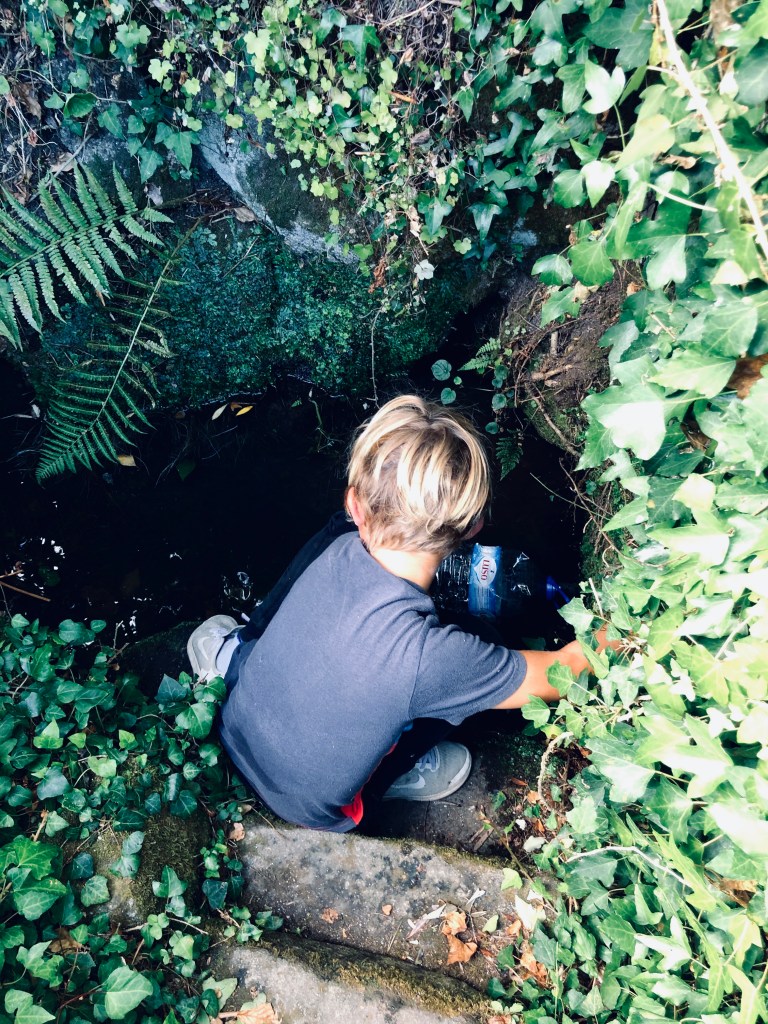
We don’t want to use our car unless we have to, it seems against the subsistence ethos of this place, and who can argue with a natural mountain spring? Arthur is dispatched cross country to fill our water bottles every day. He doesn’t complain, but when I go with him to fill up at the spring one evening in the half light, I find it teeming with worrying wildlife and full of over-rich organic smells. You must descend down some steps to a dank pool that is full of frogs and mosquito larvae, thick spider webs and who knows what else. The ancient donkeys of Terra Sangha come to water here and the air is pungent with the smell of their piss. The precious spring water trickles out of a mossy pipe inches above this dark pool. Your water bottle must be slotted onto the pipe with some dexterity to avoid contamination with the stagnant water beneath, and then you must push downwards and submerge it in the slime to find an angle so the bottle will fill. You squat there for several long minutes, hunched in the darkness, waiting for the water to trickle in while sly reeds pretend to be spiders on your neck, frogs splash around and small biting creatures drone in your ears.

A few days into our stay I have a wild and feverish night, roaming and tossing in the darkness, creatures running over me in strange smothering dreams. For some hours I battle my demons until at 5am I give up and leave the cabin to wait for dawn. I wrap myself in the Indian rug that I call my bearskin and take myself down to the river. Crossing the stepping stones to the far side I wedge myself between two tree roots that trail over the water and settle in for sunrise, hoping to see kingfishers. I have a strange hallucinatory time there in the half light, immersed in the sound of the river. I find myself slipping beneath the surface to slither through pebbles and submerge myself in the silt. Reborn slippery and grey in the ancient coiled roots under the river bed I take on many forms. The kingfishers don’t come.

When Menna finds me some hours later I feel very cold and have a sickness deep in my stomach.

I face down the illness. I am determined that I will not lose a day with my family in this special place. It is just some food poisoning from the chicken kebabs I barbecued last night (they did taste mushy in the darkness) or perhaps a small stomach upset from swimming in the river, a germ from dirty hands. It will pass.

We go out walking in the late morning climbing up to the eastern peaks that face down onto the property. We have been told about a high viewpoint from which you can admire the topography of the São Mamede plateau. I lag behind on the ascent and sweat a lot. We make it up to a high point and see an undulating landscape of yellows, browns and deep greens. The trees bring life to this dusty world: sage colours of olives, walnuts and twisted corks up on the higher mountain faces, the deeper greens of oaks, limes, poplar, birch and hazel amassed around the hidden river below.

We try to make a homeward circuit and get totally lost up there in the hills in the midday heat. Our landmarks for safe return are strange rocks and twisted trees, a sunken path, a certain hilltop ringed with white stones. These milestones shift and change from different perspectives; similar features trick us and take us clambering up false paths. We end up following circular goat tracks that end in impenetrable thickets, always convinced we can hear the river close by and will somehow overcome the banks of thorn and brushwood to find it; that one true path home. We have no water and the whole thing is slightly nightmarish though I am determined not to indulge in further dream cycles of death and rebirth. One mustn’t panic in front of the kids.

We are on the mountain for a couple of hours until we find a path that leads to the river and finally we see the Roman bridge that means safety and I nearly cry.  We make it home, bruised and scratched. It is 3pm and kids are hungry for lunch while I collapse into the hammock and pass out for hours. The kids take secret pictures of me asleep. It is a horrible sight.   

Two days later Menna looks at our water bottle as it is illuminated in a shaft of light. There, in the ‘Evian’ spring water we have been drinking all week, are tiny nematodes, long as a finger nail, furiously alive and hungry. They coil and twist like malevolent worms. I feel mixed emotions: a resurgent nausea, vindication at a bona fide parasite to blame, slightly bitter that I was the only one to fall sick. Am I now the weak member of the herd?

We don’t drink any more water from the spring and when we leave at the end of the week, Menna doses us all with her most potent antiparasitic medicine.

Off Grid

The Serra de São Mamede is a spur of the Toledo mountain range, sitting high above the Alentejo, dividing countries and climates. On the eastern side you have Portugal and the Atlantic terrains, and on the west is Spain and the Mediterranean. We are staying deep in the protected national park that nestles on the Portuguese side of the mountains, and it takes us five hours driving cross-country to get there.

There is a symbolic aspect to the journey as we gradually leave civilisation behind us and wind our way up mountain roads into the wilderness. Towns become villages, vegetation thins out, roads get pocked and increasingly rutted until finally the asphalt ends and we bump the last few miles down a red dirt track, squeezing between rocks. Then we have arrived – that is to say there comes a point where we can’t drive any further and we abandon our car in a scorched sandy clearing and proceed on foot as the sun begins to set.

The domain of Terra Sangha stretches out over the hillside like a dusty crumpled blanket, seamed with dry stone walls and scored by a river’s crease. There is an simple farmhouse in the middle of it all and that is where Ben resides, cooking on wood and lit by candles. He has no power at the moment, the solar panels have been out of action ‘for a few weeks now’, but Ben does not let such worldly matters affect him. It won’t affect us either, he tells us as he takes us to our cabin, we didn’t have solar panels to start with.

After some months of relatively civilised living on the Iberian littoral, we are now going totally off-grid. That means living with no electricity, drinking water, flushing toilet, oven, shower, tv, window-glass, wifi, phone signal or refrigeration. “There’s a cool box somewhere if you need it. I can bring you ice.” Says Ben vaguely and disappears off into the dusk, leaving us alone in our glade.

Our car, full of the heat-sensitive provisions that we have purchased for this week, is about a kilometre away and darkness is falling fast. The evening is dry and windless, the temperature still sits obstinately in the low thirties. We have some work to do.
“Does anyone know where the head torch is?” Asks Menna pointlessly.

We toil backwards and forwards to the car, laden with many (un-eco) bags full of (non-vegan) provisions, (unsuitable) clothes and (unchargeable) electrical items.  We leave surfboards and bikes dumped on scrubland by the car. We climb walls, stumble over hidden obstacles, get scratched by tree branches and curse a lot. The night falls quickly once the sun has dipped behind the mountains and the darkness is complete and unequivocal.

Dinner is a basic pasta, cooked by torchlight outside on a rusty two-ring gas stove. Around us the night comes alive with wild calls and rustling that may be leaves in the breeze but may equally be prowling paws. The Iberian lynx still lives in these remote mountains I tell the kids, maybe bears too, certainly wild boar. They have both gone very quiet and don’t venture outside the safe sphere of light that the solar lamp throws over our trestle table. Matilda screams occasionally as flying creatures suddenly zoom past her head. This is a sanctuary for bats as well we remember, and our cabin has no window panes. They will come in and sleep in the rafters.

By ten o clock we are all tucked up in our single room, wide eyed in the darkness, listening to the forest breathing around us.

The best thing about arriving somewhere after dark is that you get to arrive all over again in the morning. Our cabin sits up on a flat terrace and when the dawn sun emerges over the shoulder of the mountain opposite, it throws beams between the tree tops and through our windows. The light illuminates the dust motes floating in our dark wooden room and falls across our faces of our sleeping children in their driftwood beds, making them look unwashed and strangely angelic. I stumble to the window and stick out a squinting sun-scrunched face to take in our new world. A glade of yellow grasses, a wall of poplar, cork and lime trees, the mercury flash of running water glittering in the shadows, mountains ahead and behind, forest all around us. Birds flitter through the foliage.

We can live without wifi for a while I think.

Ericeira

It’s a nightmare driving around Ericeira. The streets are narrow and cobbled with a one-way system that only seems to apply to foreigners, while locals are permitted to come racing the wrong way and then face you down – anda tourist! – until you reverse back up. We rattled around for a while in circles, trying to find our new place. On one particularly tight corner we get properly jammed in, with Menna out in front of the car, alternately beckoning eagerly forwards then and squealing ‘Stop! Back!’ until I have see-sawed my way right into the bend and am revving and farting diesel smoke into the faces of all the brunch-eaters outside a vegan café. Eventually the owner came out and helped extricate us before I scared all her clientele away.

Once we find our apartment and ditch the car, Ericeira becomes a pleasure to stroll around. The houses are all built in the traditional style: gleaming white walls; contrasting blue fascias and architraves; burnt orange roof tiles with ornate chimney and gable work. Walking the streets is a tactile experience, the limestone mosaic calçada are warm and slippery smooth underfoot. It makes me want to go barefoot, though no-one else is doing this, and dog shit still exists, so Menna makes me put my flip-flops back on. The centre is traffic free and home to boutique surf shops and organic cafes, restaurant tables and the overspill from bars. Bougainvillea features heavily. There is noise and movement everywhere until there isn’t. You turn a corner and hit a pocket of stillness.

Our apartment here is tiny and opens right out onto a street that is too narrow for cars to park in but serves as a pedestrian thoroughfare down to the sea front. We leave the door open when we are home. Sometimes we sit out on the step with a beer and chat with passers-by as if we’ve lived here all our lives. Sometimes I play the guitar badly. Menna makes a worrying friendship with the Brazilian surf instructor who lives opposite. The kids rattle around on their bikes or play shouty games and try to climb the lamp posts.

There is a small port which we walk through to get to the beach that gives a glimpse of old world Ericeira. There they dry-dock all the fishing boats, then pick them up by tractor and tow them back out to sea as needed. It smells like a port should – of brine and sea-weed with an oily undertone of rotting fish – and it is full of weatherbeaten old sea dogs sitting around playing cards. It is messy and real, contrasting with the postcard town above. The gulls fight over huge spiny crabs that have been discarded there in the sunshine.

Life here feels easy. We get fresh fish from the mercado. We settle into our tight space and have a well-coordinated furniture rotation routine, so the table is prominent at mealtimes and the sofa comes out in the evening. We leave our surf and skateboards propped up outside the front door and hang our washing on a pulley system out on the street, until someone steals our wetsuits from the line one night and we get more cautious. We surf most days and there is an epic skatepark where Arthur is desperate to spend all his time (politely waiting his turn at the ramps as local street rats muscle in and pull impressive aerials). We wander down to the harbour wall most evenings to get an ice cream and watch the sunset. I find a charming old-school barber and have my first haircut since lockdown. He cheerily ignores all my styling requests and sends me home shorn and brutal. Menna makes a Portuguese caldeirada fish stew, dark and spicy, with squid, ray, conger eel and prawns.

After some days we are more attuned to our new town and start to pick out the weave of the social fabric here. We are part of a large and transient tourist component that stay in hostels, camps and short term lets. Entwined with the tourist group are the seasonal visitors who have come here to surf or are on retreats, working as instructors, yoga teachers or masseuses, and have a slightly longer-term legitimacy. Then there is a tribe of settlers who, drawn by the waves and the liberal vibe, have moved here permanently, put down roots, started businesses, formed a little artistic community. They live in shorts and flip-flops with flexible work patterns that accommodate tides, swell and good living. They frequent each other’s restaurants and cafes and chat on the street and in the surf. One day when we finally settle somewhere, I think, it would be good to be part of a vibrant and committed scene like this. Close-knit, stress-free, fun. A group of like-minded people, living outside where possible and tuned in to the rhythms of the ocean.

Then there is the local young no-fear generation, big aerials in the skatepark, aggressive carving in the waves, World Surf Tour aspirants with flamboyant surf-skate moves and great tattoos. And of course you have the older Ericeira locals who have been residents here for generations, moving slowly in time honoured circuits around the port, town squares and the market. A soberly-dressed, polite, churchgoing people, passing their twilight years on benches around the city, impassive observers of an ongoing sea-change that relentlessly reshapes their landscape. I think I would also like to grow old like this.

For now though we are content to be in the floating tourist group and wander round aimlessly, absorbing the vibe. Nothing very exciting happens to us in Ericeira but we feel happy and lazy and well-fed. By the end of the week we are starting to get twitchy again though and we talk about heading off somewhere wild.

I am who I say I am.

Our place in Ribamar was run by Jose, a tattooed surf hipster who talked a big game. He greeted us on arrival and sauntered around the house, talking expansively about his portfolio of rental properties; various big waves, the local night life. There were hints of a kid somewhere back in Lisbon and a girlfriend, also conveniently distant, in Sintra.
“Sometimes I sleep here, sometimes there, sometimes in one of the other houses. I just see what I feel like.”
Nice set-up, we thought (or was it just me?), AirBnB keeps the rent flowing in, hassle free, while he surfs all day, parties all night and keeps his dependents at arm’s length. Is this an economic model we might consider for the future?

Alas, as with all things that are too good to be true, the ideal didn’t stand up to prolonged scrutiny. During our stay Jose’s grandeur gradually ebbed away like the tide. He went from owner to implied partner, then manager and eventually he settled as a glorified caretaker (to the distant and fearsome Miss Maria, who we never met, but who Jose kept scrupulously updated through a rapid-fire stream of text messages). Jose had a single dark room at the back of the complex with a mess of ketchup bottles, complicated coffee apparatus, ashtrays and piles of clothes. He would emerge from this little cave around midday in his skinny jeans, silver bracelets jangling, baseball cap awry, blinking and scratching. His footloose agenda seemed to be rather on hold. I suspected he usually crashed in any of the rental properties that were vacant, though I doubt Miss. Maria ever got a text informing her of this.

We talked whenever we met in the courtyard but Jose would often get called away just as I was getting a review of the local skateparks, or a description of the killer octopus in O Pescador. The Sintra girlfriend seemed to stay in Sintra much less that Jose might have wished. She was a strong-jawed, hard-eyed lady, and seemed to have him firmly in check. The kids were scared of her and maybe I was too. She would sit chain-smoking outside our back door late into the night and I would have to make excuses when Menna told me to take out the rubbish.

There was always a surfboard propped outside Jose’s door, but on the days when the swell got big at Coxos, he lay suspiciously low.
“Dude! You are mad to surf there. It is far too heavy this wave!” He admits one afternoon when I tackle him,
“But you said the entry point was tough and it was a fight to manage the rips. I thought this was your local wave.”
“Yes, but only from watching I know this. I don’t go in there to surf. I am only surfing for a few years. I like the beach break over at Santa Cruz. This is where I learned”. In this moment of candour and mutual levelling, I am able to confess that I too am far too poor a surfer to attempt most of the big waves we have spent hours talking about with such implied familiarity. We have both tacitly overstated our abilities. Now we bond over the pragmatic unlikelihood of ever being able to surf Coxos, Supertubos or Nazaré.

We all liked Jose more and more as his pretences dropped over the course of the week. Our leaving impressions were of a super open and pleasant guy who loved to chat but would sometimes get a little carried away with the detail. I have a lot of time for people who don’t let reality dull a good story. Menna likes to mother lost souls. The kids would do skateboard tricks for Jose in the courtyard and he would applaud.

Our relationship was slightly strained on departure though, when Jose spotted what looked like fresh graffiti all over our gleaming white doorframe. Stars and lightning symbols had been scrawled at waist height together with – the smoking gun – a clearly visible ‘A’ and an ‘M’. The kids made a good attempt at denying all knowledge of this, but the evidence was fairly incontrovertible. Under sustained interrogation they broke down. It had been an experiment. Scientific really. They had used the leaves front the potted agave plant here, which gave out a little juice like this, which when smeared on white paint, leaves a dark line like that. Arthur had done a project on cycads last term, so it was all in line with the school curriculum. Homework almost.

“It’s just leaf juice Jose. I’m sure it’ll come off easily!” I chuckled and we enthusiastically grabbed cloths and set to it. Jose frowned and grimaced, sent texts to Miss Maria. After twenty minutes of scrubbing it is clear that agave juice actually does not come off white walls. We offered to send Arthur back next day to repaint it, but after silently appraising him for a moment and estimating the quality of workmanship he would deliver, Jose declined. It is best he takes care of it himself he told us with a sigh. The Sintra girlfriend rolled her eyes.

We leave Ribamar with the kids in disgrace.

Who Dares Paddles

For the next ten days we floated up and down the coast. We were based for a while in Ribamar, a sprawling little village strung along the coastal highway as it loops up through the hilltops. It was a good place from which to explore a long run of scalloped bays with exotic longwinded names: Ribeira D’Ilhas with it’s stone shelf and excellent left point; Praia do Banco do Cavalinho (Pony Bank Beach?) where the rockpools are perfectly round like manholes in the flat rock; Praia de São Lourenço, with smuggler caves high up in the cliffs and a suddenly shelving beach which generates a booming shore break, no good for surfing but awesome scary-fun for children to mess around in. Our favourite bay though was the closest and also the most notorious: Coxos, another of the famous big wave spots of Portugal. It comes with this ominous warning in Surf Europe:

“Coxos is a right-hand point break. Long, fast and furious, the wave is no kindergarten: heavy sections can turn the barrel of your life into a nasty beating. Lots of water running along the rocks make getting in/out of the water a game of patience and know-how…”

Surf Europe Magazine

It’s a world class wave and the swell is pumping, so what do the Nicholls do? Well, they paddle out of course! Not on a surfboard though, because they still value life, but just with their little naked feet, in the shallows. It seemed like harmless fun, but when there are giant Atlantic rollers battering the beach, even venturing knee-deep into the water means taking your life in your hands. We all were sea-swallow’d, though some cast again. That is to say within minutes we nearly lost Arthur, who got totally smashed by a giant wave, properly rolled around in the shingle and then sucked back out to sea underwater. I grabbed a handful of his shorts and yanked him up again just as the lifeguards came running for us and the beach turned silent.

Arthur thought it was hilarious but not the lifeguard. We got an earnest lesson on how to paddle without getting drowned. We felt chastened and we went to sit quietly up on the cliffs to watch some people who knew what they are doing instead.

Watching waves is mesmerising, particularly when they are breaking like this. We spent some hours up there on the cliffs, sitting in the sun, tuning into the ocean. It’s very hypnotic: the rhythm of the swell, the power and force of the break, the subsonic roar, the moment when a huge wall surges up and seems to hang there in the sunlight, the lines and swirls of the waveform clearly illuminated for a moment before it all crashes down in clouds of foam.

There was a whole crowd up there on the cliffs, standing, chatting, photographing, sitting on rocks and camper chairs, maybe sipping beers. We were all watching the surfers (only two!) who had braved it out that day, offering them encouragement, criticism, armchair wisdom. Our kids loved being part of this scene and sat quietly for ages up on the rocks, murmuring appreciatively about a particular face, tutting and pointing out where the surfer should have taken off to get deeper into the barrel, or, best of all, moaning with horror, little hands over their eyes, when our hero got caught inside and took a hammering.

The next day I surf at Praia Azul where it is not nearly as big as Coxos but still worryingly huge and messy. I imagine the audience up on the cliffs, and spend the session with their eyes mentally upon me, gravely critiquing my performance as I get smashed around. I see Matilda peeking through her fingers as I am caught out of position, (“Daddy’s getting a beating, she will be saying!). I hear phantom cheers as I finally catch one after many minutes of drift. I paddle back in after an hour or so and get turned over by the shore break, rolled twice, sucked back out and then dumped upside down on the sand. The comedy finish! Oh, they’ll love that!

The beach is empty, the kids are building a sandcastle and no-one has seen a thing. Menna gives me a casual wave like, oh, there you are!

I take a bow to the imaginary clifftop audience and invite them back to my next session.

We all were sea-swallow’d, though some cast again:
And, by that destiny, to perform an act,
Whereof what’s past is prologue, what to come
In yours and my discharge

The Tempest. William Shakespeare

Massacre of the Innocents

We got back into Portugal at midnight on a Friday. Reunited with our car at Lisbon Long Stay, we drove valedictory laps through some industrial estates before eventually finding our room for the night. Menna had booked somewhere cheap and cheerful and we had no idea what we would find. It turned out to be a huge ‘family room’ with a chintzy Louis XIV vibe, high up in an apartment block. There was no private parking and it wasn’t the kind of neighbourhood where you just left a car piled with possessions on the street, so I unloaded the bikes and the boards in the dead of night and we carted them on up to the fifth floor. Our suite quickly became the cluttered dosshouse we were used to.

We were down in Café Angola early next morning. We ate custard pastries, drank exotic juices and got very engrossed in a snooker match that was playing on a tv suspended over the bar. At some point Menna and I remembered that it was our wedding anniversary and we had a quick peck over the table while the kids made grossed-out faces. She admired the croissant crumbs in my beard; I thought the guava on her breath smelled like the tropics. A man called Wilson eventually won a dramatic last frame and took the semi-final.

Over the next two weeks our intention was to explore the area between Peniche and Ericeira, starting North and working our way down. Our first stop was Baleal, three hours from Lisbon, on the (toll-free) scenic route, where we would camp for the weekend.

Urban Art Camping was an indulgence for the boys. The website had various soft focus pictures of graffitied walls and skate ramps, laughter around communal barbecues, brightly coloured surfboards tossed artfully upon the grass. We had booked a ‘chalet’ (trailer) for the weekend and looked forward to immersing ourselves into the party scene.

I had to raise a admiring hat to the Urban Art marketing department when we arrived, for those careful blurred shots had made so much of what there was little, and made so little of what there was most: hard earth and grit, a veil of dust hanging in the heat.

There were some murals there it was true, and a skate ramp too, in an area of sandy wasteland among abandoned breeze blocks and plastic pipes that coiled like snakes in the silt. There were also two concrete barbecue grills as promised. They were hidden on a little walkway between the toilet block and a chainlink fence that looked out onto a desolate vista of weeds and rusting agricultural machinery.

The website certainly hadn’t mentioned that the site was right next to one of the most decrepit, rundown chicken farms that can ever have flown under the animal welfare regulation radar. The tang of ammonia and chicken shit hit hard when the wind turned westerly, cries of tortured poultry haunted our nights.

We were one of approximately five occupied berths in the campsite, so the bonfire surf vibe was muted. It became quickly clear though that the real residents here were of a different species entirely, and they were having quite the party. Flies everywhere! They came coursing into our trailer if we left the door open. They danced over my face when I tried to siesta. Matilda had twelve of them in the shower with her. Their buzz bored deep into the cranium.

There is a family philosophy that we don’t kill any creatures unless they are mosquitos. No stamping on spiders or harpooning manatees for the Nicholls. Live and let live. I have to explain to the kids that there is however going to be an exemption on flies.
“But Dad, why? They’re not actually hurting us.” Asks Arthur, rightly.“Is it ok to kill something that just annoys you? Can I kill Matilda then?” There is some difficult semantic legwork to do to build a moral case for this one.
“They carry diseases and they are super annoying. It’s just better for the world if we reduce the fly population”
Arthur proves coherently and at some length that if you were to eradicate the fly population then, in a complicated web of cause and effect, there would be at least sixteen other species that would become extinct including, somehow, the Golden Eagle.
I am reduced to: “But they eat crap and then crawl on your face. They vomit digestive juices on you and then lick it back up!” And then I am plunged into a long difficult period of self-reflection. Why can’t I argue a better case for the morality of fly swatting – or at least a more eloquent one? The fly has faster reflexes than any other living thing. They are perfectly adapted to their environment and clearly a highly successful species. They play a vital role in the decomposition of biological waste. Perhaps we should just leave them alone.

Our campsite apart, Baleal is a beautiful little village. The old town sits high on granite island and its churches and towers make a classic medieval roofline silhouetted against the afternoon shine of the westward sea. It connects to the mainland by an isthmus: a single span of tarmac that runs through a spit of beach with a unspoken ‘who dares first’ priority system. There are curved bays with fine white sand and turquoise waters on either side. This is ideal surf terrain as there are waves approaching the spit from two opposing directions, so it works on both northerly and southerly swells, and one side will pick up an offshore whatever the prevailing wind direction. We eat toasted cheese sandwiches and pickled lupini beans at a café on the cliffs, marvelling at our luck.

There is a series of beautiful beaches to the north of town with terracotta sandstone crags towering above them and this is where we spend Sunday. The waves are booming and I have one of the best ever surf sessions until my leash breaks, leaving me with a long swim back into shore. There is no harm done though and we walk the dusty road back to our campsite tired, scorched and happy. I find my spot behind the loos, fire up the barbecue and cook us up a chorizo-themed feast to finish the weekend in style. I am mellowed by surf and sun, the wastelands now stretch in front of me like a blank canvas full of promise. I superimpose all sorts of heroic and unlikely visions of the future there.

The mood evaporates later though when we return to our cabin and are greeted by a terrifying sight. We have left the door open and the flies have invaded. The ceiling is dark with them, so are the walls. They are flying lazy loops in the kitchen like they own the place. There are too many to count, though Arthur tries.

We have a family meeting. While it is true that we are a peaceful lot who seek no quarrel, tonight the fight has been brought to us. The sovereignty of our very trailer has been attacked and we must respond. We arm ourselves grimly with towels, magazines and Grandma’s fly swat, and we stride forth with murder in our hearts.

I have only fragmented memories of that night. A strange dark ballet. Metallic swirls in the dusk. Menna howling and swinging wildly. Arthur grinning diabolically as he leapt from chairs, his face streaked with some dark residue. Fluorescent lights flicker like strobes. The air-con unit groans. Dismembered limbs and wings; dark streaks down the wall; piles of small furry bodies amassed upon the floor. Matilda is a blur, twirling and stamping, teeth gritted, letting out animalistic cries. But still they pour in. They are in the plug sockets! Under the fridge! Hiding in the toaster! Sweat, blood, buzzing, shrieks. We killed them in their hundreds. Stamped on their mute bodies. Plucked off their wings. Did we…eat them?

We drive out of Urban Art Camping at nine the next morning still twitchy and agitated, the bloodlust barely subsided. We leave the crime scene behind us and flee south.

Somewhere in the car there is a buzzing sound.

Bella Italia

We’d been touring the Iberian peninsula for approximately six weeks but now we needed to divert to Italy on family business. We waved goodbye to the faithful beast in a long stay carpark in Lisbon, left the surf and skateboards piled on the roof, bikes dangling from the back, and we floated away feeling noticeably lighter without the weight of all our possessions and paraphernalia.

Arriving in Italia doesn’t quite feel like a homecoming, but after twenty five years of annual visits it certainly feels like greeting an old friend. A loud and emotional old friend, who has aged well on the whole, but dresses slightly too flamboyantly for her years. We arrived in Rome airport, having gained some extra load which we intend to distribute to our hosts – fine Portuguese wine, chocolate, soaps – and a picnic for the train. It is busy as hell there. We haven’t seen such crowds in ages, since the distant pre-covid era in fact, and we feel disoriented; village folk in the big city.

“Careful with your bags” I tell the kids sternly. Then I promptly drop the bag that I am carrying and hear the unmistakeable crunch of glass breaking. It is a sealed-up clear plastic bag from Duty Free and it fills quickly with wine. I have a surreal moment in the middle of Arrivals Hall, unsure what to do, dumbly holding a bag full of red liquid with chocolates and soaps floating darkly inside, like I’ve won a prize at the carnival but the goldfish have been massacred. Then it starts leaking and I have to run a long distance to find bins.
“See!” I tell the kids bitterly. “Be careful with your bags.”

We arrive at Martin and Giordana’s house empty-handed, but they don’t seem to mind.  They look after us, give us drinks, pretend we don’t smell, take us out to promenade the waterfront, proud of their picturesque home. We watch the sunset together and eat a long indulgent dinner in the medieval old town.  A breeze lifts away the heat of the day and Lago di Bracciano shines darkly beneath us, the gold lights of the city dancing silently away to drown in the distance. 

Menna and whisper to each other next morning that this sure beats travelling, but then we feel guilty because travelling is the life that we have chosen, because that is who we are, which is to say we’re adventurers right? And yes, it’s nice sleeping on real beds and chatting with real adults who are also our friends, but we chose to leave this easy existence behind, dammit, and seek out a path less travelled. Ours is a wilder, simpler life, under canvas, alone in the coastal wilds. Then we swim in the lake, hire kayaks, have ice creams, drink Aperol Spritz on the terrace, eat a five course barbecue, talk until the early hours. And next morning we don’t want to leave.

But leave we do, and we arrive at the train station exactly four minutes before the train departs.  In the haste I buy the wrong tickets, so that when we get our connection from Rome to Pisa, we are the only ones on the train who don’t have reserved seats and the conductor has to frown and explains our error at length, loudly and theatrically.

“You see this!” holds our ticket up for the carriage to see, “This is just a regional ticket. For the slow trains” looks of pity and disgust. “We are the intercity! We are the fast train. You need a premium ticket!”. He smiles and charges us an extra €80 which makes the whole public transport option suddenly much less economic than the car rental which we have rejected.

So we arrive back into the bosom of the Nicholl family some hours later, sleep-deprived, poor and somewhat hungover (adults) and with a surfeit of pent-up energy (kids). Which is how you should arrive back at the family home, because if your parents can’t look after you when you’re a tired and emotional 43 year-old with a grizzled beard and exuberant ear-hair, then who can?

The family have been convened for Dad’s seventieth birthday celebration and this happens next day. Picture him now, presiding over fourteen excited family members, at a long outdoor table in a restaurant where wisteria and vines are tangle on the walls, the wine bottles are never empty and the only thing that can silence the babble, for a moment at least, is a vast tray of pasta with bechamel, thyme and dark sticky ragù that is the famous tordelli alla Lucchesi. There is incessant chatter, some crying, certainly laughing, shouting, swapping chairs, loud toasts and babies wailing. By the end of the meal we have shining foreheads and half eyes, lips glazed with red wine, coffee, tiramisù or limoncello. Che si mangia bene! We spill out and take the celebrations along the the dusty roads of Lucca, up the winding hillside path, through the terraces and back to the house, where energy and emotions ebb and flow through the evening. There is a video compilation of sentimental birthday messages that my sister has edited together; there are presents, Prosecco and cake. It is the first time the family has got together this year and it seems that pretty much everyone cries at some point during the day. Italia has joined the party I see, and white teeth flashing, she moves through us all, dancing, smiling, mascara running, invisible in her catsuit.

Then over the next week we fall into a familiar easy rhythm. We get up late and run, walk, explore, read, lie around, eat huge lunches, swim. I argue lazily with my siblings. It is hot. We get a bagno at the beach and eat antipasti di mare at our traditional restaurant together with the cold fizzy Verduzzo wine that we always drink. We close the shutters to keep the house cool. We have dinner late and play loud games even later. I am sure I see a kingfisher on a morning run! We have apperativi and pizza in town. We see old family friends. We head for the canyons and ravines of the Garfagnana to escape the heat and swim in cold mountain water. We rent bikes and go for the customary cycle ride around the walls of Lucca, playing, I think, the same reggae soundtrack on our portable speaker that we played on the same trip this time last year.

After ten days we start to hear the call of the road again. We are fatter, well-rested and ready for anything. It is good to balance things out and indulge ourselves once in a while. The best thing about coming home to roost, we say to each other, is that after a while you feel ready to spread your wings once again and take on the world.

Somewhere in Portugal the waves are waiting.

Nazare

Nazaré is Europe’s big wave Mecca and we are here on pilgrimage. We are not the only ones either, a wave of this notoriety pulls a crowd. Firstly you spot the life-or-death hardcore surf crew with their deep tans and bleached eyes. Then there are the others, softer, like us, who seek vicarious thrills from the sidelines. Around all this is the periphery: the tour operators, guides, rickshaws, buskers and falafel vans.

For your surfing to qualify as ‘big wave’ you have to be paddling into monsters that are 20 foot high or greater. As a family we watched Riding Giants, the seminal big wave documentary, when we were staying in Croyde – some decades ago it seems now. It tells the story of a wild renegade scene, a group of guys who had dropped wilfully, out of straight fifties society and set themselves up on the undeveloped North Shore of Hawaii. They slept wild on the beach, lived off the land and discovered and surfed the largest waves that had ever been ridden. This scene then grew over subsequent decades as boards developed, bigger spots were found and new generations of surfers pushed the boundaries ever further. As surfing became commercialised, the big wave hunters remained splintered from the mainstream in their own secret club, a circuit without sponsors, a cabal of riders with their own mystique – until films like Riding Giants brought exposure. Now the XXL and other big wave competition are worldwide; Arthur and Matilda can recite the roll-call of largest waves ever surfed. They drop those exotic names casually into conversation: Waimea Bay, Pipeline, Mavericks, Jaws, Teahupo’o, Cloudbreak, Nazaré.

They know the big wave legends too, the stories of mythical waves were hidden in plain sight, or thought impossible, crazy, chimeric until some hero stepped forwards. Mavericks, one of the biggest, ugliest, heaviest waves in the world, was surfed alone by Jeff Clark for 15 years because he couldn’t convince anyone else it was worth the long dangerous paddle out. It was said impossible for such a wave to exist in California. Greg Knoll paddled for three hours in a unique storm swell to be the first to surf the third reef at Pipeline. Jaws was thought too fast, and heavy to surf until Laird Hamilton got a jetski to slingshot him right into the heart of the tube. And Nazaré is a deep water dragon who awakes only when the wind is right and direction of the swell merges with cold funnelled up through a 130 mile underwater canyon. This is a wave that is commemorated in shrines and for hundreds of years meant only death in this little fishing village. Until someone persuaded Garrett McNamara to come over from Hawaii to take a look at it. The picture of him riding an 80 foot smoking black mountain put the town right on the surf map.

Nazaré itself is built on legend. A twelfth-century lord hunting up on the cliffs; a white hart; a sea mist. Our Lady of Nazareth reached down from the skies to miraculously suspend his horse as it reared out over the void, she brought him back to safety. Now the old town that bears her name, with its churches and shrines, sits proudly up on that clifftop. It is connected by a funicular railway to the lower part of town, which, seen from above, is a labyrinthine swirl of of red roof tiles, white walls and narrow streets that extends down the South beach. Old ladies salt their fish in the traditional way out on the sands. A surf school runs lessons in the mild waves in the bay. A veneer of wave-generated tourism sits uncomfortably over the traditional fishing village, ‘Rooms for Rent’ say the handwritten placards that women in traditional dress wave at you. Surfer Paradise! Nazaré Monster Wave Tour! American Burger Bar! At the other end of town, Praia do Norte, where the big wave breaks, is still wild and undeveloped.

We stay in a place belonging to Tim Bonython, a veteran wave-chaser, photographer and filmmaker.  It is a stylish apartment in the old town.  There are moody prints of giant waves on the wall and a DVD copy of Tim’s latest film The Big Wave Project has been left casually on the coffee table.

We watch it of course and we are immediately plunged into the gladiatorial world of big wave surfing. A spectator sport quickly becomes compulsive when the penalty for poor performance is death. When your adversary is as implacable and relentless as the ocean then you are deep in a classic myth archetype: man – small and flawed but big of heart – doing battle with the gods. In high definition slo-mo. We find this sense of poetic heroism throughout the Big Wave Museum within Forte San Miguel, housed right under the iconic red lighthouse that features in all those famous Nazaré surf shots. The gallery of hero’s weapons is laid out for us here, in this case the wall of ‘big wave guns’, huge elongated surfboards that can achieve the necessary paddle speed to catch a ten storey wave that is moving at 20mph. The padded wetsuit, with it’s impact protection and buoyancy aids, is up-lit in the shadows, glowing like armour. There are elegies to those who have fallen, messages to the wave. “Nazaré, you gave me the best and the worst time of my life” says one marker-pen homage, scribbled on a broken surfboard.

We go down to Praia do Norte but it is deceptively, quiet. There are some fairly mushy waves breaking late on the shore. You can see the water is seething though in heavy roiling surges, churning up behind the break, sucking back from the beach in dark angry rips. We watch some surfers paddle out and they get pulled around, dunked under the water for long times. They don’t catch much.

We shiver and remember the graphic descriptions of the wipeouts that we heard on the Big Wave Project. The ability of a wave to smash you down 50 foot under the surface in seconds, rupturing your eardrums, twisting limbs, breaking vertebrae. Then to hold you down there, rolling and spinning in your dark-water prison for long minutes. We’ve all experienced enough miniature versions of this scenario to understand the world of panic and limp helplessness that waits down there under the waves. We won’t be surfing Nazaré. The wave is hypnotic though and we sit for a long time up on the beach, just watching the suck and pull of its waves.

Casa Da Lagoa

Casa Da Lagoa is hidden away behind a high gate on a nondescript side street. We wait in the road for a quarter of an hour, unable to get a response from the bell, our fat Audi squatting menacingly like a black toad, blocking the narrow, walled street. Then the gates swing silently open, and the proprietor is there to greet us, beaming and gesturing us in theatrically to hidden inner courtyards that are full of shade and olive trees, like a Moroccan riad.

Joao is effusive and clearly very proud of his place. With rights too – he and his wife have created a little eco-agri-boutique-guesthouse of great style and calm vibes. The house was his grandfather’s, he tells us, but they have now remodelled it all. The yards are cobbled with cream coloured limestone, the walls gleam brilliant white inlaid with traditional blue Portuguese tiles, and there has been a lot of careful artisanal work with hard-woods throughout. We’re sleeping in a little annex that used to be the granary, where a system of small windows and channels direct a cool airflow though the building.

On our first night Joao and his wife cook for us. We got a feast: homemade chouriço, ham, tomatoes and olives from their local farm, little grilled sardines, whole dorado in lemon and butter, courgettes and carrots. Steaks for the kids.

Clearly Joao does front-of-house duties while his wife does the real work behind the scenes. He talks us through the menu, still sweating from the grill, savouring the details.
“This is the ham of porco preto, the black pig” he says with a flourish, “they are only allowed to eat the acorn or the seed of the cork tree. It is also a kind of oak actually.”
“Kind of like the Spanish Pata Negra ham?” I offer.
“No! No! This is the better ham. Most Spanish ham actually comes from Portugal anyway. We have more of the oak trees so we export the ham to them and they call it Jamón iberico – we are all Ibericos it is true! But the best, we save for ourselves.”

We are starved of good conversation and Joao certainly likes to chat. Furthermore he is knowledgeable and cultural and his English is great. He tells us about the farming, local history, the wine, the wildlife. We are surrounded by lagoons and marshlands so I am keen to see some birds. Joao is insistent that the birds here are very special, only his knowledge of bird names in English is a limiting factor, so we go down several cul de sacs.
“There is a beautiful small bird. Red, very intelligent. I see him when I am reading in the forest. He always wants to understand who I am.”
A Pipit, Redwing, Redstart? Surely they don’t have Cardinals here do they?
“We call him the Passaros, I like him a lot”. Google calls him the Robin.
“Yeah, we have him at home too. Anything more exciting? Maybe a Hoopoe – orange colour, crazy big crest, stripy wings…”
“No.”
“What about the kingfisher? The Rei Pescador?” I love kingfishers, but it is something of a sore point that despite growing up beside a river, I have never actually seen one. Menna and the kids spotted a docile king fisher in our local park in London (annoying!) and it sat on the branch for ages, being all picturesque, accepting photos, then gliding off on its way. It was literally the only Sunday morning walk I had missed.
“No, there is not this one any more. Maybe when I was a kid but now it is too rare. But there is another blue bird, larger, always he would come to the farm in my childhood, and we love him. Very graceful. He would take away the acorns to hide”.
This eventually turns out not to be a Roller or a Bee-eater, but a Jay, also fairly common.
“And there are ducks! Many ducks!”
The kids are squirming in their seats by now and it is time to go to bed.

The next day we visit the beach, we shop for sandles for Matilda and we consume lots more ham. Menna takes the kids on a bike ride around the lagoon in the afternoon while I write, but they get lost, cycle 15km further than planned and arrive back hot, thirsty and full of harsh words. Arthur is adamant that he has seen a kingfisher when he had cycled ahead alone. There is an undercurrent of skepticism in our response to this revelation. He picks up on this and it further sours the mood. I feel guilty – everyone seems to see kingfishers all the time except me. Why shouldn’t his sighting be true?

We set off the following morning on a proper expedition around the waterways. I bring my binoculars, penknife, birdguide and feel quite the ornithologist. Arthur leads us proudly to his kingfisher spot, telling the story of his sighting many times over, adding in various details with each telling. We stay for a long while but there is an extensive lumberjack operation in full motion nearby and they are converting large tree trunks into wood chips, generating a huge amount of diesel smoke and noise in the process. It is not the peaceful birdspotting environment we had hoped for and eventually we walk on discouraged.

It is a fairly uneventful trip, but a few kilometres later we do indeed see many ducks.

Bem Vindo a Portugal

Coronavirus was riding hard on our tail. Incidence rates were spiking across the northern provinces of Spain, the travel bridge with the UK had collapsed, so we fled to Portugal.

We drove out of Galicia on empty motorways and over huge bridges that looked down upon a world of faraway bays, rivers, and ravines. There was hardly anyone on the roads so we felt free to slow right down and drink in the view. The kids were deep in their Kindles and Menna and I listened to music, checked Covid stats and ruminated on where in the world we might eventually end up. We had surfed in the morning and still felt the tang of salt on our skin. It seemed we might go anywhere.

We were worried about what checkpoints and controls we might have to go through to cross the border though (do we have our travel insurance documents? Is there some form we should have filled in? Will we get temperature checked?), but in the end we just drove over the Minho river unremarked. ‘Bem-vindo a Portugal’ says a sign, and it’s done.

Our first stay in Portugal is on the coast, 100km south of the border. We cruise through Porto, wishing we could stop. We drive along the dusty roads of the Beira province, along tarmac which deteriorates with every kilometre southwards, where old men in hats sit out at the roadside with offerings of squash and pumpkins. Through the deserted streets of Mira we cruise, and a small boy on a scooter stares wide-eyed at our loaded English car as if we were the armoured cavalry rumbling through his town. We have picked up some deep electro-country beats on the radio and now in the heat haze, everything through the windscreen seems like it’s moving in slow motion.

And as we drift along, feeling strangely stoned, I realise that this is something that I associate with Portugal. This sense of temporal dislocation, a winding down of the clock. There is a different time scale here, it is a slow moving dance that is elegant but tinged with mournfulness. There is something in the architecture, the bullock cart full of watermelons, the town squares where the old men sit out. You see it in the young girls with their dark eyes on the boardwalk, even as they smile and chatter together.

There is a Portuguese word which has no direct translation in English. It is saudade, a suggestion of melancholy and nostalgia mingled in various ways. It is the dream of something that has not yet happened, or something that could not happen, or something that will never happen again. It is deep in the music and the literature of Portugal (think fado). It’s not an active sadness though so much as a sense of vague pleasant wistfulness.

I think of a people only loosely tethered to the present, drifting through slow courteous interactions, smiles tinged with a sad charm, always half-imagining a better world that is somehow denied to them.

In the wild seas off Portugal, saudade surfers skim offhandedly across huge Atlantic breakers, dreaming mournfully of perfect waves that could never be.

I explain this theory to Menna in some depth but her view of Portugal is different.
“But even the small towns here seem to have a real sense of community,” she says, “The houses are brightly coloured and people gather together, chatting on street corners and outside bars. There’s much more soul than in some of the empty towns we saw in Spain. Everyone seems happy to me.”

I concede that this is true on the surface, but I hold onto my theory that somewhere beneath there is a deep melancholic vein of saudade, It feels poetic and I’m in that kind of mood.

Menna and I work out that apart from Italy, where my parents live, Portugal is the country that we have most visited together: this will be our eighth trip. We love this place. There is something in the faded elegance and courtesy, the relaxed hospitality, that pulls us back. We too live through wistful moments of detachment, I think secretly to myself, where reality can never match the impossible ideal. We dream of the life that we might lead, the places where we could be, the people we might become.

“Saudade. A pleasure you suffer, an ailment you enjoy.”

Manuel de Melo

“A vague and constant desire for something that does not and probably cannot exist, for something other than the present.,, [it is] not an active discontent or poignant sadness but an indolent dreaming wistfulness.”

Aubrey Bell.

Galicia

We spent a week camping in Galicia, right up in top left Spain, but round the corner now, staring westwards out into the Atlantic. Our campsite was pretty in a dusty, sun-dappled sort of way. We had a tent under the pine trees with four beds, a lamp and a fridge. It seemed to be a short stay campsite, all around us tents popped up and disappeared daily and a bubbling soundtrack of excited Spanish coursed around us like a stream around a rock. At the weekend highly dressed girls would emerge out of tiny tents to go and party, but they would be gone by 10am the next morning. We lived in the middle of all this movement and chatter in our own peaceful little world.

Apart from one night on the ferry, this was the first time that all four of us had all slept next to each other. There was a whole new range of nighttime whistles, snuffles and whispers to get used to: Matilda sitting up and giggling mid-dream, Arthur rolling out of bed for a pee in the early hours, breathing rhythms that rose and fell through the sleep cycles. The kids claimed that I snored terribly and did many lurid impressions, but I never sleep on my back so I found this unlikely.

The campsite was run by a father-son combination. There was also a mistreated old lady who did the cleaning, who might well have been mother. The son had big dark eyes like a water rat, and the same wild flickering gaze when he rattled through the camp commandments on our check-in. You notice eyes so much more now everyone is wearing masks. He scurried around the campsite, in a tight Homer Simpson t-shirt and short yellow trunks, conducting a fruitless war against the ants. Arthur found him hilarious.

“Dad, I just busted him crouching down behind our car. He looked at me and said ‘Ants you are too many. Die now’ and then he did this kind of dance and sprayed poison all over the floor. He’s so weird!”

The father ran the camp café. He didn’t like us and showed it by charging us a different price every morning for the same four croissants, two coffees and a loaf of bread. He only dropped his scowl once when Menna took him a red wine to uncork for us, and on seeing the label his eyes widened and he talked urgently and at length about its unique properties and then shuffled off to his living quarters to show her that he had this exact bottle himself. It was a very average wine that we had grabbed at the supermarket in town, but we sipped it carefully, trying to understand the hidden qualities that inspired such passion in the granite-faced old miser.

Our campsite gave straight out onto the beach. There was a large turtle shaped rock which the kids dived from and also used as a good vantage point from which to hurl seaweed grenades at their parents and other passers-by. Better still though was the next bay south, Playa Lanzada, a long beautiful beach which curved obliquely to the prevailing wind and swell. At the near end it was sheltered and calm as a millpond, but at the far end we discovered a break with beautifully spaced lines of waves that the offshore wind made steep and glassy. We surfed a couple of sessions there every day. I paddled so much that I tore the rotator cuff muscle in my left shoulder.

North of the campsite, after the end of the urban drift, there was a worn old boardwalk that wound its way out of town. We took this one day and wandered some miles through a series of deserted bays, through a landscape of evocative rock formations where sly faces and stray creatures loomed up in our peripheral vision. We came upon an old military site where artillery emplacements still pointed blindly out to the Atlantic. We ended up having our picnic down in a cove, right under the shadow of one of these rusted cannons. As we ate a sea mist rolled in around us and we were cold for the first time since arriving in Spain. We built a driftwood shelter and there we huddled together to warm ourselves awhile before wandering on our way.

Ghost Story

“What does it say Dad” asks Arthur in a quivering little voice. The sign was nailed to a tree right in the middle of the woods. We could just about make out the writing in the faint torchlight of my phone. It was in an old and ornate script.

“Well, it’s in Spanish of course, but I would translate it like this:

We the dead lie under your feet.
Like you we roamed the forest at night,
Then they came, they caught us, as we ran.
Listen and you will hear them now.
They are coming, coming, coming!

You walk on the path of death.
You walk on the path of pain.
You walk on the path of torment.
They are coming, coming, coming!

You must run.”

We stop still and listen for a long moment in the darkness. The forest around us groans and creaks and whispers.
I jump. “I think I can hear something!” I grip Arthur’s arm. He lets out a kind of moan
“No Daddy, no. It’s not real right? You’re being stupid”
“I think they’re coming…”

We run to catch up the girls. Arthur is in quite a state. I get badly told off by Menna but, flushed with wine and encouraged by the excellent reaction I have managed to get, I can’t help periodically creeping up to Arthur in the darkness and whispering “They’re coming, coming, coming!”

I do this all the way home.

This is how I ruin the night walk back from the restaurant in Boal. By the time we arrive back to Hotel Solanda, our farmhouse up in the mountains, both kids are in a real panic and Menna is absolutely furious with me. The silly ghost story has overshadowed the bats we saw, the hissing snake that crossed our path, the fine dinner down in town, the woodland path that we thought it would be romantic to take in the moonlight. My proposal to Menna that we might sit up and chat about life, drink whisky and look at the stars, is shot down angrily. I am sent out alone while she tries to restore calm.

“What did that sign really say?” ask the kids once they have been finally cajoled into bed. It is a chance at redemption, but I just can’t bring myself to say that it was only something dull about hunting restrictions.
“It said that they’re coming, coming, coming. I would be very careful tonight if I were you.”

And this is why I spend an extremely uncomfortable night on the sofa bed while Matilda takes my place next door in the master bedroom.

They never did come.

Video meliora proboque, deteriora sequor.

Ovid

Barnacles

We celebrated the end of our time in Salinas with a dinner out. We’d tried hard to stay on budget during our week there, making picnics for the beach, eating fish from the market, revelling in having our own kitchen. Now it was time to live a little. Salinas hadn’t shown much promise in terms of restaurants but we weren’t fussy.

Menna chose us a place that had been recommended by nervous Maite, our AirBnB host. El Real Balneario de Salinas, at the end of the boardwalk, beautifully situated right on the sea front.

As soon as we walk in I realise we have misjudged this. Dim lighting, lush carpets, a expensive bronze statue of a lobster uplit on a mahogany coffee table. A small crowd of waiters coalesces around us and we are greeted in warm but hushed tones, Arthur’s skateboard is whisked away, we are ushered to our seats, two glasses of champagne materialise. I didn’t think that Salinas had this kind of restaurant.

Luckily we’re ‘dressed up’ which means that Arthur isn’t bare chested and I have a crumpled shirt on. We are in flip-flops though and our feet are sandy from the beach. Matilda wears her new skirt from the market which is several sizes too big and is gathered in with a belt, her hair is wild and her eyes flash danger. I myself haven’t had a haircut since lockdown started and I’ve given up trimming my beard too. More than this, I have been cultivating some spectacular ear hair which has already been attracting a lot of admiration around Salinas. I see the waiter clock it, his eyebrows raise a quarter inch before he can compose himself.

We are like a family of mariachi gypsies who have left their wooden caravan to sign a reality tv contract with Simon Cowell. Only he hasn’t shown up.

We haven’t been in a restaurant together since the day before lockdown was announced in the UK – some five months ago – and it appears that that all sense of dining etiquette has left our kids. They run between tables of murmuring businessmen and Spanish aristocracy, shouting random observations back at us. They find a tank of lobsters and crabs at the back of the room and immediately start trying to touch them, then fish them out. I go over to tell them off but somehow get sucked into the game.

Our waiter weaves a passionate story about the specials. We nod encouragingly and smile, understanding little of the shellfish terminology. He’s very keen to make his point though, so he repeats it in English.
“The chef recommends the percebes, they are very fine this year. Very special indeed.” Seeing our confusion, “I think in English, you call them barnacles.”
Barnacles? Surely not. Clams maybe. Whelks even. We check Google and they are indeed barnacles. I still have a delicate stomach and this doesn’t appeal.
“I think we’ll share some of the jamón and perhaps a plate of the croquetas to start thanks my man.”
“But the barnacles are truly very special and it is a typical plate of the region. Perhaps I might suggest just a half portion to share.”
We get a half portion of barnacles to share.

By the time the starters arrive the kids have wolfed down two baskets of fine bread rolls and aren’t really hungry any more. This is a shame, as we have now been served a large platter of very expensive acorn-fed smoked pig and a silver plate where 12 golden croquettes nestle invitingly upon a delicate floral arrangement.

Then the barnacles arrive.

I was expecting some little innocuous round shells, of the type that cling to rocks or boat keels, but that is not what we got. The Gooseneck Barnacle (Pollicipes pollicipes) is a dark, crusted tentacle topped with a white shell claw, and it looks much like a gnarled old witches’ finger. I pick one up and play with it for a while, totally at a loss what to do. A waiter appears at my elbow, smiling indulgently, and gives us a short lesson on how to cut, twist, break and suck out the interior worm of mollusc that is hidden within each hairy warted tube. We find out too late that they squirt out a salty emission when you breach them. I get a jet in my face, Menna’s dress is soon covered with a fine spray of barnacle juice, the table cloth is a mess. We make such a hash of it in fact, that a new waiter appears ten minutes later to give us another tutorial. I think they were all watching us from behind a two way mirror. The barnacles are nice in a salty kind of way, but we give up on them before the plate is finished.

The meal was long and varied, the service attentive, the cuisine fantastic. We had way over-ordered and as I suffer from a compulsion which means I cannot bear to leave food on the table (except eggs and barnacles), I eat an extraordinary amount that night. Monkfish parcels, hake meunière, melting tenderloin steaks, strange amuse-bouches, strawberry millefueille with almond ice cream fondant.

The bill when it came was roughly equivalent to our entire living budget for two weeks. I was pleased to note that the half portion of barnacles was the highlight, coming in at a sweet €100. I speculated to the waiter that the grease spots on Menna’s dress were probably worth a euro each.

We strolled home along the beach under a beautiful sunset. Menna and I argued all the way.

The postscript to this story is that gooseneck barnacles suddenly began to permeate our lives. A barnacle necklace would catch our eye in a boutique window as we strolled past, we would see graffiti on an ally wall, stumble across an Instagram hashtag, even, most gallingly, find whole clusters of them flourishing wild (and free!) on the rocks by the sea. I was tempted to gather a bunch and go sell them back to the restaurant.

Billions of bilious blue blistering barnacles!

Captain Haddock

Fever Questions

The fever came on and off for a couple of days, mainly spiking in the evening. It wasn’t particularly bad – some hot and cold periods, never more than 39˚, some sweats, stomach cramps, a bit of a headache.

Menna was worried though she wouldn’t say so.  She is the family doctor and all responsibility for anything medical is immediately outsourced to her.  I sit passively like a pudding (tiramisu!) while she sticks thermometers in my armpit, changes my dressings, prods my appendix, tells me to shower and opportunistically cuts my toenails.

While she discounts options, calculates probabilities and works on her diagnosis, I meander through a lazy series of scenarios and questions. What if it was coronavirus? Would I have to go to hospital? Here? Salinas? Would we be deported from Spain altogether? How would we even get back home? You can’t fly or take the ferry when you’re infectious. Drive then? I have a nice daydream about the insurance company springing for a private jet to repatriate us, realising we have no house to go back to and being forced to put us up in a nice hotel to recuperate. Then I remember about the pandemic exclusion clause that I found in the small print which pretty much renders our expensive travel policy totally invalid.

Is the whole family about to fall ill with this?  Will the incubation period mean that our infections are staggered, each one of us falling sick two weeks apart, drawing the whole thing out for a couple of months? What if Menna herself gets ill? Then we would be really screwed. She is the one who really keeps this leaky vessel fuelled and floating.

We would have to do contact tracing too, that would be fun. I think about trying to identify and reach out to everyone who was in Dreamsea, everyone in the ferry too. All those hundreds of intersections and interactions over the last weeks, like a game of tag where each touch leaves a radioactive afterglow. I visualise a wispy cobweb stretching across Europe, stretching and pulsating, the lines lengthening, splitting, unravelling, reforming; viral particles flowing through the strands as a sinister green illumination; nodes glowing; breakaway elements floating off to spawn new clusters that then grow and bond and strengthen and then radiate further, carrying the viral load out into the world. And imagine this new green network of ours transposed over thousands of other existing viral webs, in all the colours of the spectrum, together forming a deep-rooted, multi-layered tangle that grips and chokes the whole globe. Surely mankind is doomed.

I wake.  What if we needed to go into quarantine and isolate, then where would we go?  Can we stay here in this tiny apartment? Could I bear a wall of Brad Pitt staring at me for two weeks? (Sure I could! He’s an extraordinarily good-looking guy). But it’s probably already booked out to someone else next week and it’s going to be very difficult to find any new accommodation as a confirmed covid case. I would be a social pariah!  I suppose I could manage a couple of weeks sweating the fever out in a little tent alone up in the dunes. The family could leave me messages and packages of food outside. I would talk with the gulls, monitor the environmental impact of the Avilés factory emissions, carve strange evocative sculptures from driftwood.  Is the booking deposit on our next camp refundable?

Menna discounted coronavirus.  The fever pattern wasn’t right.  The abdominal pains weren’t consistent with Covid.  There was no cough or secondary symptoms. 

Was it a recurrence of endocarditis then? I had gone through some weeks of fevers a few years ago before finally getting diagnosed with bacterial infection – right in my frickin heart. On that occasion I spent seven weeks on a drip in the Royal Brompton hospital. That would be way worse than coronavirus! I imagined seven weeks in a Salinas hospital. I’d definitely improve my Spanish and the kids would be very accomplished surfers by the time I got out. Menna may well have run off with a salsa instructor or something by then though. The suspicion of another complicated illness sends her a little wild-eyed and manic. She was the one who really took the brunt of my last illness with all the daily hospital visits, looking after both kids solo, managing her work shifts and giving constant updates to a wide community of panicked friends and family. No way she’s sticking around for another one.

Menna eventually reaches a diagnosis:  “You have some non-specific virus that isn’t endocarditis and isn’t coronavirus. It doesn’t seem particularly bad.”  I am crushed.

I have forgotten that the world is still full of the same old nondescript illnesses that were always there. They still come and go with the same frequency, they have the same impact, they’ve just been pushed out of the limelight.  They aren’t interesting.

I feel totally fine by Wednesday. The fever is gone but the questions remain. I realise that life out on the road leaves us in more of a precarious position than I had believed. It is disconcerting. This is a time where there are no clear answers, the old protocols have eroded and with them the security of delegated responsibility. The rule book is being redrafted and in the meantime we will just need to figure things out as we go along.

We all go to a remote beach and explore some spectacular caves. From a responsible distance, we talk to an old fisherman gathering limpets out on the rocks. “Everything has changed now” He tells us, “the seas were full of life before, but now you see nothing. It is very hard. In twenty years it has all gone” He waves expansively at a black smudge that runs across the cliff face. “That is oil pollution there.”

Once humankind has been decimated by coronavirus perhaps the limpets will all come back, I think. And if we need to isolate in the meantime, those caves will do nicely.

The Desolation of Salinas

As we drove through the grim port streets of Avilés we were starting to feel really uneasy. This wasn’t how it was supposed to look. A rusted maze of industrial pipelines, graffitied warehouses, yellow smoke seeping from stained factory chimneys. The occasional pedestrian looked at our laden British car “Extranjeros?” they muttered to themselves menacingly, “Foreigners?”.

Menna is tense. She’s booked this one.

“I’m sure we’ll turn a corner and suddenly find ourselves in beautiful countryside.” I say comfortingly, but she’s hunched over Google Maps which tells a more precise story.
“We’re two minutes from our destination” she says.

And so it is. Salinas is linked to the industrial entrails of Avilés by a narrow sandy road that cuts through some scrublands. There is a screen of pine trees that blocks the worst of it, but it can’t hide the gantries and chimneystacks that loom high in our rear view mirror.

We haven’t researched this next leg very well. We have been nurturing an image of Salinas as a charming little surf town, telling others how quaint it is, but at some point in our journey today we have realised that this pipe-dream has absolutely no foundations. We got our first reality check when we scanned the surf report in Magic Seaweed and found a rather sniffy description:

Always crowded. Some localism. Ugly, urban setting with tower blocks and concrete walkways. Residential and stormwater pollution together with industrial pollution from the nearby factories of Avilés. Good beach facilities including a surfing school. Plenty of shops and bars nearby.

“Well, at least there are some shops and bars right honey?”

The seafront is indeed dominated by a row of imposing concrete towers and it turns out that our apartment is on the fifth floor in the last one of them. We’re met at the roadside by nervous masked Maite, who, with handbag under her arm, guides our car in an uncomfortable half-jog down into the subterranean carpark system. She tells us at length about a complex system of keys and the risk of getting imprisoned behind self-closing doors in a series of underground concrete corridors and steel storage vaults. We nod and smile exaggeratedly behind our masks, throughout her longwinded instructions, covering our internal dismay. In the meantime Arthur has exploded out of the car like a ferret out of a cage and wildly skateboards around the carpark, covering himself in soot and diesel. We shout at him.

The apartment is small and carefully decorated with black and white magazine pictures of film stars that have been cut out and glued directly to the wall. It faces not towards the sea, but back towards Avilés. There is a whole wall of homage to Brad Pitt, mainly taken from a single photo shoot which we date as of the mid-nineties, some point between Thelma and Louise and Twelve Monkeys. The place is immaculately clean and there is some heart there. The kids room is dark purple with a life-size mural of Spider-Man painted in a wild but enthusiastic hand, and they are immediately happy to be in there. The door closes and they start to rearrange the furniture.

Later we get a burger on the boardwalk and watch the waves, which are absolutely huge. The same swell that we saw in our last days at Dreamsea is still battering the coast. There are some great surfers out there and we get to watch a masterclass in big wave surfing.

The next morning we are up late and determined to find the best of Salinas. Architecture be damned, there is a hidden heart that beats in this city, we say, and we will seek it out.

Breakfast doesn’t start well. We can only find one nearby bar and all they will do for us is tostadas. ‘What is this?’ We ask stupidly. ‘It is toast’. Dry, white toast in fact that crumbles to powder. Four pieces piled up for us on a single plate with some hard butter that makes it disintegrate and apricot jam which we use to stick it back together again. The service is surly. The coffee is very good though we tell each other, aren’t we lucky. We must come back.

Arthur and I have brought out our skateboards, for there is a long smooth pedestrian promenade that runs along the sea front and it might well be the best thing about Salinas. We cruise along, feeling cool, weaving our way in and out of walkers (losers!). The girls meander behind. The sun is out, the waves look good and the day is yet ours.

Once we’ve checked out the boardwalk we peel off the seafront and head up into town to find a supermarket. On a bumpy towpath I do an exaggerated swerve round a couple of old ladies. As I smile gallantly at them, I hit a weird patch of tarry black grit that had no business at all being on the path, my board instantly sticks and I go properly flying. I hit the tarmac pretty hard and it hurts like hell. The old ladies come darting to help me and then they remember about Coronavirus and pull up, circling around me, clucking and twittering in Spanish, very agitated. Menna and Matilda run up and after a second or two I leap to my feet and tell everyone very loudly how fine I am. “Estoy bien, ningun problema! Un poco sangue, hahaha, nada màs!” I have a deep cuts on my elbow, both hands and my hip.

We limp off through a park, inspecting my injuries, and then we cut across the canal. In a surreal twist, I look down from the bridge and one of the old ladies is squatting right in the middle of a glade below us. She is peeing, her buttocks exposed like wrinkled white balloons. I look away shocked. “Don’t look down!” I mutter to Menna, all puritanical, but the kids overhear and immediately rush over giggling. We savagely whisper threats at them until they are back under control.

“What is wrong with this town?”  I ask no-one in particular.

I am still pretty shaken. Menna sits me on a bench and makes me eat dry croissants. We find our supermarket and load up on provisions for the week: fresh tuna steaks, salads, chorizo, olives, crisps, jamón, a really nice Rioja. We can still turn this situation around. Adventurers like us thrive on adversity.

I am gingerly skating home when I hear a primeval howl of frustration behind me. The zip has given way on our rucksack and Menna stands frozen in a pool of destruction. Our shopping is all over the pavement around her, ham glistens, tomatoes roll, olive oil seeps, shards of broken glass are glinting green in the sun. There are dark rivulets of Rioja running down into the gutter like blood. Matilda bursts out crying with the emotion of it all. A passerby tuts and shakes his head before hurrying on.

That evening I come down with a fever.

A Session to Die For

On the last day of our stay at Dreamsea I was invited to come along for a surf session with the instructors. There was a serious swell forecasted and a bunch of them were getting up early before work to go and catch some big waves at a Gerra, a distant beach which is ‘much more pumping!’ than Oyambre where we normally surf. I wonder if I am ready for this, but it is too good an offer to turn down.

Despite my good intentions, I ended up staying up late the night before. I can never turn down a pub quiz. I got a few hours of restless sleep but was already awake when my alarm went at 5:45am, visualising alternate scenarios where either I totally amazed everyone with epic surfing – of the kind that I had certainly not shown in any of the sessions so far – or where I drowned. I quietly eased out of the tent and dressed outside in the darkness, where I had a small pile of clothes waiting. “Don’t die” said Menna sleepily and rolled over.

There was mist below the pines and a morning chill. It was either that or I was shivering from nerves (how big exactly is ‘big swell’?). I was the first one at the rendezvous and struck a nonchalant pose by the gatepost: surfboard under my arm, wetsuit over one shoulder, wishing for insouciant cigarette to hang off my bottom lip. Gradually the others appeared in ones and twos and a minibus roared up to the gate. We loaded the surf boards onto the roof. We were six all together, I was the only camp guest and I felt a little like I’d gatecrashed a private party.
“You coming too?” I am asked, surprised, by Matteo from the kitchen. Even though the camp is very relaxed, there is the inevitable division between staff and guest, no matter how much ping pong you all play together. Is my presence restrictive? Are the team unable to relax properly and enjoy their session? Do they feel they need to look after me? I was offered a banana and ate it in silence.

We drove along the high coast road and already the waves looked big. We parked on the cliffs and the waves looked bigger. We climbed down to the beach and the waves look bigger still. Glacial green mountains rolling ponderously inwards then smashing down with percussive impact, throwing spray high into the air. The white water is foaming and heaving and sucking. The paddle out looks long and dangerous.

“My God! We gonna surf today!” Says Gigi, good-looking Italian receptionist.
“Those waves look like Bali when it gets big on the reef” says playboy Manu, camp owner.
“Hombre! Last session like this I broke my board” says Victor, our surf coach, though it is understood that he is not on duty now. I am on my own here.

They’re smiling and joking and doing complicated warm up routines. Getting pumped. No one notices that I’ve gone silent and am contemplating quietly hitching a ride back to camp.

But you can’t right? All the bravado; all of the tales of Costa Rica; kids looking up at me with little disappointed eyes, ‘But Daddy, you said you could surf anything…’ (‘That was a frickin joke Arthur! Go back to bed damnit!”). Some things are worse than death by drowning.

So of course I paddled in after them and it turned out just as you would imagine. I quickly lost the others; saw them find the outbound channels; make quick progress out in the gap between sets; paddle up and over those vertical rushing walls that would soon come crashing down on me. Then we were separated by angry mountains of salt water.

I spent a long time in the impact zone on that paddle out. I had some bitter moments of self realisation there. I made the line-up fifteen minutes later, tired and breathless, salt water in my belly, but that arrival felt like a triumph in itself. Friends! Safety! Of a sort. We were bobbing on our boards in a loosely strung-out line, pulled around by rips and currents, floating up over the rollers. I triangulated myself against various reference points on the faraway land. I mustn’t go too far out (too long to paddle in again) mustn’t go too far in (get caught by the big sets) mustn’t drift too far right (rocks). And eventually I found a kind of peace there, in the perfect antithesis of surfing, trying my hardest to go precisely nowhere on a board. Occasionally I would give a thumbs up or shout “nice wave” at one of the others, as they caught another epic ride. It felt good to be part of the pack.

“Go Weeliam, go! Go! Paddle now!” Victor shouted at me, totally breaking my zen. Startled, obedient, I turned and paddled. I was in just the right position and for a moment I felt the wave loom up behind me and saw the line I would take inscribed on it. I felt then that I might do something amazing on that wave. It was so big and steep though that I just screamed my way down the face for some eternal frozen moments, then totally failed to make the turn at the bottom, got caught up in the break and tumbled underneath for a long time. As I rolled in the darkness, twisted and massaged by mighty underwater forces, I reflected on just how amazingly that wave might have gone. And that was pretty much the highlight of the session. There was another time when I drifted out of position and got badly caught inside by a set of five big waves, but I don’t count that.

After the last hold-down I decided that I’d proved my mettle enough for one day and paddled alone back to shore. I had been out for less than an hour.

I sat cross legged on the beach and thought I might meditate for a while while the others finished, but I was far too adrenalised. Instead I watched the white walls and red tiles of far-off San Vicente light up in the morning sun and I congratulated myself on a heroic session.

Did I catch any good waves? No!
Did I have fun? Not really!
But did I survive? Yes!

So let’s take that as a win shall we? A war story: I was out there in the big Gerra swell of 2020. I couldn’t wait to tell the kids how big it was!

Dreamsea

In the foothills of the Cantabrian Cordillera, somewhere between Santander and the baroque palaces of Comillas, we found Camping Huelguero, a neat little spot, fringed with flags and pine trees. As we drove through the site, wondering if those regimented rows really captured the true spirit of camping, we found a smaller hill right at its centre, deeply wooded with oak and eucalyptus, where a steep winding access road was marked out in chalk. We took this track upwards and there, nestled in clearings between the trees, were the tents and rolling walkways of Dreamsea Surf Camp.

It was perched there like a crusader encampment above enemy lines; all bamboo structures, white bell tents emerging from the vegetation, fluttering banners and downtempo beats.

We arrived in this serene oasis and promptly vomited the contents of our car out onto the decking, under the bemused gaze of a handful of surf-bums drinking daiquris at the bar. Bikes, surfboards, skateboards and yoga mats are piled up, wetsuits, backpacks, bags overflowing with laundry (we only left Plymouth two days ago – how is this possible?), electrical wires, a box of school books, half a bottle of Llaphroaig, a badminton set.

We were urged to chill. Just let the luggage sit there, someone will probably deal with it.  Come and take a tour…

There was a central living area with a canteen, bar, chill-out zone and some kind of Swiss Family Robinson bamboo shower block. A teak yoga platform juts out over a gorge, then down a twisted path is an elemental dance floor, sunken in a hidden glade where tree roots tangled with lighting cables and lizards danced in the sunbeams. There was a skateboard ramp and a rack full of bikes and longboards and surfboards for you to help yourself to.

Our bell tents sat on a raised wood decking and they had carpets, beds made of authentic looking coffee pallets with proper linen and there was some kind of antique chest there under the yucca plant. For pampered city folk easing into a life under canvas, this seems like a pretty good start.

There was an ethno-organic-Bali-soulsurf kind of vibe that permeated Dreamsea.  It was super chilled and a consequently a little chaotic.  The showers didn’t have hot water; someone was going to get around to it but they’re probably off surfing right now.  You wandered to the bar to order your sunset mojito to find that bartender, manager, and pretty much everyone really, had downed tools for an impromptu group session on the skate ramp and they’re really into it, and pulling some pretty gnarly moves, and it was probably better not to disturb them.  

The camp was staffed by a tribe of young beautiful people with floppy hair and great tattoos, usually with a beer in hand. They loved to chat. It seemed to be a mandatory requirement that all personnel not only surf, but skate as well, and they were keen to prove their credentials on the ramp that is conveniently right by the bar. Arthur, with his new birthday skateboard barely out of his wrapper, was in total awe. Within three days he had been fully assimilated into the crew and was taking his turns on the ramp and being earnestly coached on how to throw a healside turn. Despite being a longboarder myself (read middle-aged sedate cruiser), this scene was seductive enough that I wanted in. I gave it a few goes and predictably I wiped out hard each time, and soon had cuts all over my feet and elbows. Everyone was so encouraging though, I wanted to nail a big move just to please them.

These were the Lost Boys and Wild Gals of Surf. Chasing the next big wave and some impossible dream, unable or unwilling to put down roots, talking animatedly about what adventures they might find next season (I have a friend in California! I hear the surf in Bali is going off! Head for Sri Lanka dude!). Always looking for something around the next corner: girls, boys, waves, enlightenment, but never having quite found it yet. I liked them a lot. Come and have a mojito! Let’s go and have a dance! Hey Steve, get the BMX onto the skate ramp! They inhabit a celebratory live-for-the-moment kind of world. I think that’s what we’re looking for too.

It became apparent there is a bit of a cult thing about Dreamsea. The Cantabrian location isn’t a one-off, there is a list of sites that reads like a roll call of the surfer heartlands – Bali, Sri Lanka, Nicaragua, Portugal. The staff drift between them, and the more avid guests challenge you for prior visits, before listing the four or five that they’ve stayed at, with their relative merits. We wondered if we were in a subtle indoctrination program. Perhaps we would wake up hungover one day in Bali with Dreamsea hoodies, a collection of tattoos and a rinsed-out bank account.

Victor, our surf instructor was from the Canary Islands. He had a moustache, zinc warpaint and melancholy eyes. His passion for surfing was huge and the kids absolutely loved him. We got a family coaching session on day one: drills and technical instruction on the beach then out together into the breakers where Victor pushed the kids into the smaller shore waves while shouting instructions at me and Menna as we surfed further out at the back.

“No Weeliam, in the bottom turn you must look for your line, then lead with the hands. Shoulder and hips will follow… It’s like salsa! You dance salsa right” Wrong Victor, I dance a kind of jerky techno.

“No Manna, two step pop-up only! Why your knees?”

Our days quickly settle into a pattern that looked something like this: wake, sunrise yoga session, breakfast. Arthur and Matilda do some reluctant school work in the central living area. Morning surf coaching. Picnic lunch on the beach. Afternoon surf coaching. Beach chill, visit local town, eat ice creams. Menna tries to make us all go for a run and sometimes we give in. Skate ramp. Ping pong. Cocktails. Dinner in the dining area. Party / salsa dancing / quiz / concert. Bed. Repeat.

It’s exhausting, but we all made good progress at surfing. The waves were big but mellow. I had my pop up totally re-engineered. The kids are very enthused and would do anything that Victor says. All of us feel our shoulder strength building: we can paddle for longer, catch bigger waves. Arthur is getting the parallels between surfing and skating, it is not long before he starts to put together some fairly slick looking turns on the skate ramp.

We talk to Victor about his tattoos and he weaves a life story around them.

“This one has the lion waving the Rasta flag. People all say it looks like the gay flag but it is not. And ok, so what, I still like it. It was done on a beach in Thailand. This one is the mermaid firstly because of the sea but also because of what she symbolises about love, you know, it never works out and it’s all like an illusion really. You think you’ve found the one but then something always goes wrong. It disappears.” Shrug. “These ones on my shins are High Tide, Low Tide, very common. This one here, ‘Be Everything You Can Be’, was from an advert, a big sign outside the house when I was staying all alone in Canada. It gave me big motivation…” He stops and sighs, something of that lonely Canadian winter flickers across his eyes. “So anyway, the tattoos are my history. Now let’s go surf!”

Matilda won Wave of the Week in a campwide prize ceremony. There was some confusion when she wasn’t there to receive it and we had to drag her out of bed at 11pm in her pyjamas. She was all sleepy and confused but very proud. So were we. So was Victor.

Pont Aven

We are on a ferry! Going to Spain! Escaping Covid, Brexit and the peculiar malaise of being British in the summer. We have slipped the surly bonds of home. Windblown and barefoot, small Nicholls flit across the sundeck like sparrows. We have all of our travel essentials ready: Pringles, beer, a G&T in a plastic cup; binoculars, a picnic and an orange hoodie to wave at tiny far-off Grandma on Plymouth dockside, who cheerily returns our farewell using a Sainsbury’s plastic bag.

We were leaving England on a magnificent adventure, only three months later than planned, and it was Spain of all places that was to be our first overseas destination. Spain I tell you! A country of lemons and olives, jamón, paella, Rioja; with matadors strutting around in their finery like a relics of a bygone age. There would be lush coastlines and parched desert interiors, granite massifs peppered with vineyards, olive groves and precarious adobe villages clinging to the rock face. We would follow the footsteps of George Orwell, Laurie Lee, Ernest Hemingway. The Spanish are a dark-eyed sinuous race, ever laughing and twirling, impervious to the heat of the day. Their glossy hair is always groomed. Some of this flamboyance and self-belief will rub off on us surely. Not for us the Mediterranean sun traps of Malaga and Marbella though – claro que no! We are going to surf our way around the Atlantic coast. Live on pan y chorizo and apricots picked from the tree, fall asleep to a soundtrack of flamenco guitars and Balearic beats. We would camp in the clifftop wildlands of Cantabria, Asturias, Galicia – and just how satisfying are those names as they bubble through your mouth, with their deep Spanish assonance, strange feminine ‘c’s, vibrant fricatives and trilled rhotives (rolled ‘r’s right?)? The Iberian peninsula is the only place to be in summer 2020.

And the ferry was awesome! Huge and new, proudly proclaiming herself the flagship of the Brittany Fleet. The Pont Aven, God Bless her! Or rather que Dieu la bénisse! as onboard there was an charming francophone insistence, which meant all signs, announcements and crew interactions should be initiated in French, despite the fact that the boat was heading between Plymouth and Santander and had nothing to do with France whatsoever. Magnifique!

Our cabin was a triumph in ergonomics. It had a sofa that flipped into a bed and three further bunks that pulled magically down from wall and ceiling panels. There was a bathroom the size of a phonebox full of clever folding gizmos. The kids nearly exploded with excitement, but given the lack of space they could only squeak and bounce furiously for a while before creating a game where you had to hop from bunk to bunk in a certain sequence. I tried it, but was disadvantaged by my size and then Menna told us all off before I could really nail it. We stayed up long into the night, piled on one bunk ,watching Jurassic Park on my iPad, then we slept in very late, confused by the total darkness of our internal berth.

The best thing about the ferry was the wake. A churning highway that stretched straight and true for miles behind us, gleaming foamy white against the dark bottle green sea. I sat on the top deck and watched it for hours with Menna as the kids scampered between decks. At one point we saw a commotion of gulls and dolphins in a feeding frenzy and later there was a lone tern that seemed to navigate along its line for some hours (I wished it had been an Albatross!). We passed the lonely Edistone lighthouse, far out at sea, a navigation milestone that unleashed many nostalgic tales of Menna’s childhood cross-channel voyages.

That wake was a road that connected us to our home port, but it was also a symbol of progress. We were surging forwards on the unmarked face of the ocean, blazing a new path where there was none before.

We have a one-way ticket outbound and who knows when we will be home again.

We Are Sailing

We filtered off the A386 and Plymouth wrapped its stony arms around us. We all felt the change. We had only been out of London for six weeks, but living in open space and sunlight and in some way we now felt accustomed (entitled!) to wider horizons. Our car was loaded down with possessions, we were chattering and windswept after a long moor walk and now we arrived to roadworks, roundabouts and the relentless swell of urban movement. Plymouth is draped across many hills with rows of slate grey roof-lines that stretch as fingers down to a storm grey sea. The domes of the naval boatyards sit like oil drums in the harbour, half-submerged among a silt boneyard of masts, cables and cranes. The seagulls seem angry. The signs tell us that this is Britain’s Ocean City. It is a serious seafaring place.

We were there to see Menna’s parents and throw ourselves onto their hospitality. It was our first social visit after three months of lockdown. We were also booked in to do a yacht course. The Hodins are a sailing family and Menna herself was brought up racing yachts, though now she has softened and been made less confident by some decades inland. I am pretty inept on a boat but always keen to widen my relationship with the sea. We need options too: there might be points in our travels where the road will end and we will need to take to the sea. My aim was to become an able crew member under Menna’s captaincy.

In sailing you have to get comfortable with ambiguous movement. You set off for a fixed destination but your progress is always indirect. You must tack and jibe to reconcile your destination with the wind direction, but even within these supposedly linear movements your boat is constantly sliding, drifting and curving obliquely; making hidden runs that are hard to spot against the changing face of the ocean. The sea is wrapped all around you, and it twists your vessel and plays with it. Tides and currents pull on the keel as the wind fills the sail and pushes at the hull. The line of your progress, if plotted over the sea bed, would be meandering and full of lateral drifts, even as the bow points always forwards. The boat responds to your commands in it’s own time, often unwillingly. There are no brakes.

Perhaps sea voyages aren’t so much about functional travel as about reversing perspectives. You leave solid land of fixed horizons to find a fluid and unstable world. Vistas shift and tilt. A new set of options open up though: you have different lines of approach; you can reach coves and bays that are inaccessible from the land; you can drop anchor in the waves. Out on the deck you get to see what your country looks like from the sea. Plymouth relaxes. It sweeps back statesmanlike from the shoreline, the slate roof lines now gleam like sliver hair swept back with pomade. The boatyards open up to show their secret workings. The Hoe promenade drives grandly up to the lighthouse. The seagulls are still angry.

There is a Frank O’Hara poem, To the Harbormaster, that I think of sometimes when I am at sea. It speaks of battling tides and insurmountable distances to reach an ideal. There is a tone of hopeless optimism that occasionally falters, and it strikes a deep chord with me. Brave resistance turns to submission, blind hope gives way to the sinking feeling of realisation. The poet uses a sea voyage as a analogy to explore how heroic ideals are derailed by life, but I prefer to stay in the metaphor, that is to stay with the sea. My relationship with the ocean is a hopeful attempt to find solidarity with something infinitely vast and strong, where too often my small advances are suddenly reversed and I am left with the realisation that I am small, scared and insignificant. I make excuses: I was caught in some moorings; my indecisions and vanities subvert me; the waves hold me back. But still I naively trust in the sanity of my vessel, despite it all. I will make my port.

I crashed the boat on the third day. It was in the terrible channels of the Queen Anne Battery Marina. Slowly heeling round from my mooring to find the line to open sea, I too was driven by the wind, but rather than finding the seductive brown lips of the reeds, it was the hard claw of a superyacht’s anchor that tattered the cordage of our boat (stanchions and guard rail twisted, winch scored deeply). The hull luckily remained intact.

We had already had two magnificent days of sailing. We had learnt mooring, helming, navigating, anchoring. We had charted and completed a complex river journey, tied onto a pontoon in very challenging conditions, skimmed over the waves under full sail in a force seven. We had simulated disasters at sea and rescued men overboard. And then came this horrible slow-motion collision in the morning rain. We disentangled ourselves and limped out of the harbour, our instructor grim-faced, calculating the damage that had been done to his boat. In the silence of my disgrace I thought again about my subservient relationship with the sea. Faltering strokes forwards, hard-won triumphs that last for moments, with the knowledge that at any point I may be pushed back, beaten, submerged at the ocean’s whim. Is it the difficulty that makes it all worthwhile? Is it the heroics of chasing an impossible dream? I am always tying up and then deciding to depart, In storms and at sunset, with the metallic coils of the tides around my fathomless arms.

To The Harbormaster

I wanted to be sure to reach you;
though my ship was on the way it got caught
in some moorings. I am always tying up
and then deciding to depart. In storms and
at sunset, with the metallic coils of the tide
around my fathomless arms, I am unable
to understand the forms of my vanity
or I am hard alee with my Polish rudder
in my hand and the sun sinking. To
you I offer my hull and the tattered cordage
of my will. The terrible channels where
the wind drives me against the brown lips
of the reeds are not all behind me. Yet
I trust the sanity of my vessel; and
if it sinks it may well be in answer
to the reasoning of the eternal voices,
the waves which have kept me from reaching you.

Frank O’Hara

Farewell to Croyde

Our time in Croyde eventually wound down, as all good things must. It wasn’t the African safari adventure that we had originally planned, but we had no regrets. The pieces all fell into place. ‘Shall we get this inscribed on the family tomb?” I asked Menna on Father’s Day. “Here Lie The Nicholls. They Landed On Their Feet. RIP.” She was disinclined, but I myself can’t think of any better epitaph for someone to mutter as they toss my ashes into the wind. “He jumped a lot, and mainly he landed on his feet. Sometimes he didn’t it’s true, but he kept on jumping regardless.”

I don’t think we could have asked for a better place than Croyde in which to hide ourselves away, scheme and lay low until the frothy coronavirus panic ebbed away a little. It was a halfway house to decompress and mentally adjust. We needed to leave our London lives behind and turn towards whatever adventures might still lie ahead. I had gone to Devon harbouring a hidden feeling of resentment, thinking it was a poor substitute for the subtropical climates we had planned for, but, as I found, sometimes you can fixate on exotic faraway shores and forget that there are places of extreme beauty right on your doorstep. The South West of Britain, in those times when the sun is firing; the sand is like demerara sugar and the wind blows spray back off the wave tops, well, I think it can rival just about any tropical coastline in the world.

Anyhow, what I’m saying is that something just worked for us there. It clicked. The town was quiet, the beaches empty, the clifftop headlands were ours to share with seabirds and gorse babies. There were hot pasties and ice creams in the village shop. Nature was all around. A bunch of young surfers with a portable wood-fired oven made surprisingly epic pizzas in the Post Office carpark. We had a charming beach cottage to hide away in when it rained. The waves were gentle and mellow some days and then big and hollow on others. We did a rainy beach clean one morning in a hidden cove and alongside ropes and sandals and bags full of plastic, we found treasures: cowrie shells and crab claws, a black pebble with a perfect hole.

I thought occasionally about how coronavirus was wreaking havoc across the world and I would feel guilty to be so far out of it all, like we’d chosen not to participate in a grand global event. But we’d paid our dues. Menna had served on the front line. We’d isolated and distanced, we’d cut ourselves off from the world and then we slipped off quietly into the night without a sigh. We had had a world trip wrecked. And then it would be low tide with a southerly swell and such thoughts scattered into the wind.

On our last night in Croyde, Arthur and I camped out in the dunes. Menna and Matilda came to help us set up camp and stayed for barbecued sausages and Sweet Child O Mine at full volume by the driftwood campfire. Then the wind picked up, the first rain drops landed and the girls went off to look for rabbits, and it was just the two of us huddled up against the weather. We played cards and stoked up the fire. I drank some whiskey. We saw the sun set and ran down the steepest dunes in the dusk. I told Arthur my best ghost stories until he begged me to stop and refused to leave the safety of the firelight. We curled up in his tiny two man tent. I couldn’t stretch out and had sandy tufts under my back, so I didn’t really sleep too much. It was early July but it was so cold outside I swore I could see my breath fogging in the moonlight.

We rose sometime before 6am and paddled out into the sea, looking for shells in the misty flat light before the sun came over the headland. Arthur scampered around and chattered, and there was a moment when he turned and looked up at me with his eyes all shining, and then around him like a halo, the first morning sunlight blazed off the river delta that runs through the beach. I’ve never felt so close to my boy.

Then we broke down our camp, kicked out the embers, went home and packed the car. We drove out of Croyde and onwards to the next leg of our adventure.

The Cliffs

We went for a coastal hike yesterday on the northern face of the headlands. This completes a linking series of cliff walks that we have done over some weeks, taking us right around the North Devon peninsula from Saunton Sands to Ilfracombe, some 100km or so.

The cliffs in these parts have something about them that I’ve not felt before. All cliffs are huge and inspiring of course, that is their nature. These ones though have a jagged angular violence has been imprinted deep into the shape of the rock. There are dragons teeth that emerge dark and wet from the foam of the sea. Broken slate shards pile up under the crags as though they had come raining down in sheets. Dark fissures split open the cliff face. We saw a cove where rock ridges ran in lines across the shingle, like the black spines of some reptile that slept beneath.

Within the sedimentary rock there is colour and texture. A corduroy layering emerges in bold lines from the sea. The stripes rise up in diagonals that echo in successive and opposing cliff faces. Slate, granite and quartz are compressed into lines of pink and black and glittering crystal. But then the symmetry ripples and buckles, and you know that this stone mass was once spun and twisted in some huge pressure furnace like hot glass. There is suppressed energy throughout this landscape. Immense elemental pressures have played out here, and antagonistic forces remain locked in counterpoint, frozen within those misshapen bubbles of stone. There is a feeling of interrupted motion. At some point the rocks will surge upwards again. They will grind and thunder as they erupt: ripping out tree roots; showering boulders like rain; throwing nesting sea birds screaming into the air.

We leave the National Trust pathways wherever possible and slip onto the sheep paths that undulate through the gorse and ferns. Sometimes it works, sometimes it doesn’t. The tracks take you back and forth, criss-crossing through wind-stunted greenery, lulling you with smooth lines that rise and fall with the topography of the headlands. False trails peter out deep in the gorse, or lead you suddenly out onto limestone overhangs that could erode at any point. You wander how many sheep ambled along this path at night to suddenly find themselves on the edge of the precipice. Does some instinct pull them back? Or do those woolly coats sometimes catch a gust of wind, and then they are tumbling through black space, bleating wildly? You shiver and pull back from the edge.

I find that my thinking slows on these walks. I listen to my breath. I catch myself trudging up the escarpment muttering out simple rhyming word associations to myself, senseless poems to punctuate my footfall. Jurassic, bombastic, we lack it, eclectic (disrespecting), drastic, classic, smash it! Be enthusiastic!

We climb down to an empty beach where the surf beats onto the boulders. The low thunder sends us all gradually into a frenzy and we shout and run. We throw stones and jump off boulders and splash our way blindly through rock pools. We hold crab claw tokens and cowrie shells in our sweaty hands as we climb back up the rocky path again.

Sometimes you emerge over a hill top to find yourself unexpectedly on a vantage point where you can see the full line of cliffs undulating away into the distance like a folded ribbon of dirty grey. Perhaps there is a lighthouse in the distance, certainly there are birds wheeling in the sky. The sea is bottle green, flecked with sunlight and white horses. The wind whistles around, buffeting you back away from the edge.

Boulder, golder? (more gold?), hold her, quiet smoulder, cold shoulder, eye of the beholder.

Up on these massive granite slabs you can get hit by a sudden sense of your own smallness. A squall of futility blows up around you, borne on the sea wind. What are your puny ambitions and dreams lined up against the permanence, the gravitational mass, the sheer indifference of the rock? What flicker of time can you offer up against his eons? We pilot these towers of bone and muscle forwards over the headlands, spindle legs scissoring, furiously pumping blood down through branching tubes, breaking down matter deep in our guts. This pulsating mess of us all wrapped up in downy veined skin. We totter our towers onwards as though we will topple when we stop. We cover them around with bright materials and we shout out from the top: about our plans and schemes, and what we feel, and what we will do with life. As though it mattered.

Granite, tannic, magnetic, peripatetic! We say. Dead gannet, red planet, dormant, titanic.

As is the way of all small beasts, we disdain even smaller creatures, we care nothing for their worries. The world belongs to us alone. We are unaware that we are just mites creeping unnoticed along the shoulder of a sleeping giant.

But then I suppose he is unaware that in his way he too is small; that he lies on a larger rock which swings silently through space, circling an insignificant star that is hidden somewhere out on the far-flung spiral arm of a galaxy. One single galaxy among many.

Gorse Babies

We were walking up on the headlands and it was late. The wind had picked up, and out to sea there was an ominous black cloud line running right along the darkening sky. We were far from home.

Then I heard it, as the wind dropped for a moment, a little high pitched snicker, then a skittering sound of tiny feet scrabbling on dry earth. Arthur picked it up too. He has magnificent ears.
“What was that Dad?”
“It’s nothing” I say, “probably just a weasel in the undergrowth”. He moved in closer to me and we pressed forward in silence. I picked up the pace and hurried the family along.

We both knew that sound though.

The kids are familiar with gorse babies ever since that run-in we had with them in Dorset some years back. And now as we walk hurriedly back home, the rising panic of that sultry evening comes flooding back to me. I curse myself for not learning the lesson then. That too was a summer’s walk, only it turned into a nightmare as we gradually grew aware of their presence. First a sly rustling and snickering deep in the sea of gorse. Then a building storm, the foliage sighing and trembling all around us, as if the rooted foundations beneath stirred and seethed. Tiny hands pulling at the fronds, brown limbs entwined like snakes around the branches, yellow eyes glinting out at us from between the yellow furze flowers. There must have been hundreds of them. It was only through a commotion of shouting, stamping and hammering the path with a heavy stick that I was able to force us a route out of there. We shuffled homewards along the pathway for an age, clustered close together, the kids tightly guarded, Menna snarling and bringing up the rear.

I had never heard of the little creatures being so brazen before. It was simply not known for them to approach while adults were present. Usually it would be just an unattended child who might quietly disappear on the cliff top. Clearly we had run into a tribe that day, one that was powerful enough, or desperate enough, to attack a full family.

I would like to know more about gorse babies, those vile little creatures that fascinate and disturb me in equal measure. I’ve heard the stories, of course, vague and speculative as they are. That the first colony was started in Victorian times, somewhere in the south country, seems realistic. It was most likely a pair of very small children that were either deliberately abandoned on the moors, or became lost somehow. I always imagine a couple of smudged little tots, wide-eyed, tearful, holding hands as the dark closes in; their voices undetectable over the howling wind. They would have sheltered under those wide robust banks of gorse I guess, burrowing in deep to avoid the needles, cushioning themselves in the dry scree underneath. Perhaps they found rabbit or badger holes there. Perhaps they scraped away the earth with their own little fingers. Did the yellow beams of gas lamps flicker distantly in the night? Did the wind carry far off voices shouting their names with increasing desperation? Or were those first nights uninterrupted but for the slithering and scratching of wild creatures making their winding tracks under the fern and gorse?

Whether they were looked for or not, they weren’t ever found. Neither alive, nor as frozen bodies curled tight around the gorse roots. Instead somehow, against all odds, they survived. Some say the founders of the first great colony are still down there somewhere, enthroned in galleries of clay; an ancient and twisted little king and queen of the gorse world, surrounded by the wild civilisation they have created. I don’t believe this myself. That would make them well over a hundred years old. And to survive so long, in a life so harsh…

Our children didn’t sleep well for ages after that first Dorset encounter. They knew that they had had a very close escape. They were still small and malleable and could have so easily been snatched away and pressed down through dark holes into a new life under the earth. A life of slithering through tunnels, eyes straining and swelling in the darkness, bodies never to grow again, skin hardening, fat melting away, tendons, ligaments and bone gaining prominence. How long would it take them to forget their parents and their old soft lives in that subterranean world? Their backs would curve and knot under new muscle growth, their limbs contort to facilitate a life of scrabbling on all fours. Small naked bodies taking the colour of clay, covered in scar tissue and course matted hair. Teeth filed into little points; hardened claw fingers; flesh pierced with thorns and gorsewood. A life driven by instinct and tribal duty, squirming around the gorse roots, sleeping piled up with other small bodies in musky, airless underground chambers, nourished by the blood of rodents and who knows what else? They would have spoken that reedy, chirruping language, full of the anger and violence of wild moorland creatures. Many children have been lost this way.

Now though it’s different, Arthur is nearly ten and Matilda a plump eight year old. They would never flit through the tunnels that honeycomb the headland. Their bones have set, their haunches are soft and they have no value as conscripts to the tribe. Now they are simply prey.

The mist was rising as we hurried on into that yellow dusk. Around us the rustling and chittering slowly intensified like a locust storm approaching. I looked for a stout stick.

Why We Ride

I got pulled into surfing because it felt cool and alternative, shallow though that sounds. Menna grew up in Cornwall where the surf culture permeates, so she had an excuse. I still don’t know how an obsession with waves grew so voracious in a lad who grew up in landlocked Hereford and couldn’t even swim that well. Certainly it had something to do with Point Break, a film that detonated deep in my adolescent psyche and left some pretty deep marks. I had an image of surfers as a bunch of carefree, muscled, tanned, laid-back Gods of the Sea. And who doesn’t want to be in that gang? It’s anti-establishment but it’s not nihilist. There are associations of punk and skater culture on the one side, and a spiritual, at-one-with-nature, mysterious soul-surfer ethos on the other – but there’s a stick-it-to-the-man kind of vibe that bridges both camps. It’s aspirational, particularly to anyone who believes themselves to be liberal and non-conformist. We know of course that many elements of surf culture today are as manufactured and infiltrated by big business as any of the tribal demographics that are packaged up and marketed to us, but even so, it came from something pure and simple and the value-set feels good.

The reputation and culture is enough to get you out there into the ocean (probably on a foamtop). You want to give it a try. You’re ready to rip! Then you get to find out the first hidden truth at the heart of surfing: for something that is predicated around such a simple ideal – to stand up and glide for some seconds on the unbroken face of a wave – it is astonishingly difficult. There are levels of complexity that hide behind that simple premise, and once you start breaking down the constituent parts, then they quickly become complicated and technical. Position on the board, paddle techniques, getting out back (over waves, turtle-roll, duck-dive), reading sets, understanding wave shape, anticipating the break point, the paddle-in, the pop-up, stance and positioning, turning and moving on the wave face, power zones, when to bail, wave priority and etiquette.

When you start out it seems like a trick has been played on you. Something you assumed would be so straightforward is in fact fiendish and full of hidden artforms. But whenever you watch anyone who is half-decent, their movement on the wave is so graceful and elegant it strips away the complexity. A great surfer seems to embody a mental and physical sense of flow that seems otherworldly and very connected in form to the ebb and swell of the sea.

So you have a choice. Either you realise it is too hard and will take too long to master, and so you give it up and maybe turn to golf. Or you are fired up by the challenge, your desire to be a zen master of the waveform is strong enough for you to take the first steps on a long winding road where progress is measured against a far off horizon that never seems to get any closer. You must learn to take beatings, that are many and varied, yet specific enough to have names – the Hold-Down, the Spin Cycle, Caught Inside, On the Head and the worst one, that sinking feeling when you think you’ve just made it over a large breaking wave, only for it to suck you back over the crest to topple down the face with the full force of the wave (and maybe your board) landing on top of you. We call that Over the Falls.

You have proper realisations of ‘this is it. I’m actually about to DIE!’, not just once or twice, but tens of times: moments when you are thrashing blindly in deep water, having been spun viciously, now swimming towards the surface in desperation, lungs empty, only to realise your leash is tugging you the other way and in fact you’re swimming downwards. But as the beatings get worse (you’re progressing to bigger waves) so do the moments of victory get more intense. You catch a wave right in the sweet spot and suddenly you’re there, in a moment of sunlight and silence, the universe crystallised down to a single point of time and emotion, as you scream down a wall of water, knees compressing with the g-force as you bottom-turn into the wave and see it stretched out in front of you like an emerald highway, and you ride it for perhaps five seconds, maybe even eight. Two or three waves like that in a session will sustain you for weeks. You’ll talk at length about them to anyone who’ll listen.

Over time you get to understand another of the dichotomies of surfing. The emotional intensity is driven on one side by the feeling of flow, elevation and ‘oneness’’ with nature when you catch a wave. On the other side it is pushed by adrenaline and pure fear when the wave catches you. Above and below. Fear and joy. Effort and grace. You’re never quite sure which side of the game is responsible for that aching, shaking, drained feeling you get once you finally climb out of the surf.

Your mindset changes over time of course. A large part of any surf session involves sitting out on your board beyond the break, examining the topography of the ocean. You’re trying to anticipate wave size, speed and peak from a distant bump on the sea’s face. Is this set spaced out? Are they clustered? Doubled-up? Where will they spike? Can I catch this? Am I in danger? You need to calculate all of this before the wave reaches you in order to select the right waves and get in position to catch them, or identify the ‘clean-up’ sets and get safely over them. So you sit watching the ocean with single-minded focus. For long stretches. In silence. Floating. It’s a lot like meditation really and it’s an addictive part of the game. You see a lot of surfers off-session just sitting on beaches, cliffs, dunes, zoning out and watching the waves build and crash. I’m writing this now in a notebook, sitting high up on a dune, watching the waves peal in between sentences. They look sweet today, coming through in well ordered lines with a slight offshore breeze glassing up the faces.

A moment of honesty here. Even after a year of surfing in Central America, trips to Bali, Sri Lanka, Hawaii and various European sessions here and there over the following fifteen years, I am still not a good surfer. Not close. I don’t catch lots of the waves that I paddle for. I don’t link beautiful turns on the face and I can’t do a snappy cutback. I have been deep inside a few barrels, but flailing around, off my board and preparing for an almighty beating. But I love it and I want it always to be a part of my life. “The best surfer out there is the one who’s having most fun” as the zen master once said. So I try always to smile as I get sucked back once more over the falls.

Surfing is such an amazing concept. You’re taking on Nature with a little stick and saying, ‘I’m gonna ride you!’ And a lot of times Nature says, ‘No you’re not!’ and crashes you to the bottom

Jolene Blalock

Covid Don’t Surf

What drew us to North Devon, other than having nowhere else to go, was the surf.

Since our year in Central America we still think of ourselves as surfers. Yes, it’s true that barring a couple of weeks in Bali in 2008 and a very occasional session here and there in Cornwall or Portugal, we haven’t really surfed properly in 15 years. But it’s like riding a bike right? And so, once we get down to Devon, boards loaded on the top of the car, many readings of the swell reports en route, heated discussions about pressure systems and fin types, we are ready to wind back the clock and dive back into a life on the waves.

A storm system battered the South West on the Friday a few days before our arrival and our go-to forecaster Magic Seaweed is showing that there is still going to be some solid swell on on our first morning. It’s a little big for Menna’s first day, but I’m itching to paddle out.

The sun’s shining. I wax up my trusty 6’4” squash tail thruster, attach the leash and walk into the sea. I bob over the first few lines of white water then start to paddle out to the line-up with strong powerful strokes. My shoulders wake up, instantly responding to the demands with some innate muscle memory. I navigate a large incoming set without too much difficulty, timing my duck dives to slip smoothly beneath the breaks. The cold water hits my face like an invigorating tonic. The waves are coming in neat clean lines, about six feet high and barrelling slightly. It‘s big, but nothing compared to Puerto Escondido in 2005 – or that gnarly reef break we surfed in Panama. Getting out back, I feel my heart rate is nicely elevated, lungs are working well, there is blood coursing through my muscles. There are about 15 surfers clustered around the peak. Fellow pros. They look at me and recognise one of their kind.

I float on my board and wait. It’s not long until the next set, and I watch the guys position themselves and then drop in smoothly on wave after wave. It’s clear they know this break well. Then my chance comes. The last wave of the set breaks late and the peak has shifted slightly to the left, catching everyone out of position, except for me out on the edge of the pack. I paddle hard for it, feeling the tail of my surfboard lift, getting my chest down and accelerating my strokes just as the wave ramps. Then there it is: the glide, that most amazing sensation as my speed matches the wave speed and then we are planing together. I am high on the face of the wave and bang in the pocket, the wave face is crumbling right next to me. I explode to my feet and I’m off, left rail wedged into a green wall that swells and builds in front of my board. The ride picks up in pace as I take a sharp diagonal down the wave face and then a sweeping bottom turn. Up to the top and it’s time for a cutback. My board carves a tight S shape to turn back towards the break and refind the pocket, which I’ve now outpaced.

On and on the wave runs and I’m drawing beautiful lines. My fins carve a white signature into the green face for all to see. It’s a moment of pure harmony between man and ocean. The tears in my eyes are only half from the wind.

And then a soft fade back to reality. This is a composite of several daydreams I’ve been having on the way to Devon, and they have carried me happily right up to this moment. This moment now. My surfboard under my arm, a hero’s pose, standing calm and ready at the water’s edge

The sun’s shining. I wax up my trusty 6’4” squash tail thruster, attach the leash and walk into the sea. I bob over the first few lines of white water then start to paddle out to the line-up with strokes that feel rather laboured and ineffective. A big set comes in and I remember the adrenaline shot of fear as a huge slab rumbles towards you. I remember how huge a wave looks from your low vantage point at its base. I remember the feeling of impact that resembles nothing so much as a ton of liquid cement being poured on your back from height. There are relentless white walls lined up angrily in front of you, and you need to pass through them all before you find yourself in deep calm waters. Inefficient duck-dives rob you of air and leave you floundering in foam before the next wave crashes right on top of you. Poor paddle technique means you lose meters of progress with every wave you pass.

And so it happens today. I get caught in the impact zone for a long time, shoulders quickly weakened, lungs on fire, salt water in my stomach. For several waves I have to ditch my board entirely and just dive under, feeling the leash on my ankle yanking frantically as my abandoned board gets smashed around on the surface. Finally there’s a gap between sets and I’m able to limp my way out back, gasping and red faced.

I float on my board and wait. It’s not long until the next set, and I watch the guys position themselves and then drop in smoothly on wave after wave. It’s clear they know this break well. I’ve no heart to go after anything myself, I’m exhausted already. I try to get my breathing back to acceptable levels and slip into a reverie. I don’t notice that everyone has suddenly started paddling fast for the horizon. The clean-up set has arrived, a group of monster waves that are far larger and therefore break far deeper than the rest. One by one everyone makes it over the crest of the first roller, but I’m caught inside again and I take the full impact of the first big wave and then its companions. I am dragged deep under and spun around flailing, emerging for a frantic breath before getting hit by the next. And the next. I get swept far enough towards shore that once the super set has finished, I’m way out of place again and have to do another weary paddle back out.

As I reach the line up again I see a beautiful wave coming through. The peak has shifted slightly to the left, catching everyone out of position, except one lad. He paddles hard for it, feeling the tail of his surfboard lift, getting his chest down and accelerating his strokes just as the wave ramps. I am totally in his way. He is forced to pull out at the last moment and he mouths something at me which I can’t hear. I limp my way to the edge of the pack. There are about 15 surfers clustered around the peak and they look like pros. When they look at me it is clear that I am not one of their kind.

But I will be.

Signs of Freedom

Since we escaped London some weeks ago now, we have been going through a mental shift.

It is something to do with moving into a very rural area, having lots of free time and being outside for most of the day. There is a different set of signals we pick up now. New priorities steal our attention. People talk a lot these days about re-wilding gardens and outdoor spaces; allowing nature to reclaim manicured lawns and geometric lines. In a way it feels like we are rewilding too.

We came here from the city. That means we came from a place where energy and determination are revered and prioritised above all else. We measured efficiency and productivity at work. We obsessed about ways to improve metrics and smash our targets. At home we charted our step count, heart rate and sleep time, sharing them with communities who would then push us to improve. We tacitly competed with our friends on the quality of our dinner parties. We tried to improve our running speed and build our pushup count. Life moved fast and all moments were accounted for.

Once you step out of all that and dial down the speed of life, it takes a while to reprogram the system. The first week or two down here you could see Menna or I suddenly stiffen up like prairie dogs at a given moment, as our minds threw up random worries to try and get the panic systems rebooted. (NO! I forgot to put light fittings on the inventory! Coffee cup slips out of numb fingers to smash on the floor.) We would ping awake in the night, grasping for something to get all twisted up about. (What if we need to vote in a snap general election? We have no current residency! Heart thumps madly in the darkness). We’d check social media surreptitiously on family walks. We would obsess about the news.

Then slowly it slips away. The interruptions become less frequent, then disappear. The nights become longer and fuller. We wake slowly with strange tastes in our mouths and the lingering aftermath of heavy dreams. Focus builds and small tasks absorb us. Sometimes we find ourselves just sitting and thinking for a while, doing nothing really.

Busy minds, deprived of action plans and to-do lists, start to open up other enquires. They turn outwards towards the world. The wind is strong today and it’s shifted to behind the dunes. I’ve never seen clouds twisted up into a vertical column like that. Who is that small bird who trills between the sea gulls’ screams? It feels somehow like it’s going to rain later.

Once you recognise this shift, and you open yourself to it, then the world suddenly seems full of signals and patterns that were hidden to you before. It feels big. You can turn it into a huge spiritual revelation and believe that the universe is whispering in your ear. Three cormorants heading east before summer’s dusk? Winds are coming I tell you! Or maybe it just makes you feel content and a little more connected to this new landscape around you. You might feel that yes, you did make the right move coming down here.

A kestrel hovers on the headland almost every evening now hunting his prey. Little pulses of his wings keep him motionless above the gorse even as the wind blows everything else around.

The fields near us hide a subterranean population of rabbits who emerge out for a cautious sniff early mornings and at dusk. A slight noise and they will all skitter away, a tumble of white feathery tails disappearing into the hedgerow.

A pungent weed permeates the hedgerows and dune flowers. It is called Houndstongue but known locally as Rats and Mice because of its musky damp rodent smell. We all found it disgusting the first time we smelt it. Now it’s like a soggy friend that comes to greet you as you walk down the sandy lane to the beach.

Foxgloves are everywhere this month, priapic purple stalagmites rising out of the gorse. There is a similar-looking but more reserved blue flower in the dunes which I prefer. It’s got the awesome name of Viper’s Bugloss.

The tides reshape the beach and headlands every hour. We’re getting to know the timings more intuitively now, and more importantly to recognise the confluence of wind, tide and swell that makes the best waves.

A flock of goldfinches (sorry, a charm of goldfinches) surprise us with sudden flashes of red and yellow as they flitter past like leaves in a gale.

You come to see how the prevailing westerly wind has comprehensively sculpted the landscape around us. You realise how relentlessly it bends and pushes everything away eastwards, and then then you start to see its mark everywhere; triangles and wedges sculpted into dunes, gorse, trees, hills and even the limestone cliff faces. The hypotenuse always points down to the most westerly point.

I saw a single dolphin far out at sea one evening, a leaping shape midway to the horizon. I was alone in the surf as the sun was setting and to be honest it was something of an epiphany.

Arthur and I went out to do some starwatching in the dunes. We found The Pointer stars at the end of the plough and they directed us to Polaris, then on to Deneb which, together with Vega and Altair, make up the Navigator’s Triangle. This always points you southwards I lectured Arthur (well ok, an iPhone is easier but that’s not the point).

On a Sunday cliff walk we saw a family of seals far below in the rockpools. Their whiskery heads bobbed up for a quick a chat before they slipped down again below the dark green swelling waters.

There is a good but infrequent wind that comes from the east and makes the waves clean and glassy.

I want to develop a subconscious sense of where the cardinal points are, even in cloud cover or deep in a forest (Arthur can already do this but I can’t. I’ve always had a rubbish sense of direction).

We arrived into two straight weeks of atmospheric high pressure, so hard blue skies and sun. Now the system has moved on and we feel smaller beneath a huge expansive cloud world whose architectures show various distinct textures and densities in different strata above us.

For many days last week there was an ominous storm cloud which stretched squat and black right down to the horizon. It seemed to trap light beneath it, so that the hills and cliffs seemed strangely illuminated and you could see for miles. We spent our days outside slightly on edge, feeling that the storm might vent down upon us at any point. The air was so thick and charged with electricity. All that tension and power just hung there in stasis though, hovering above us for days. It barely even rained. I don’t know why.

A dead gannet waited on the beach the other day. It was on its back, half submerged, neck thrust up as if its last moments were spent trying to force its way up from its sandy tomb for one final flight. We gathered in a semi circle around it, the kids silent and solemn. It was a sober moment, like finding a whale’s carcass in the desert, or a frozen hand reaching up out of the glacier. I was going to give some homily about the circle of life and how death comes to all things, but in the end I just kept quiet.

There are books that help decipher these messages. On my bedside table right now I have Wild Signs and Star Paths by Tristan Gooley. It’s a lucid exploration of hidden keys and signals in nature and how to determine their significance. Can we recapture such a sense of awareness of our environment that we read signs and link patterns instinctively, generating subconscious insights on weather, direction, animal behaviour that feel something like sixth sense? (Pretty cool). Then, as a counterpoint, Carl Sagan’s Cosmos lifts your gaze away, up to the most distant horizons, for a universal context. Great travellers lead the way – Redmond O’Hanlan, Bruce Chatwin, Ryszard Kapuściński. They talk about leaving behind the impediments of your former life and going through a kind of rebirth on the road. We have guides to animals, flowers, geology, trees, stars. On my phone I have downloaded the Collins Birds app.

It feels like there is a lot to learn.

I had long felt in my gut that the world was extravagantly rich with signs… Many thousands of hours outdoors had led to my spotting patterns, asymmetries and trends; they were beautiful but often hard to explain.

Tristan Gooley. Wild Signs and Star Paths

Finally, at the end of our wandering, we return to our tiny, fragile, blue and white world, lost in a cosmic ocean vast beyond our most courageous imaginings. It is a world among an immensity of others. It may be significant only for us… It is on this world that we developed our passion for exploring the Cosmos, and it is here that we are, in some pain and with no guarantees, working out our destiny.

Carl Sagan. Cosmos

A Dilemma

As coronavirus swept through the world like a noxious sandstorm, we found ourselves in something of a dilemma.

We were mentally committed to escape from our suburban lives. We had invested a lot of time and emotional effort into our getaway plan, both internally (casting away lifelines, forgoing stability, setting sail against the tide of conventional wisdom) and externally (hundreds of explanatory conversations with family and friends, quitting my job, seeing out a four month notice period, Menna applying for sabbatical, extracting ourselves from the system, cancelling our subscriptions, applying to homeschool for a year, putting our house up for rent, buying insurance, getting many varied vaccinations, booking tickets, accommodation, buying expensive stuff). We had been aware of Coronavirus as a news story that was rumbling on in the background, but it hadn’t really factored into our plans until suddenly BANG! It was everywhere.

As the virus relentlessly surged forwards, breaching borders, spreading inexorably from continent to continent, there came a tipping point. It suddenly became all that anyone could talk about, even though in the early days, no-one really knew anything. Before the virus itself really hit us, it was preceded by a huge deluge of speculative, incomplete and downright wrong information. We were awash with over-reporting, where the few real facts (infection rates, death tolls) was padded out with frothy rumour and a new jargon that seemed to be made up on the hoof (superspreaders, R-rates, social distancing, self-isolation). Then came a wave of policy response across different countries which seemed improbable in itself, far too knee-jerk and hysterical (Seriously, the Italians aren’t even allowed to leave their homes? What, Trump has shut down all borders?). It was disorienting. The framework by which you conduct activities, the mechanisms that you use to plan and move safely around the world had shifted and become unstable. The rule of order and safe international conduct seemed to be undermined.

Throughout most of early March, when it had seemed that Coronavirus was just an Asia thing, we blithely talked about re-routing our trip to South America and then on to Australia – we would just skirt around it! Then Italy got it bad. It spread across Europe. It hit our shores. UK government policy was pretty lax and incoherent long after most EU nations had locked themselves down pretty hard, and this gave us the illusion of freedom. We would still fly to South Africa and just wing it from there, this is what we thought then. We would slip through the net of closing borders and then go off-grid. We would buy a Landrover and head up through Namibia to Botswana. Surely lockdown wouldn’t stretch to the safari outposts out there. We would spend a few wild months in the bush and once we emerged everything would have blown over.

In late March we found tenants for our house, and still operating under a head-in-the-sand optimism (denial), we signed a three year lease agreement with them, congratulating ourselves that we had managed to lock in some renters despite these difficult conditions. Literally two days later, BA cancelled our flights to Cape Town, AirBNB voided our accommodation booking and Boris announced lock-down.

This was a predicament. We had now made ourselves homeless and we had no onward travel options. Should we try and wriggle out of our landlord obligations and just stay on in our house? I had left my job and was unemployed, but Menna could cancel her sabbatical and carry on working, keep some money coming in. I would be homeschool teacher / cook / cleaner / hairdresser / house husband. This seemed to me to be a poor substitute for a year of global travel. If we don’t go now, I reasoned, we lose our chance to escape. We have everything lined up and ready. If this chance slips through our fingers then I will need to get a new job and that would lock me in for at least a couple of years. Arthur goes to secondary school next autumn. The kids will hit adolescence before we know it. We would be stuck in South London at least for the rest of the year. Maybe forever! If we do go now, Menna counters, we will have nowhere to live, no countries we can visit. What kind of round the world trip will this be?

The debate lines up like this. In the blue corner, Menna. Her natural instincts orient towards care, caution and realism. She has deep and admirable qualities of loyalty, responsibility, duty and care. She is a doctor by heart as well as by training, it means putting others first, being careful, methodical and not taking crazy risks. Motto: better safe than sorry.

In the red corner: myself. Big ideas, head in the clouds, low on detail. Eternal unwarranted optimist in the most dire of situations. Very loosely grounded in reality, enemy of the practical, taker of unnecessary risks; believer in constant change and the winds of good chance. Breaker of bones, loser of phones, intolerant of moans. Motto: Fuck it, what’s the worst that can happen?

Together we are a formidable team. I break and Menna cures. I paint the colours and she does the shading. She is the rock and I am the wind. It does mean though that we find ourselves coming at a difficult decision like this from different sides. We talked it over for days, round and round, back and forth, up and down. We switched positions, laid red herrings, talked ourselves in circles then in squares. We would wake up in the morning to find the anguished tableaux of our late night indecisions written in wine bottles, chocolate wrappers and unwashed dishes. We couldn’t remember where we had ended, what positions we had manoeuvred ourselves into during the late hours, and so we would start the discussions afresh.

To take the leap in this environment was huge. It meant the kids leaving school and Morwenna leaving her job and all of us leaving our house. And we had nowhere to go! No borders were open. There were lockdown restrictions and logistical impossibilities. We certainly didn’t want to become vectors of the disease. Menna was fearsome in her application of the lockdown protocols and the responsibility of her position as a front line caregiver. She also felt a huge duty to continue her work at the hospital.

(Bizarrely the fear of actually catching coronavirus ourselves never really entered our consideration. I mean, we worried that we might inadvertantly transmit it to other more vulnerable people, but the idea that we would actually fall ill ourselves and maybe die – never! Menna was in the hospital on the front line every day, dealing with cases on the paediatric wards, fully exposed, colleagues dropping like flies all around her, bringing a viral load home to us every night. We didn’t really worry about it.)

In the end we found an uneasy compromise. We would postpone the rental date by six weeks. Menna would carry on working on the front line through the main surge of infections. Her team had a replacement doctor scheduled to start in June, which would make her surplus to requirements and a burden on the stretched departmental payroll. We also felt we owed it to our new tenants (stuck in compromised accommodation positions themselves) to honour the rental agreement that we had signed with them. We would head South, find a cottage near the sea somewhere, and hide away for a month or two and see what happened. Maybe we could find a border that we could slip our way through. Maybe we would be able to do a coastal tour of the UK, cleaning beaches, charting pollution, surfing. Maybe we would even settle somewhere. Camper vans were discussed. Caravans were emphatically rejected.

We rented a house through AirBnB in Cornwall and then they cancelled on us at the last moment, saying that vacation travel was now forbidden and they worried about what the locals would say. ‘But this isn’t a holiday, this is essential travel’ we cried, ‘we have nowhere else to live’. They just laughed evilly. We booked another one and that cancelled too.

It appeared that no-one wanted us. There were only a couple of weeks now until we needed to leave, so we did an emergency call around family and friends looking for unused properties we might squat in / spare rooms / gardens where we could squeeze a tent. Menna wan’t sleeping well at this point, envisioning terrible months living off the land, illegally pitching our tent after dark in industrial wastelands, on verges, down in quarries. She could see us cooking roadkill beneath an underpass on the A303, while torrential rain sent oily rivulets into our sleeping bags. We would be carting our possessions around in overflowing bin bags, always on the move, just one step ahead of the lockdown enforcement officers and their snarling Dobermans.

It one of Menna’s doctor colleagues that saved us in the end. I write this now from her amazing surfer bolthole in North Devon (a million thanks Sophie and Drummond!). The news that we had SOMEWHERE that we could stay, even just for a few weeks, changed everything for us.

In the good old days Menna and I rolled as Dinkies – double income, no kids – flitting around the world, propelled by a instinct for the path less travelled, a preference for spontaneity and an infallible belief that whatever the challenges, we would always land on our feet. We are now Nitkinhs – No income, two kids, no house – but I find the underlying principles to be fairly similar.

One of my rules in life is that if you get the opportunity to define a new socio-demographic status then you should always jump at it. The Nicholl Nitkinhs, it has a certain ring about it. Anyway, fuck it, what’s the worst that can happen?
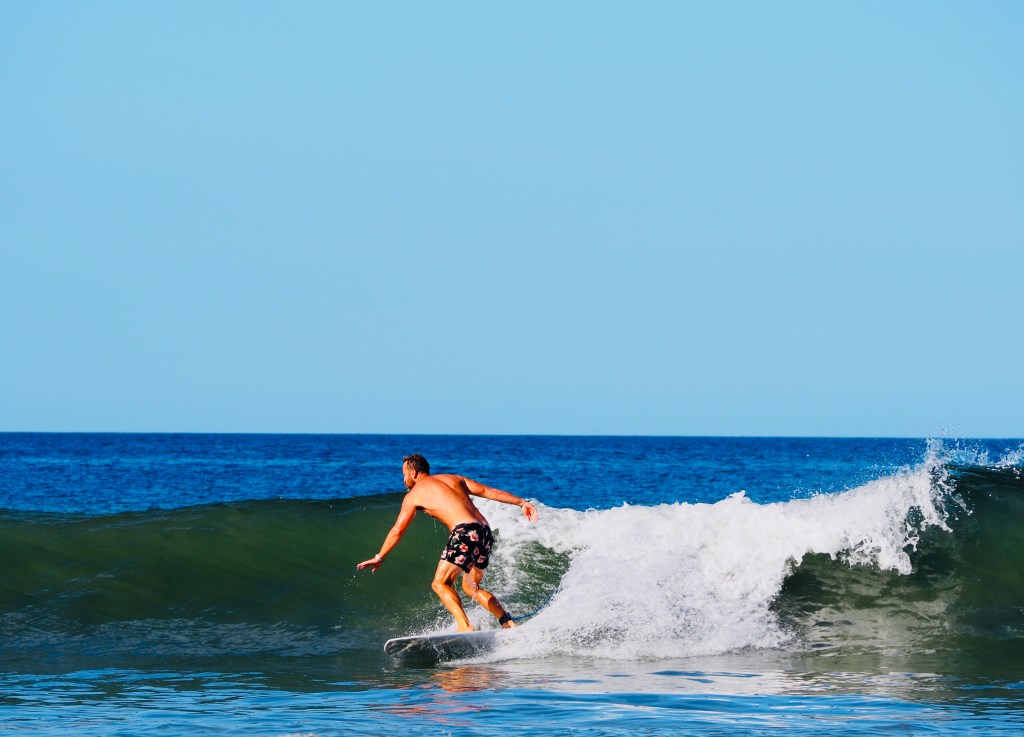
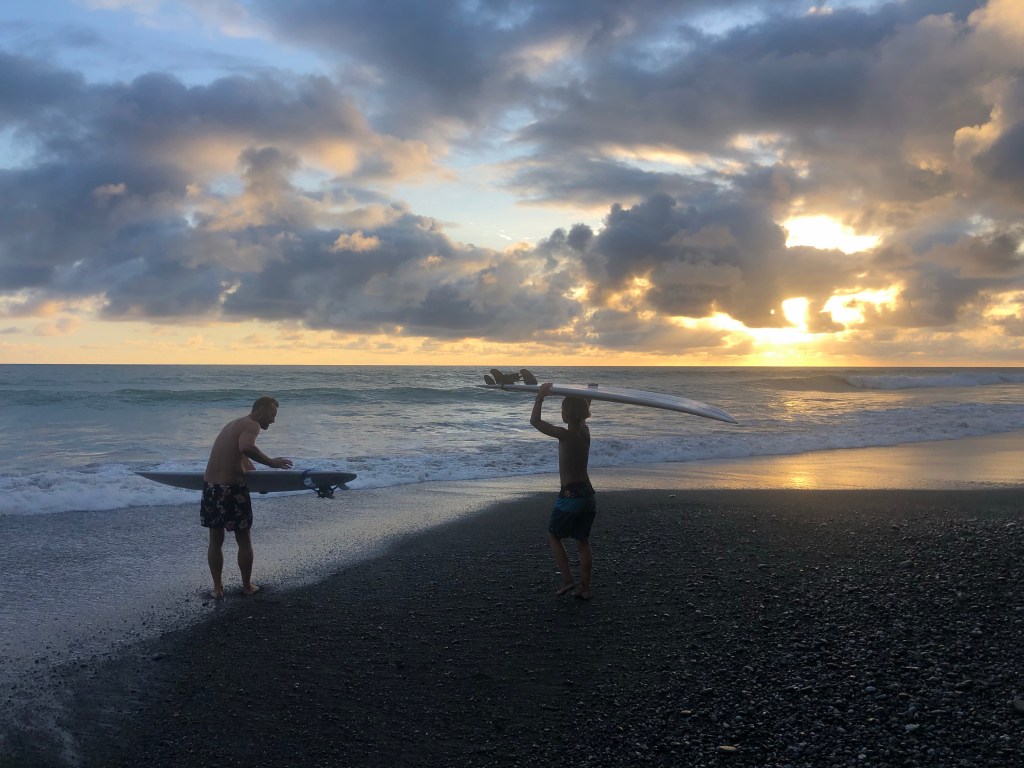
False Start #3. America

We were moving to New York! We knew the drill pretty well by this time, the order of things. We knew when to notify the schools (never), how to spot the psychos on the ex-pat forums (exclamation marks!), when to hand in Menna’s notice (last moment), how to sell it to the kids (‘listen, you’ve both heard about cowboys right?’).

We flew to New York as a family in Easter 2019. We met the relocation people and spent a couple of fairly depressing days looking around heinously expensive apartments in Brooklyn, creaky mansions in New Jersey, posh villages in Connecticut. We found the gushing realtors extremely irritating and had to reassure ourselves that many Americans weren’t like that. We dined out with all the company execs. I had the kids on best behaviour and looking angelic for dinner with my boss and his family, and I listened in awe while Menna spun a finely calibrated sob story about how she would be forced to leave her beloved career to move to the US, and tried to pump up the relocation package.

Guess what? After nearly a year of visa application delays (Trump!), this one fell through too. Shift of focus to Asia..[bleep]…maintain balance of executive team across key hubs…[static hiss]… investors want stability prior to transaction year…[click]… the general direction of overheads being inverse to desired trajectory… [system overloading] safeguarding P&L in a transaction phase… [error, CRASH, malfunction, death!]

This is when we started cooking something new. Screw the corporate relocation. Screw business generally. I needed to extricate myself from high-stress leadership positions that suck the hours out of your soul and then screw you like a wingnut. Menna needed to take a break from her all-consuming hospital work. We needed to spend more time together as a family and we needed to do it somewhere that wasn’t South London.

That’s when we hatched project Global Domination. We would simply quit our jobs, rent out our house and remove the kids from school. We would raid the rainy day fund. We would get primitive and nomadic for a year or so. Become masters of our own destiny again!

We would start in Capetown and then spend some months under canvas, off-roading our way up to Nairobi, where we had friends who would give us refuge. Then a boat across to Goa where we knew people who owned a yoga retreat. We would ride the railways up through India, trek the Himalayas in Nepal and work our way overland to South East Asia. After Thailand, Cambodia, Vietnam we would hit Australia, probably about nine months or so into the trip, and then stay there for a while crashing with all the people we knew out there before onwards to New Zealand, Japan, home…

(…or maybe not. Menna needed the reassurance of a well ordered itinerary and a clean endpoint. I liked the ambiguity of an open-ended trip that could conceivably go on for years. Decades even!)

The beauty of this plan was that we were totally in control of all the elements at last. There was no relocation schedule, no corporate investment, no sign-off from the board. We had no timelines or outside dependencies. Barring some major unseen disaster, nothing could go wrong. We booked our flights for Capetown on April 15th 2020.

It felt like just the right moment to do this. I could see some clouds on the horizon that didn’t look great for business – there had been some kind of virus coming out of Wuhan which looked like it might impact our China revenues for a month or two. It could make it harder to hit our targets next year.

It was time to get out. Time to fly!

False Start #2. Australia

We tried again a couple of years later. I had rolled through another couple of roles at this point, including a global position at a new firm which I had thought would cure my longstanding wanderlust. I left that business after a couple of years, having been made to ‘restructure’ my sales team deeply as part of a merger with our parent company (code for firing lots of people) and I was feeling pretty burned out. I restructured myself out last, like the Captain leaving a sinking ship right? Or the last drunk out of the dive bar. I thought I’d like a bit of a break from business.

At this point it felt like the right moment to dust of the old escape manual again. This time we had Australia in our sights. It would be an easy move. We had a gang of friends there, it was an English speaking country, their medical system was compatible with ours so Menna could find work. They had epic surf, great food, awesome wildlife and a healthy outdoors kind of vibe that felt like the antithesis of our urban life at this point.

The plan was contingent on Menna this time. She would be the breadwinner, inserting herself into some high powered paediatric role maybe in Melbourne Children’s Hospital. Visas would be thrown at us and I would ride along as the plus-one.

Maybe I would find work out there, but then again maybe I would not. I had long been nurturing a secret fantasy where I became a ostensibly a stay at home Dad, but used the hours of free time while the kids were at school to 1) secretly do a PhD and then make everyone call me Doc. 2) Set up a series of extremely low-effort but highly lucrative business which would pretty much run themselves. 3) Become fluent in Mandarin and various South East Asian dialects which I would learn via flirtatious chat with our attractive polyglot Filipina nanny. 4) Become an online chess hustler.

While I could see no obvious flaws to the plan, it unravelled nonetheless. We were undone this time by the twin forces of bureaucracy and boredom. The Australians wanted to stem the tide of disaffected doctors who were streaming off that rusting old aircraft carrier that is the NHS, and seeking a life of sunshine, reasonable hours and decent pay in the Southern Hemisphere. They had put in place several administrative hurdles that were guaranteed to delay any job application for at least a year. So we gritted our teeth and filed the paperwork needed to get Menna’s certificates and qualifications translated into the Australian vernacular.

In the meantime however I had got bored. A couple of months of ‘finding myself’ involved doing morning yoga with lots of old ladies at the David Lloyd, drinking kale smoothies and listening to podcasts on poetry. It was winter and no-one else wanted to play. Even the kids were absent most of the day at school before coming home to participate reluctantly in various elaborate projects I’d dreamed up in their absence.

After a few months of this I’d had enough of kicking around so I set up a company (Outlaw Strategy since you ask) and prepared to kick off the first of my low-effort high-reward side bets. A consulting business requires no upfront capital, no equipment and no assets other than an ability to look smart, weave a sharp story and use arcane business jargon proficiently. I have this in spades.

My first gig was a three month strategy project, advising a fast growing research firm on how to structure their commercial team. It was a fantastic company, well run and full of smart people who basically already had all the answers and were dying to tell you so. I travelled around all their offices, interviewing the troops and synthesising their wisdom. Stir it all up, sprinkle a few insights, some infographics, a gant chart or two and a pinch of business homilies, then prepare to ping over your invoice and ride off into the sunset. Consulting is the FUTURE I thought to myself.

Somehow they pulled a fast one on me though and before fully thinking it through, or even really getting Menna’s sign-off, I’d somehow accidentally signed a contract to become their Head of Sales. I was now on the hook to implement the convoluted strategy that I had cooked up, which, I now realised, was highly ambitious and overly elaborate. I had also committed myself and family to relocate to New York the next year.

Australia was off.

False Start #1. Africa

By 2015 we knew that we needed to wake up, unplug and take off again before it was too late. The trouble was that we were far too old and risk averse by now just to disappear for another year of bumming around, rinsing the credit cards and booking sofas for the crash landing. Do that with two kids in tow? That would be nuts. But once the notion of adventure gets into you, it lodges deep in your guts and gnaws at you like a parasite, until all you hear is the rain on the skylight, drumming out the word escape, over and over, as you lay awake in the night.

The safe option at this point seemed to be some kind of corporate escape, (I didn’t see the oxymoron lying like a bear trap in the grass). We would get my business to fund our adventures. So with a bit of manoeuvring I managed to insinuate myself into a new role as Head of Africa, spearheading an international expansion plan for my employer. The job would require our family to relocate to Johannesburg and then travel all over Sub-Saharan Africa setting up partnerships and channel networks. Menna wasn’t immediately sold on the idea of living behind barbed wire in what was, everyone delighted in telling us, one of the most dangerous and crime ridden cities in the world, but I mean, fuck it! We’re talking about Africa!

I took her on a carefully choreographed visit to see some of the premium gated communities out there, I showed her how we might live across the road from the condo where Oscar Pistorius gunned down his girlfriend. This wasn’t the selling point I had hoped.

We both found it hard to live with the idea of being locked away in a luxurious bubble with a certain narrow demographic, rather than being properly immersed in the local culture. It didn’t feel like real travel.

In the end I laid out a contorted proposition: yes, we would live fenced away in a affluent oasis with high-tech security and posh neighbours (horrifying), but down the road there would be a townships and shanty towns (fascinating), a highly diverse population and rich revolutionary culture (inspiring), Menna might work in one of the world’s largest children’s hospitals (galvanising), and only some hundreds of miles away there was the Okavango Delta, Zambesi river, Namibian salt plains, Victoria Falls and all of the forests and savannahs of Sub Saharan Africa (irresistible!).

The prospect of moving to Africa put a thousand volts through our humdrum commuter existence. Quitting jobs, saying goodbyes, opening up tentative friendships on the expat forums, telling making travel plans and packing lists, contacting storage companies, pulling the kids out of school, looking for tenants. I was shuttling back and forth to Johannesburg laying the groundwork, interviewing people, giving rousing speeches in the local office about how bright the future looked.

Shame the whole thing fell through.

We found out barely a month before our departure. The oil price crash of late 2014 hit my company hard (in credibility as much as anything – we had world famous oil economists and forecasters who had totally not seen this coming) and most of our revenues in Africa were derived from exploration projects which subsequently dried up. The Rand devalued massively which screwed all the project forecasts. Furthermore there was a big merger going on behind the scenes. It was the kind of thing that happens in public listed companies ,where disturbances in the macro environment impact revenues, the share price dips, board members panic, risk aversion rockets, investments are cancelled and all the implications of this flow mechanically downstream. The pieces on the board get rearranged, doors open and shut, lives are reoriented, escape routes get blocked.

Some Context

I should probably explain how this all came to pass.

We are perennial escapologists, Menna and I. We met some sixteen years ago, at a point when I was already deeply committed to an escape plan. I had had enough of my unfulfilling tech sales job, I needed to get away from an unhealthily hedonistic social life and mostly I wanted to quieten the various internal voices who muttered about the slippage of time and the death of ambition.

The plan was simple: 1) I would tone down the partying quite considerably 2) I would destroy my sales targets and get a serious bonus, 3) I would then give work the old two finger salute, jack everything in and fly off to Costa Rica. 4) I would spend a year alone, living an ascetic life in a place somewhere where the rainforest met the water, surfing, meditating and writing a novel which would probably change the course of modern literature.

There was only one snag to this otherwise flawless plan, and Menna was it. We collided in a nightclub one Friday evening (a relapse) and before long she was entwined around my life like ivy round a drainpipe. I hadn’t intended to get romantically involved with anyone at this point. I certainly hadn’t intended to fall in love. It was a serious spanner in the works.

I remember 2004 as a highly intense year. I was planning a twelve month solo mission, I was working long hours, chasing an elusive bonus which I needed to fund the project, and all the while submerging deeper and deeper into a new relationship. An explosive relationship at that, with wild surges and retractions, always dancing around our commitments, my future departure unspoken but present between us like a doleful prophesy. In the end I conceded. One night in Paris, in a restaurant somewhere in the Latin Quarter, I took the plunge and asked Menna to come with me. She told me she had already bought tickets.

And so it happened. We escaped together, barely knowing each other really.

I never managed to write the epoch-defining novel. It turned out that Costa Rica had a surf culture which was even more consuming than the scene we had escaped in London. We had no jobs, no itinerary, no deadlines, but we had a Jeep and we had surfboards and this was all we needed. We probably fell too much in love with the idea of chasing storms and adventures. We wandered barefoot through Central America following waves and winds and any roads that would take us away from reality.

I look back at it now and it all has a dreamlike feel. The memories are sun-bleached and faded like over-exposed photos; the throbbing reggaeton soundtrack has been softened by time. I can see a collage of gradated forest landscapes fading into mist; filaments of sunlight deep in glass-green waves. I remember eating fresh-caught tuna with lime and chilli, drinking cold beers, making huge bonfires on the beach. Howler monkeys screamed at us in the night. Menna giggled at some now-forgotten joke, as we floated drunkenly on our backs in phosphorescence.

We didn’t see another human for two wild weeks on a hidden beach in Nicaragua, but we shared our shack with tarantulas and tree frogs. I got to feel the cold squirm of a stingray under my foot in the shallows, the burn of a jellyfish tentacle across my back; I knew the smell of mangoes rotting in the sun. I lent my surfboard to a ragged kid in El Salvador to use in a contest and watched as he carved crazy lines which I could never dare dream of copying. We arrived by boat into a Panamanian island archipelago, late at night, and we saw it glitter and recede on the water like a mirage, like the afterglow of a firework.

We are the vientos de poniente that rise on the sea; we are dustballs rolling on the Mexican highway. A wave forms and grows and we are flotsam on its crest. It breaks in thunder and spray, leaving some of the foamy residue to seep into the pools of memory, while the rest is pulled in riptides back out to sea. Somewhere in the Nicaraguan badlands I crashed our Jeep into a truck, and I can still see Menna perched bravely on the crumpled bonnet, clutching a machete as she guards all of our worldly possessions. Her face fades into darkness as I walk off down the road to get help.

It was one of the most surreal and epic years imaginable. It turned us into quite different people.

Our plan in 2006 was to return home when the money ran out (check), sofa surf until we could get jobs and our own place (check), and then save up enough to move swiftly onwards to New Zealand or Argentina for the next big escape (fail).

I can only assume someone slipped something into our drinks, because we woke up ten years later, married, with two children, a cat and a mortgage, living deep in suburbia. I had a career in sales leadership and Menna was a senior doctor, holding down several important-sounding posts in a large hospital. We were numb, institutionalised and fully wired back into the system. I found myself driving an German SUV – even though we lived in South London where the closest thing to a mountain was the ramp onto the South Circular. Our beloved surfboards caught only dust and shadows in our garage, gradually sinking under a pile of junk. They looked reproachfully at me whenever they caught my eye.

I know the skies exploding with lightning, and waterspouts

And the surf and the currents; I know the dusk,

The dawn, exalted as a population of doves

And at times I have seen all that man believed he saw!

Arthur Rimbaud. 1871.

The Devonian Era

We arrived once night had fallen.

We had made a strategic stop for fish and chips on the beach at the next town down the coast, ostensibly to stretch our legs and give the kids a run on the dunes, but really to wait for sunset so we could sneak into our new accommodation undetected. We had felt self-conscious enough driving across country during lockdown. Non-essential travel was strictly vetoed, and nothing about our car, loaded as it was with surfboards, luggage and bikes, indicated that this journey was in any way essential.

(“It is essential though isn’t it, right?” we reassured each other periodically).

The roads had been impressively empty throughout the five hour journey. I had known that a police cavalcade could materialise at any moment and I was mentally committed to the high speed chase, screeching off the motorway to fish-tail our way down miles of dirt roads (those poorly-fastened bikes would come cartwheeling off around a bend and take out at least two of the pursuing patrol cars), along to the inevitable finale where cornered and desperate, I would be forced to drive the car off the Dorset cliffs into a technicolour sunset, with Camilla Caballo playing full volume on the radio.

I hadn’t fully gone through this plan with the family, but I felt they would be supportive. It didn’t come to pass though, and as we pulled up to pick up our pre-ordered takeaway, I felt kind of disappointed. Where was the challenge? The confrontation? The clever wordplay with the forces of the law? (“Well, why don’t you define ‘essential’ to me officer? I believe it derives from the Latin essentia meaning the essence of the thing. Well, stick your nose in here officer and smell my essence of musk car freshener! Yes, thank you. We will be on our way”) It almost felt like the journey had been too easy, like we had been lured into a trap.
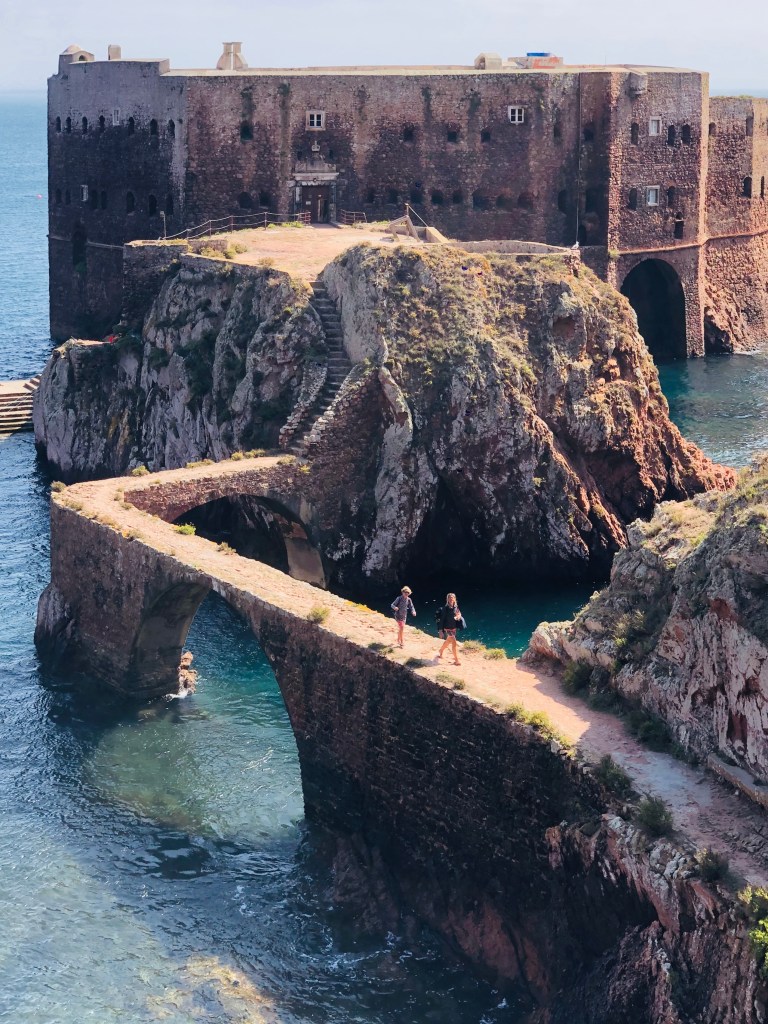
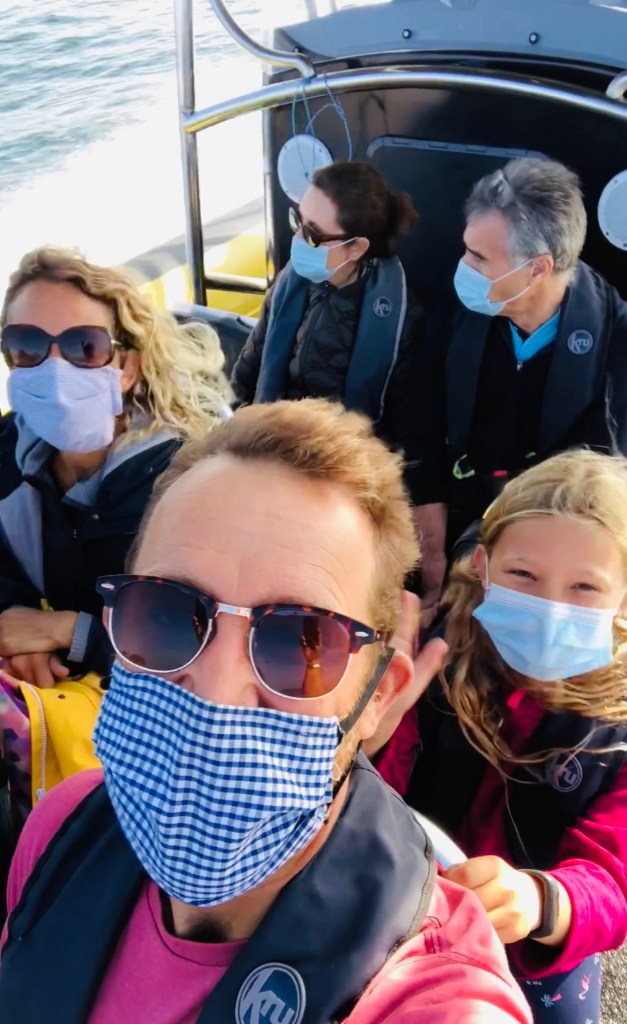
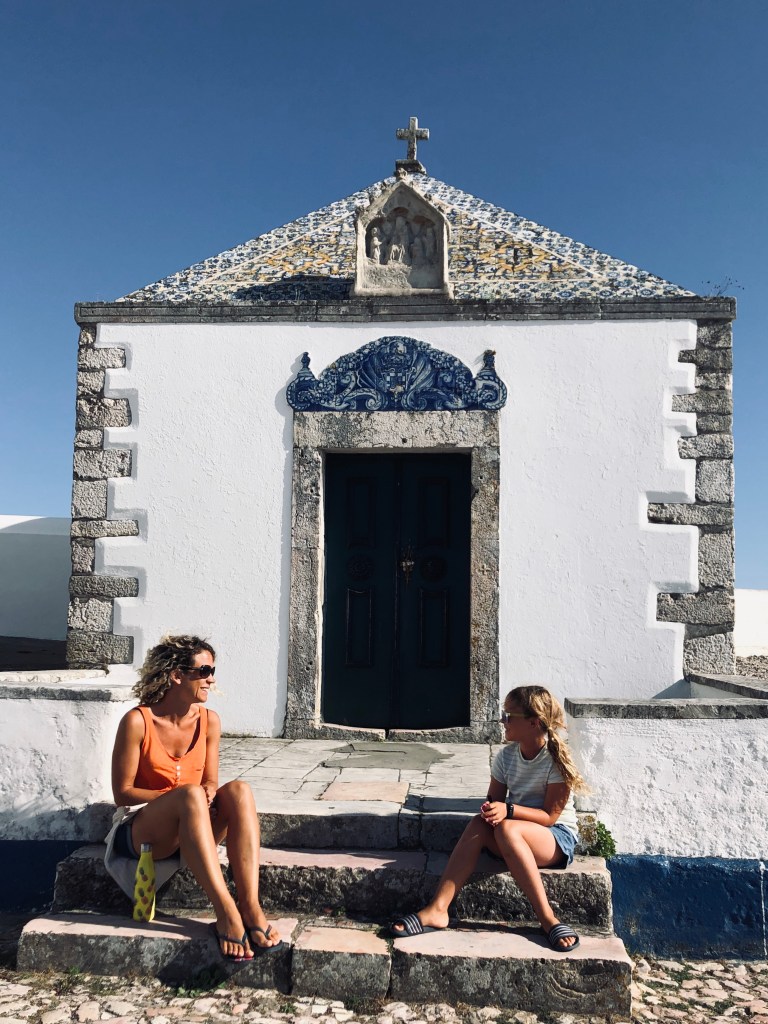
This is just the start though, I told myself grimly. We would certainly face a difficult reception in the little Devon town that was to be our first stop. Up until this point, our destination had been completely untainted by the mark of corona, and so they would inevitably be resistant to strangers from the big city, potentially bearing plague and notions of an integrated European market.

I knew pretty broadly how this script would play. We’ve all seen the movies. It would start fairly subtly, perhaps a slight turn away whenever we met anyone on the street, maybe a refusal to meet my eye as I piped out a cheery good morning to a cloaked fellow walker in the mist. Conversation at the Post Office would suddenly halt as we walked up, and the participants would disperse silently in different directions. The door would bang shut and the sign flip over to ‘Back Soon!’ In handwritten gothic script, the cheery exclamation mark giving just enough encouragement to sustain a two hour wait in the drizzle before we would finally give up and go home. The Post Office would be the only source of food in the village of course, so we would be forced to live off chewing gum, wasabi peas and that melted box of Celebrations for the first few days before we could get an Ocado slot.

We would decide to ignore the provocations though and keep on making friendly overtures, still believing that we could overcome the hostility with dignity and good nature. That’s the Nicholls for you.

By the second week it would become apparent that this strategy wasn’t going to work. The locals would start crossing themselves as we came into view. I would be barged off my surfboard in the line-up by a man whose features would be hidden by a black neoprene hood. One morning we would awake to find dead seagulls had been hung from our car wing mirrors. We would find strange wicker tokens placed in the recycling bins outside. The wind would reveal crude desecrated likenesses of ourselves, made of driftwood and whalebone, half-buried in the sand dunes behind the beach. Arthur would go down to the local skatepark and return covered in tar, with a mess of feathers and crisp wrappers stuck to his head. He wouldn’t ever speak about what had happened.

It would be when they broke into our house in the early hours, masked and carrying flaming torches, to put a noose around my neck that I would finally have had enough.
“My wife is a fucking key worker!” I would shout, “She’s NHS for Christ’s sake, a doctor. Front line!”
The chanting would stop.
“Hospital or GP?” Would come a cautious voice.
“Hospital! She saves lives man. Now we’re homeless. We’re supposed to be travelling around the world but it’s all fallen through because of the virus. We’ve got nowhere else to go. We should be in Cape Town doing a wine tour in the Garden valley or a shark dive or something. But this… this… this is all we have now.” I would be sobbing pretty hard at this point.
“Hear that lads? We’ve got a bloody doctor in town! God save the NHS! Sorry mate, thought you were second homers, just down for half term like. We’ll tidy up after ourselves shall we?”

That was what we expected.

So once we had got to our new home, unloaded the car in the darkness, quickly swallowed a bottle of Cabernet Sauvignon, then found the oblivion of sleep for a few hours, I wasn’t surprise to hear a heavy knock on the door at 8am. I arose to meet the lynch mob in my boxer shorts, my hair defiantly un-styled.

It turned out to be the police. Or rather, a policeman. A fresh-faced honest-looking lad of a copper with straw coloured hair. The sun shone brightly behind him.
“I have been led to understand that this isn’t your primary residence,” he offered by way of an opening gambit.
I took a measured breath.
“My wife, officer, is a key worker…”

The Great Escape

We have attempted an escape, despite it all.

We have emptied our house of clutter, history and mess. We have repainted the walls to erase our scuffs and marks; mowed the lawn to soften the yellow rings left by Arthur’s tent; regrouted the bathroom where the kids swamped the bath nightly.

We have unstuck the windows that we had accidentally painted shut, so now the air circulates differently through the hallways. We have dismantled the pile of equipment, tools, kites and kit so that our adventure junkyard is just a garage again: swept, sad and empty except for a few mysterious contraptions hiding among the cobwebs in the eaves.

Art, books and beds have all been sent into storage. Crates of food got boxed and banked. Jars of out-of-date pickles, mustards and chilli sauces had to be emptied in the sink and their lumpy contents finger-forced down the plug hole.

We have given away and thrown away literally thousands of toys, gadgets, tools, utensils, cords, containers, magazines, cushions, chairs, games and a whole lifetime supply of pens. Most stuff ended up on the pavement outside for passers-by to pick up. An amazing amount of random items went that way, most of it under cover of darkness.

You get a kind of embarrassed feeling as all the clutter of your life lines up on the pavement outside, like a public confession of your Amazon addictions. You realise just how much unnecessary crap you accumulate without thinking and you make serious promises to quit buying so much rubbish and get more eco. The future lives we will lead will be barefoot in the sunshine with no need for material goods. Even as our possessions disappeared silently away into the community we were jabbing at our phones, ordering more things online for next-day delivery. We needed a roof rack, a spare set of bungee cords, more bin bags, a battery pack, cables. We ignored the irony, deferred our good intentions and clicked through to checkout.

We have made some effort to throw out too all the opinions and advice that have been gifted to us over the last few months. The protests, amusement and disbelief. The raised eyebrows, looks of horror, guffaws (You’re going travelling? In the middle of an pandemic?) We’ve dealt with our own fears and misgivings. At least I think we have, though to be honest we’ve talked things around in so many circles now, I have no idea what is going on in everyone’s head. How much are the kids aware of what is coming up? They understand we’re no longer headed for Africa, or Australia, but driving instead to South West Britain for an indeterminate period until better options present themselves.

Do they lie awake worrying about what this means? Is Menna really as on board with this crazy plan as she says she is? Am I? There comes a point though when you are simply committed, and speculation and worry is no longer helpful. We stopped talking about the future some days ago, and now conversation is tight and practical.

We burnt all of our confidential papers in a steel dustbin behind the garage one evening last week. Bank statements, bills, payslips, reviews, reports and appraisals went up in smoke as we sat around on camping chairs, listening to old rock n roll. I was chugging beer and poking the flames, all bare-chested, soot-smudged and channeling some fairly primitive vibes. We went a bit nuts that night. It felt heavy and symbolic, like we were burning our longboats on the beach in a flamboyant gesture of no return. Even the kids ran off to get their old school work to throw on the flames. There was some nostalgia in the air too; as though a part of our history and identity were somehow encoded into that P45 from when I got fired in 2002, the insurance policy from that trip to Bali.

I manage to save my birth certificate at the last moment. I didn’t get to my GSCE certificates in time.

And then it was all over, all traces of ourselves removed from the property. We had vacuumed up all the scatter of our lives and condensed everything we needed down to one heavily laden car. Two surfboards on the roof, two bikes, two skateboards, one tent. A bag each of clothes. A bag of wetsuits and towels. Another bag of wires and chargers. A box of games. A box of school books. Two yoga mats. One laptop, three iPads, two Kindles, three phones. A first aid kit. Assorted soft toys. Some Lego.

I was grinning with what I could tell was a slightly manic air as we pulled off. The moment seemed hugely significant. I could feel a release of tension surging through my shoulders and arms, the physical aftermath of many days of non-stop packing, sorting, shifting, burning, dumping, heavy-lifting, and very little sleep. Menna was sobbing quietly beside me, mainly I think about the cat, who we had had to leave behind with our neighbour. Two pairs of wide eyes stared back at me in the rearview mirror, ecstatic at first glance, then worried and shell-shocked.

We drove off from our home of the last seven years and away from our jobs, our schools, our friends, our nicely ordered well-structured lives. It was 2:30pm and the sun was technically past it’s zenith, so I think you could legitimately say we drove off into the sunset. We headed off into the Covid-ravaged wastelands of lockdown Britain, homeless, jobless, and with no particular plan to speak of.
“It’s going to be fun” I kept saying to no one in particular. “It’s going to be such fun.

An hour or so later the mood had shifted considerably. The car was full of chatter and sunbeams as we trundled our way southwards down empty roads. Anything could happen! Drawn by ley lines and wild pagan impulses we swung off the A303 for an impromptu stop at Stonehenge, but it was cordoned off with red and white tape.

Freedom is just another word for nothin’ left to lose.
Nothin’ ain’t worth nothin’, but it’s free.

Kris Kristofferson