Blood Sports

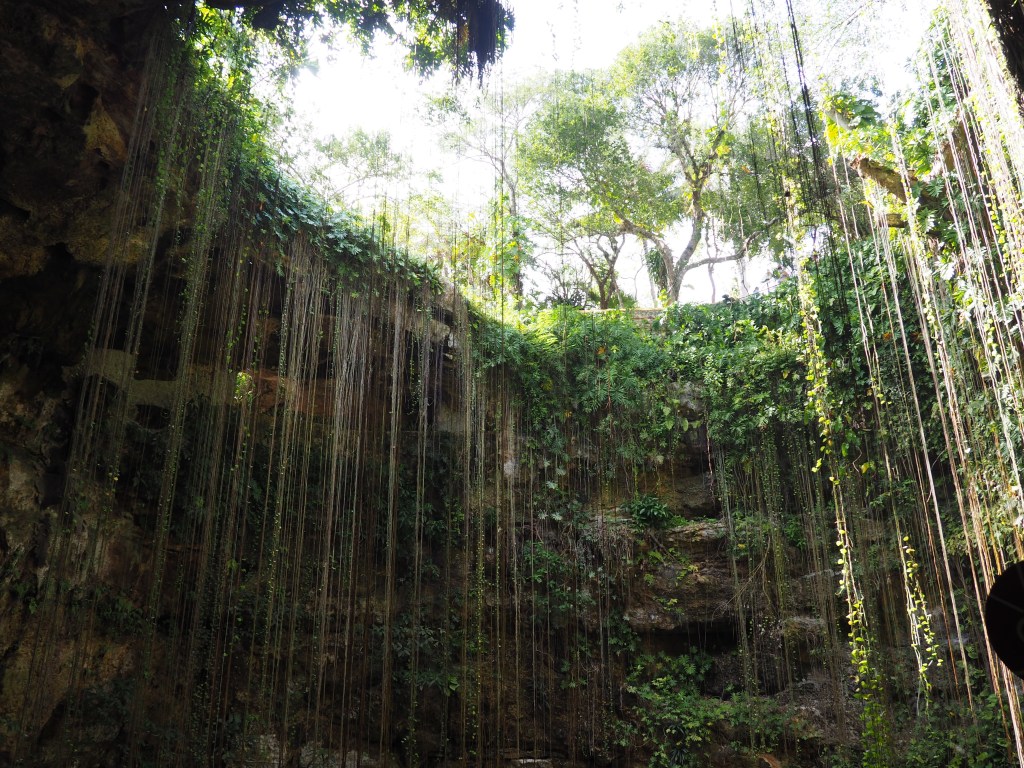
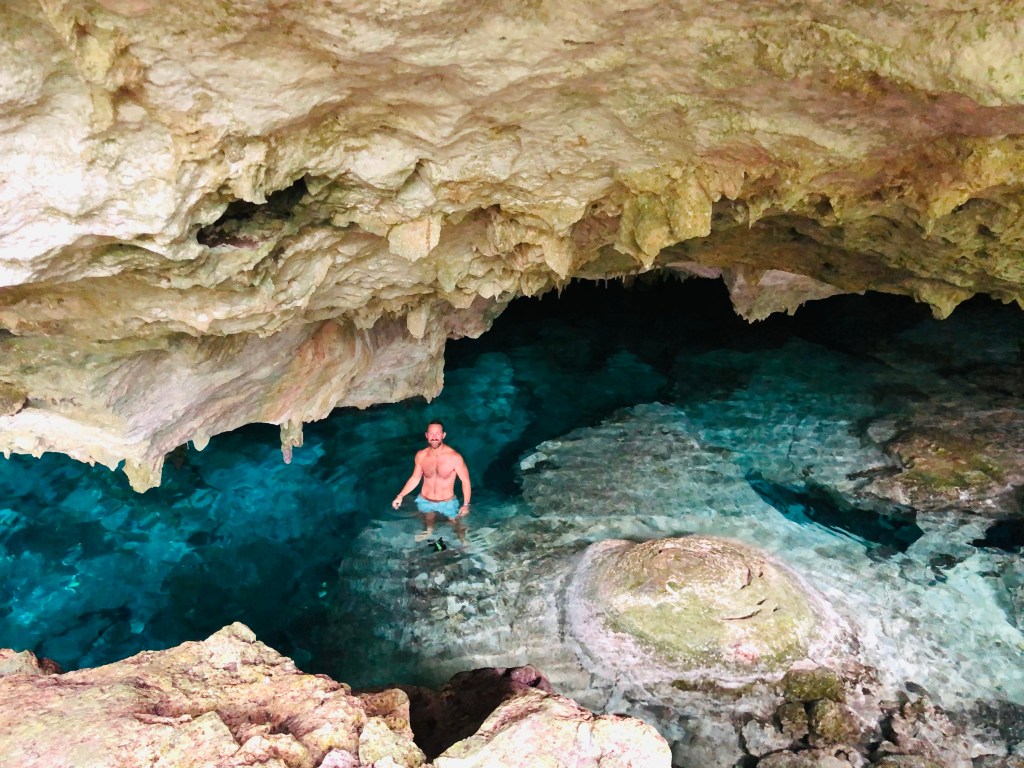
We go on a tour round some jungle cenotes and it’s ok, a good way to spend an afternoon, get out of the heat of the day. We’re a bit spoiled and world-weary now though and the murky pools here in the Dominican Republic feel rather provincial compared to the crystal clear channels to the underworld that we saw in Mexico. Our guide is charming and enthusiastic so the kids try to be polite and ask lots of questions, but I know they aren’t impressed.

Better than the cenotes though are the ruins of an ancient stone citadel that we come across out in the jungle. There are arches and walls, old lamp holdings, stone steps, a raised pyramidal dais choked by lianas. You can make out skulls and snakes carved into the stonework. It is a big site.
“Is it an ancient temple?” we ask our guide.
“Who even were the indigenous civilizations here?” Menna asks me in a whisper, but I have no answer.
“No hombre! This was once the biggest nightclub on the island. All outdoors.The bar area here, the DJ up there, none of these trees and vines were here back then. There was some rich American owner, only he ran out of money, or he didn’t pay off the government or he got shot or something.” He makes a double finger gunshot gesture at Arthur’s head, “So anyhow it all got shut down. Only the monkeys party here now.”

We trek on, see some caves and stalactites, swim in underground pools, try a rock jump or two.
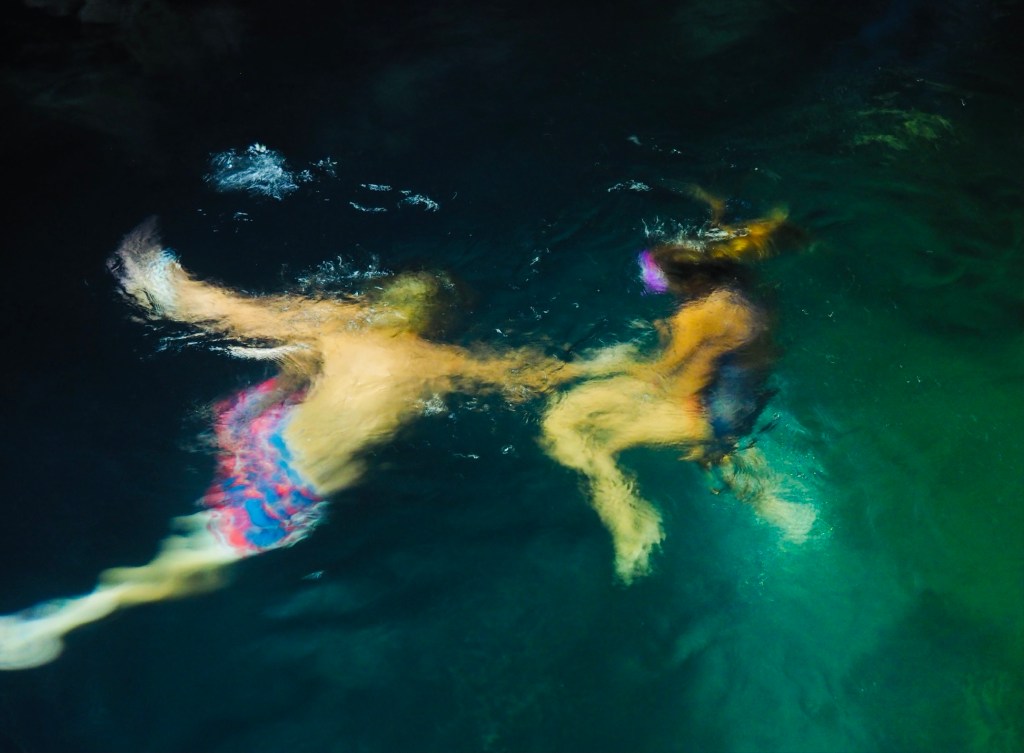
A couple of hours later we are all finished, sticky and mosquito bitten. We tip the guide, tell him it was awesome, then head homewards feeling weary.

As we walk home along the dust road that runs through the slum end of town, we pass a play park – hard earth floor, some rusting goal posts, a muddy ditch along one side. There’s a crowd gathered there maybe thirty or forty strong, shouting and seething, mainly kids, though there are some young bucks strutting round bare chested, shouting orders, bossing it. There’s money exchanging hands, fast betting, lots of cheering. We edge into the crowd for a look.
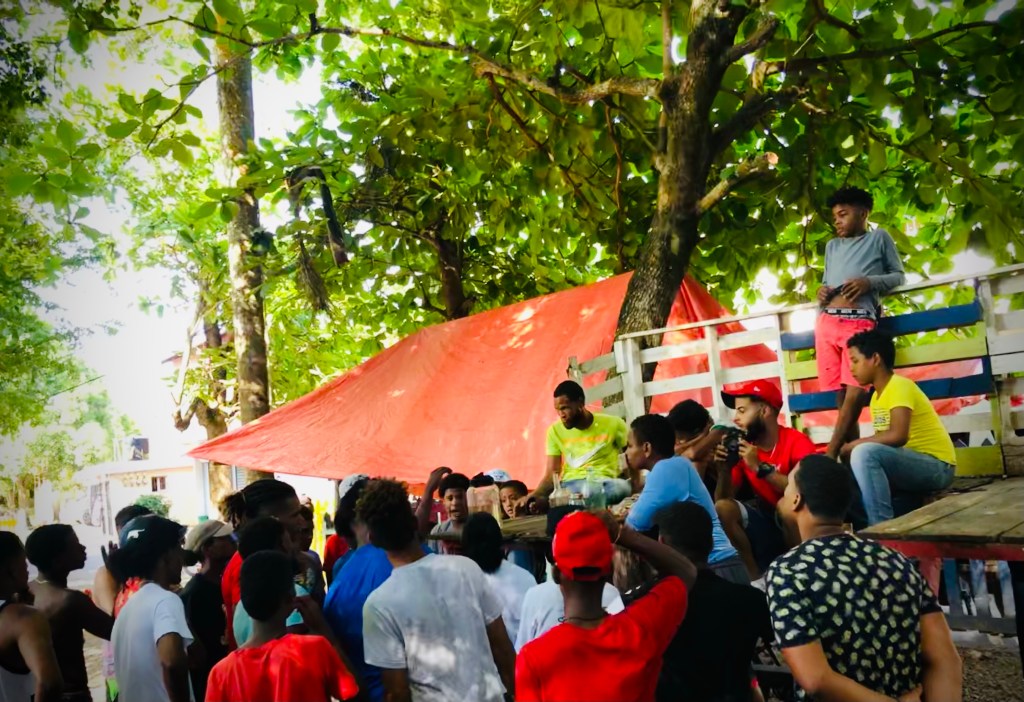
Up on an raised platform that looks like some defunct climbing frame there are various glass jars, kids squatting and hanging on the wooden framework all round. The action is all going on around the largest of the jars where there are swirls of motion, red and orange fronds uncurling like silk banners in the water.

“Siamese fighting fish my friend,” one of the lads answers my question. “Ten pays you fifteen dollar against red. Him de champion.” The fish circle each other with flowing fins, nipping, darting and harrying one another, puffing up then closing tight. And in moments it is all over. Orange turns belly up, then motionless he flutters down to the bottom of the tank like an autumn leaf. Red is champion again.

“Brutal!” I mutter in horrified admiration, wondering if this is suitable for my kids.

But now there is a change of focus. The noise has moved and intensified. Kids swing down from the climbing frame bars, the congregation swarms away to reform in a different part of the playground. Some kind of chanting and clapping breaks out. We are pulled over, helpless to resist the magnetism of a crowd baying for blood.

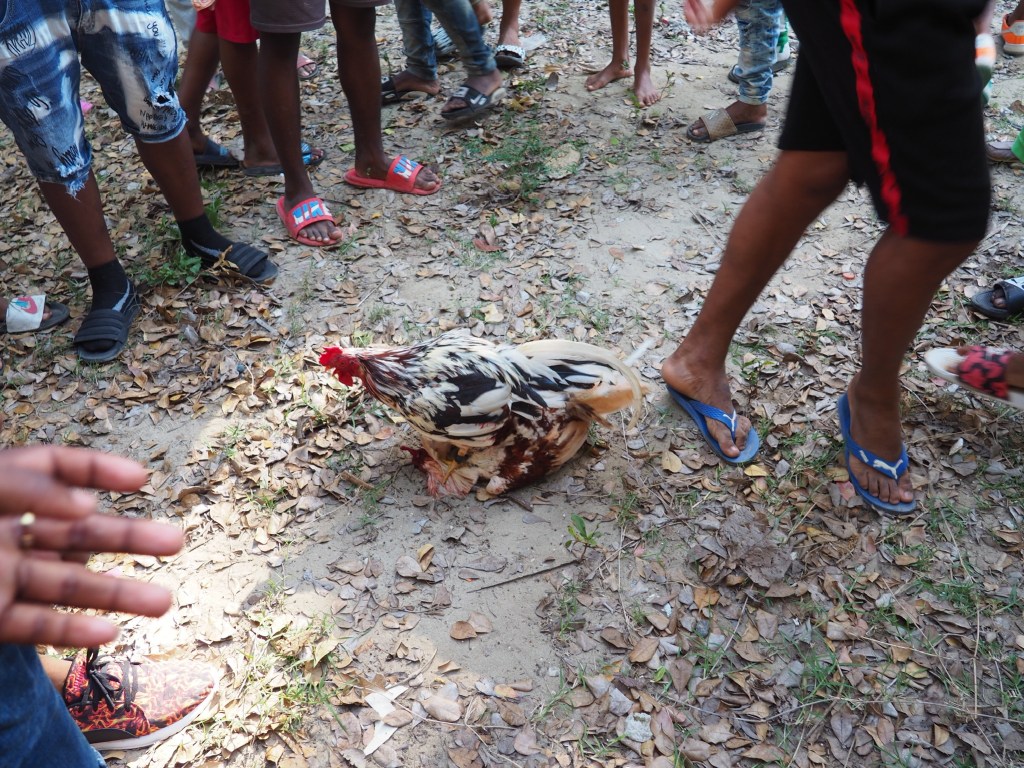
A circle has formed around two lads who seem to be doing some kind of dance around each other. They’re going to fight, I think. It’s a bare knuckle boxing match! I grip Matilda’s hand tightly not sure whether to pull her away. But there’s something about how the boys are moving, their hands are down but I can’t see why. There is a wall of brown backs clustered tightly around them. Then the ring of bodies parts to give one of the fighters more space and I see that he has a feathery package nestled under his arm. Then I understand: this is a cockfight.

The lads hold their roosters tightly, a head in their hand, the body under the armpit. They dance around each other, drawing close and then pulling away, allowing each bird to see and smell it’s opponent. The crowd are chanting and screaming. Some guy keeps pulling at me and waving a fistful of dollar bills. He wants me to bet on the match, but I have no idea of the names and strengths of the birds, how the book works. I can’t understand what he is saying. I shake my head at him, shake his hand off my arm.

Then the birds are released onto the floor and it is like an explosion. Small leaps and whirls, wings flapping like fans, pecking dives, claws flashing crescent arcs, glittering strangely in the sunlight. The movements are frenetic but also mechanical in their persistence, it is like two furious wind-up toys have been released. In less than a minute one bird is on top of the other and has its claws locked into the soft shoulders below and now he is raining down vicious pecks onto the exploded neck and head. The cock beneath staggers and sinks down, trying to twist away but it is impossible. The crowd roars. The cockrel screams. We have a winner.
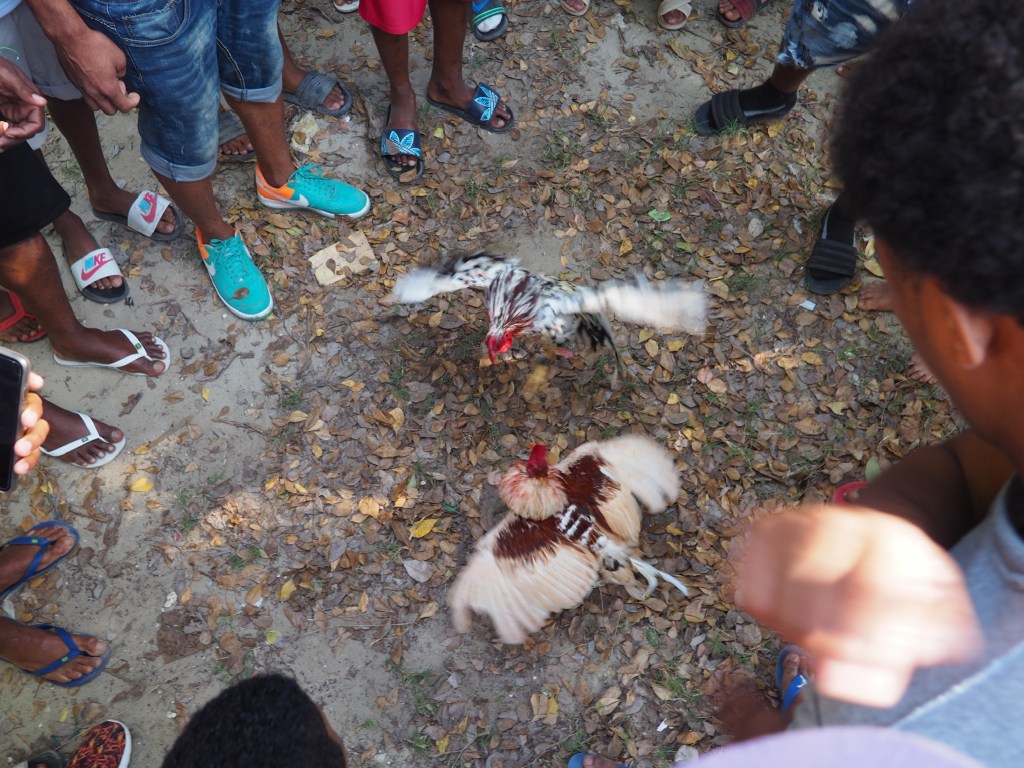
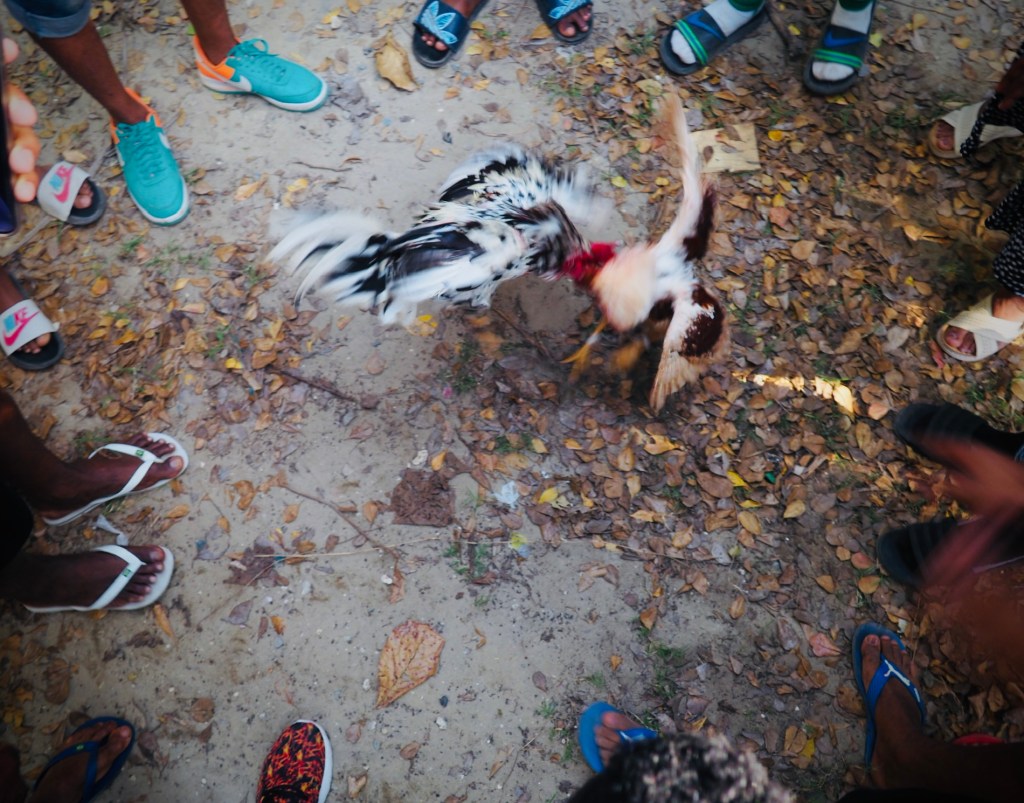
One lad picks up the victorious cockerel and holds him up high. He shouts something and there are cheers. The winning bets are payed out. The other cock is picked up by his owner, inspected, then he is tossed back into the dust. The winner is placed upon him and he attacks the lifeless body at his feet pecking savagely, releasing a spray of blood with a twist of his head. Matilda squeals by my side.

I come back to reality and look down with concern at my daughter.
“Are you ok sweetheart? I don’t think you should have seen that.” She looks up at me and grins, her little eyes sparkling with excitement and bloodlust. Red cockerel blood is splattered across her cheeks.
“Will they do another fight Daddy do you think? Can we stay? Please!”

I did not think I was that kind of person: another voice yelling for blood, another face craning to see the kill.

Charles Nicholl. A Cock Fight. Granta
 

Into The Underworld

Tak Be Ha is one of many windows into the land of the dead. From here we may enter the first of the nine layers that make up Xibalba, the ‘place of fear’, the Mayan realm of the underworld.

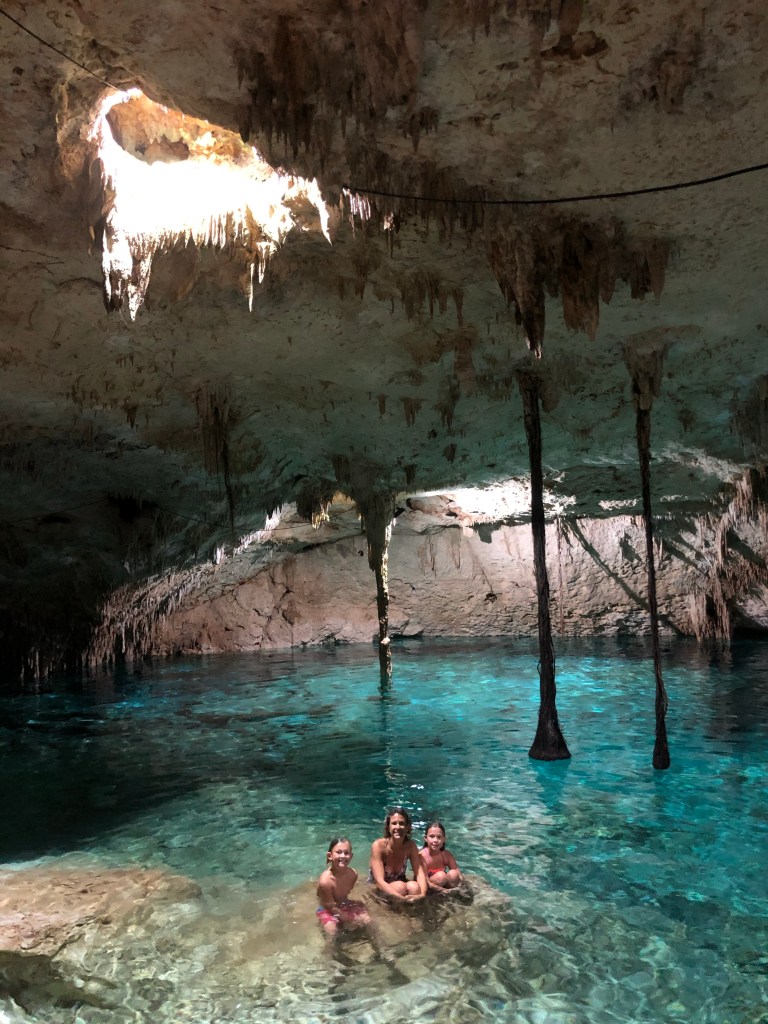
We climb down through a narrow opening in the ground and find a wooden ladder in the subterranean gloom. After the heat and dust of Mexican midday, the cool darkness is a shock, we shiver away on a rocky platform. Then we must submerge ourselves into the cold clear waters below, sinking down under the surface, ritually dying.

From above the water looks flat and still, a milky azure, shimmering gently in the darkness of the cave. Once we dive under the surface though a dramatic jagged landscape of underwater mountains and crevasses suddenly appears. There are stalagmites and columns lit up by hidden phosphorous lights. Deep ravines fade into midnight black far below us. The underwater world here is far wider and more expansive than the size of the cave above should allow. The limestone walls slope far away beyond the upper chamber and they seem to go down for ever. But beware! If you explore too far outwards you can’t surface for air – the roof traps you underwater. Spectral wraiths slither out from caves far below us in the darkness, lit up by underwater lanterns. We think they are scuba divers silently exploring the deeps, but who knows?

Tak Be Ha: syncopated hard syllables that evoke a brutal ancient language, Tak, a chopping sound. Bay, the exhale cut short. Haaa, a whispering sigh as the soul is released. There would have been sacrifices here without a doubt. There must be bones, daggers, gold, ceremonial masks lying undisturbed down in those dark crevasses, but we are only equipped with snorkels and goggles, so we float on top of the world of the dead. Our time has not come. We will not journey to the deeper layers.

This is one of many freshwater sinkholes in this part of the world – one of thousands even. Some are as large as lakes and open to the skies while others are just holes in the vegetation, narrow shafts with subterranean chambers branching out from them. There is no standing or running water on the surface of the Yucatan peninsula, no rivers or lakes, instead rain has dissolved away the limestone over centuries, and the water table permeates below the surface in underground chambers and channels that riddle the bedrock.

The Mayans named these cenotes, ‘sacred wells’. They were not just a vital source of water but a crossroads between the worlds of living and dead. Here at the gateway to the spirit world Mayans could communicate with their gods, perform religious ceremonies, carry out burials and conduct sacrifices.

We have already visited Cenote Azul, a pleasant system of outdoor swimming holes, rock jumps and picnic spots where fish nibble your toes as you dangle them in the water. It was well-run and the entrance fee was reasonable. We saw none of the gods amid the nicely maintained wooden walkways and recycle points but that doesn’t mean they weren’t there. Tak Be Ha is a very different experience though. We have to find our inner Indiana Jones as we enter. The underwater landscape is scary but spectacular and for hours we flap our way through underwater caves and limestone labyrinths, Matilda’s little white legs writhing like underwater snakes ahead of me in the turquoise gloom.

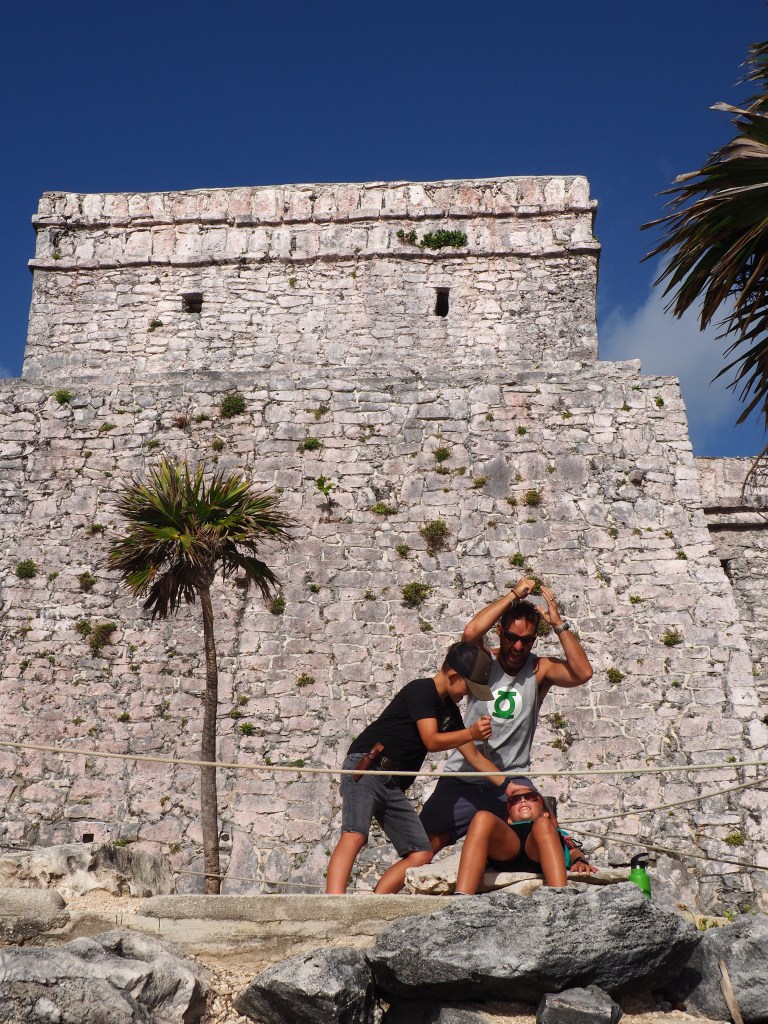
We are very into Mayan mythology at the moment. We have already ritually sacrificed Matilda on a stone altar to Ix Chil, the moon goddess. This was high on the cliffs in the Mayan ruins that overlook Tulum, the city we call home this week. Now I am wondering if we need to make another offering to Yum Cimil, the Lord of Death, down in this subterranean cave. Arthur would be the obvious choice.

In the end we risk the gods’ displeasure and return to Tulum with a full car, even squeezing in three hitch hikers, for somehow Avis has sent us off with a minibus instead of the SUV we ordered.

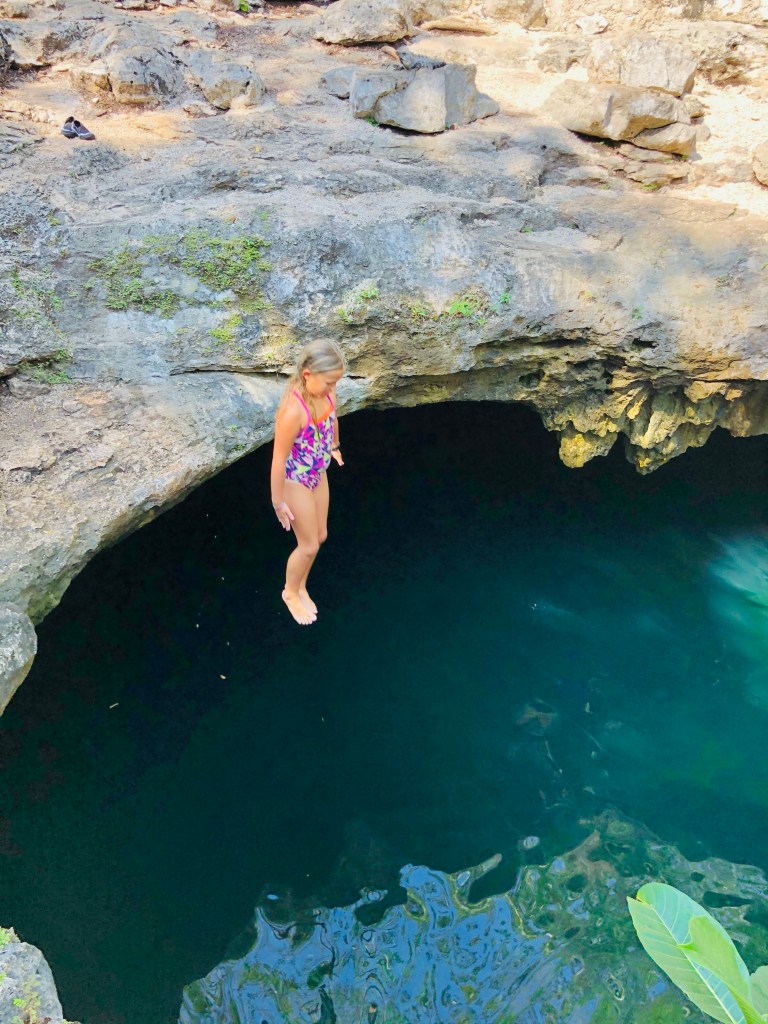
We are enchanted by the magic of the underworld though – silent, cavernous, cool and blue, a sanctuary away from the heat, dust and searing light up on the surface – and so we end up seeking out a second cenote in the afternoon. Cenote Calavera is a single bat-filled cave sitting in a stretch of jungle just outside Tulum. To enter the cavern one must jump through one of three holes in the ground and plummet down into the water below. The drop is about five meters. It is a leap into the dark in the truest sense.

It takes Matilda a long time to pluck up the courage to do this, but once she is initiated, the magnetic lure of the deep is established. She and Arthur spend the whole afternoon throwing themselves into the fathomless waters time and time again, trying ever wilder jumps and dives.

There is a hysterical American lady who takes on the role of sacrificial victim. She spends half an hour hesitating, moaning, unable to pluck up the courage to jump (“Um gonna do it! Um gonna do it! Oh gawd, uh can’t!). Various onlookers scattered around are chanting and cheering her on. Roll back the centuries Oh Ixtab!

Matilda appears beside her to offer advice, an ephemeral spirit-guide in a pink swimming costume, showing how one might enter the dark waters of Xibalba with a neat pencil dive. She has become emissary to Camazotz the Mayan bat monster I think. I see it in her red rimmed eyes, those sharp little teeth, that insatiable yearning for blood.

It is a deep and mystical week we pass in Tulum. We are steeped in legends of bloodshed and sacrifice, of psychedelic gods and shamanic rituals. We visit the incredible Mayan ruins at Chichen Itza and sit before the great pyramid that was built in homage to Kulkukan the God of the Wind. Then onwards we go, to the nearby Cenote of Ik Kil, which is not wild and spiritual at all, but run like a soviet swimming pool complex. At its heart is a deep well shaft that has been reinforced by concrete walls where trailing creepers hang, so we feels like we are floating in a giant abandoned nuclear reactor.

We visit next day the cenote of the Dos Ojos, two pools each with a central island that is ringed with dark glittering water like kohl-stained tearful eyes. We commune with the dead one final time here and then we come back to the surface and walk away. We are done with cenotes.

We go back for a last night out in Tulum before we move onwards. Menna and I flirt with Acan, the Mayan god of intoxication.