We Are Sailing

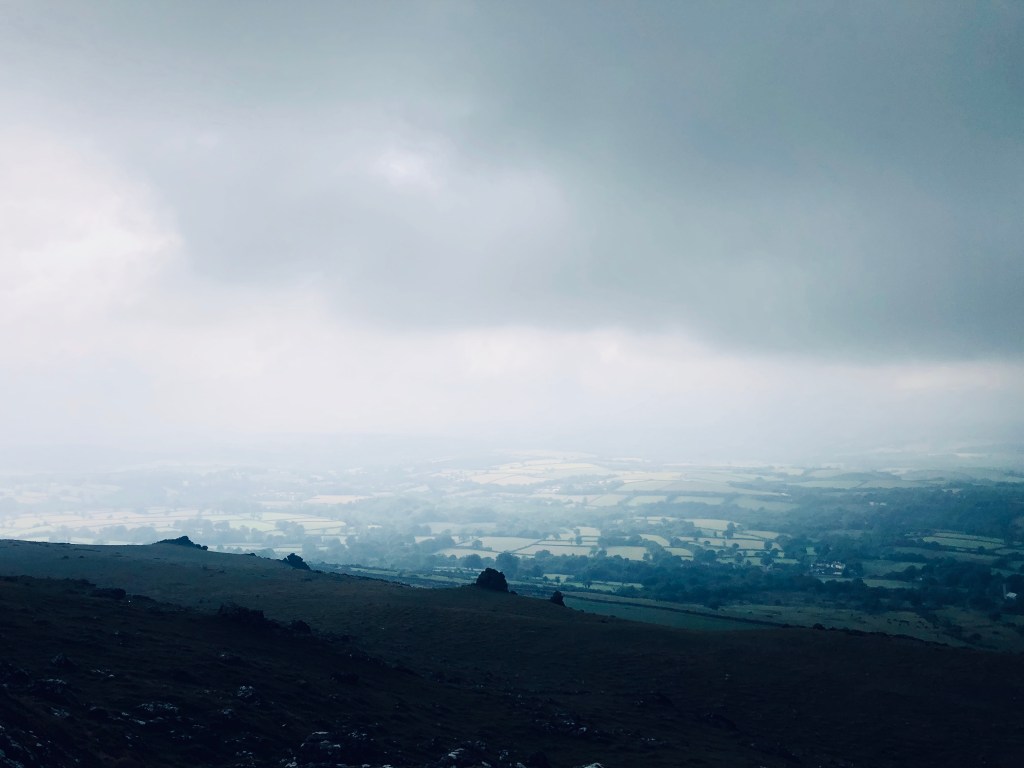
We filtered off the A386 and Plymouth wrapped its stony arms around us. We all felt the change. We had only been out of London for six weeks, but living in open space and sunlight and in some way we now felt accustomed (entitled!) to wider horizons. Our car was loaded down with possessions, we were chattering and windswept after a long moor walk and now we arrived to roadworks, roundabouts and the relentless swell of urban movement. Plymouth is draped across many hills with rows of slate grey roof-lines that stretch as fingers down to a storm grey sea. The domes of the naval boatyards sit like oil drums in the harbour, half-submerged among a silt boneyard of masts, cables and cranes. The seagulls seem angry. The signs tell us that this is Britain’s Ocean City. It is a serious seafaring place.

We were there to see Menna’s parents and throw ourselves onto their hospitality. It was our first social visit after three months of lockdown. We were also booked in to do a yacht course. The Hodins are a sailing family and Menna herself was brought up racing yachts, though now she has softened and been made less confident by some decades inland. I am pretty inept on a boat but always keen to widen my relationship with the sea. We need options too: there might be points in our travels where the road will end and we will need to take to the sea. My aim was to become an able crew member under Menna’s captaincy.

In sailing you have to get comfortable with ambiguous movement. You set off for a fixed destination but your progress is always indirect. You must tack and jibe to reconcile your destination with the wind direction, but even within these supposedly linear movements your boat is constantly sliding, drifting and curving obliquely; making hidden runs that are hard to spot against the changing face of the ocean. The sea is wrapped all around you, and it twists your vessel and plays with it. Tides and currents pull on the keel as the wind fills the sail and pushes at the hull. The line of your progress, if plotted over the sea bed, would be meandering and full of lateral drifts, even as the bow points always forwards. The boat responds to your commands in it’s own time, often unwillingly. There are no brakes.

Perhaps sea voyages aren’t so much about functional travel as about reversing perspectives. You leave solid land of fixed horizons to find a fluid and unstable world. Vistas shift and tilt. A new set of options open up though: you have different lines of approach; you can reach coves and bays that are inaccessible from the land; you can drop anchor in the waves. Out on the deck you get to see what your country looks like from the sea. Plymouth relaxes. It sweeps back statesmanlike from the shoreline, the slate roof lines now gleam like sliver hair swept back with pomade. The boatyards open up to show their secret workings. The Hoe promenade drives grandly up to the lighthouse. The seagulls are still angry.
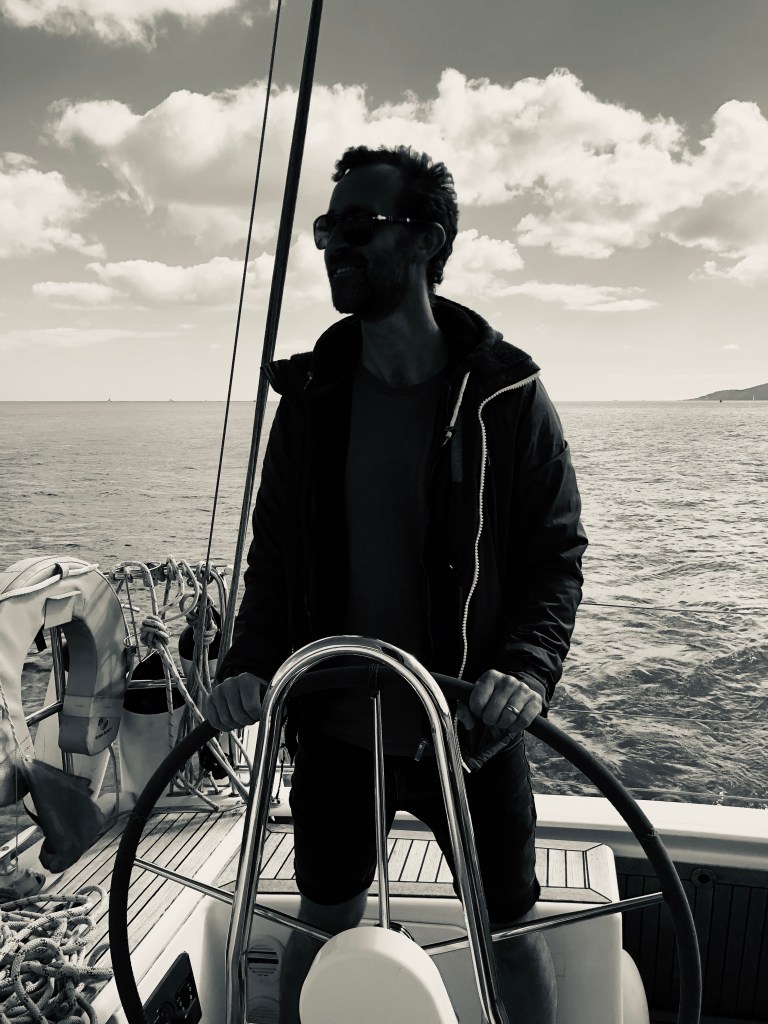
There is a Frank O’Hara poem, To the Harbormaster, that I think of sometimes when I am at sea. It speaks of battling tides and insurmountable distances to reach an ideal. There is a tone of hopeless optimism that occasionally falters, and it strikes a deep chord with me. Brave resistance turns to submission, blind hope gives way to the sinking feeling of realisation. The poet uses a sea voyage as a analogy to explore how heroic ideals are derailed by life, but I prefer to stay in the metaphor, that is to stay with the sea. My relationship with the ocean is a hopeful attempt to find solidarity with something infinitely vast and strong, where too often my small advances are suddenly reversed and I am left with the realisation that I am small, scared and insignificant. I make excuses: I was caught in some moorings; my indecisions and vanities subvert me; the waves hold me back. But still I naively trust in the sanity of my vessel, despite it all. I will make my port.

I crashed the boat on the third day. It was in the terrible channels of the Queen Anne Battery Marina. Slowly heeling round from my mooring to find the line to open sea, I too was driven by the wind, but rather than finding the seductive brown lips of the reeds, it was the hard claw of a superyacht’s anchor that tattered the cordage of our boat (stanchions and guard rail twisted, winch scored deeply). The hull luckily remained intact.

We had already had two magnificent days of sailing. We had learnt mooring, helming, navigating, anchoring. We had charted and completed a complex river journey, tied onto a pontoon in very challenging conditions, skimmed over the waves under full sail in a force seven. We had simulated disasters at sea and rescued men overboard. And then came this horrible slow-motion collision in the morning rain. We disentangled ourselves and limped out of the harbour, our instructor grim-faced, calculating the damage that had been done to his boat. In the silence of my disgrace I thought again about my subservient relationship with the sea. Faltering strokes forwards, hard-won triumphs that last for moments, with the knowledge that at any point I may be pushed back, beaten, submerged at the ocean’s whim. Is it the difficulty that makes it all worthwhile? Is it the heroics of chasing an impossible dream? I am always tying up and then deciding to depart, In storms and at sunset, with the metallic coils of the tides around my fathomless arms.

To The Harbormaster

I wanted to be sure to reach you;
though my ship was on the way it got caught
in some moorings. I am always tying up
and then deciding to depart. In storms and
at sunset, with the metallic coils of the tide
around my fathomless arms, I am unable
to understand the forms of my vanity
or I am hard alee with my Polish rudder
in my hand and the sun sinking. To
you I offer my hull and the tattered cordage
of my will. The terrible channels where
the wind drives me against the brown lips
of the reeds are not all behind me. Yet
I trust the sanity of my vessel; and
if it sinks it may well be in answer
to the reasoning of the eternal voices,
the waves which have kept me from reaching you.

Frank O’Hara
The Cliffs

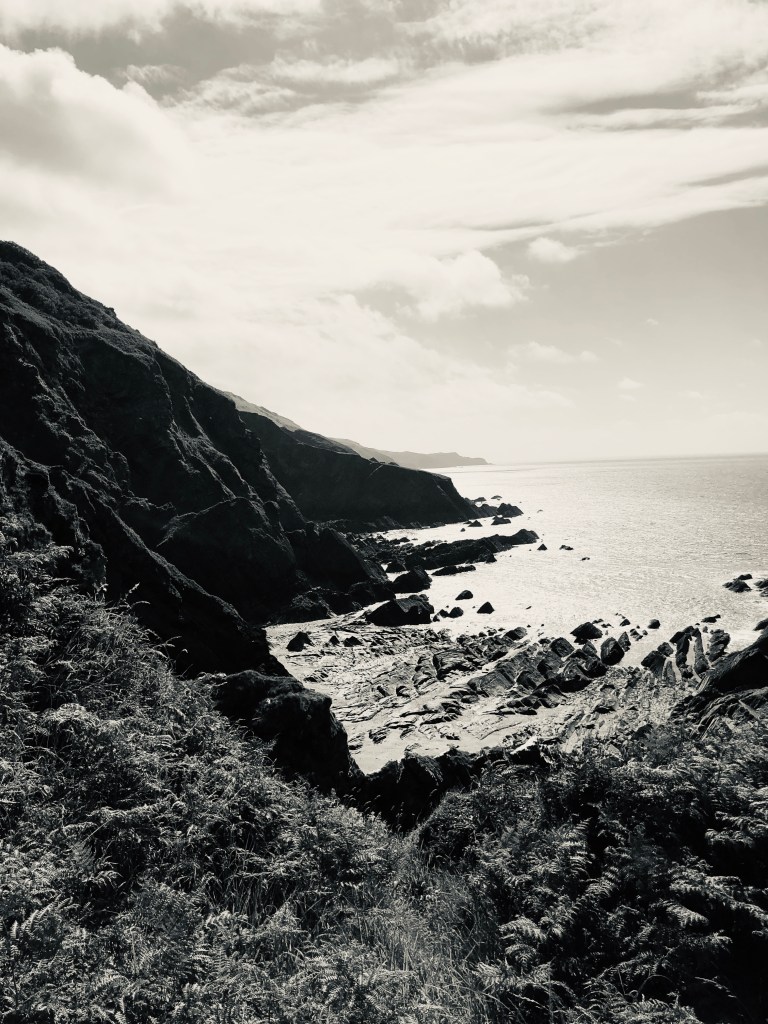
We went for a coastal hike yesterday on the northern face of the headlands. This completes a linking series of cliff walks that we have done over some weeks, taking us right around the North Devon peninsula from Saunton Sands to Ilfracombe, some 100km or so.

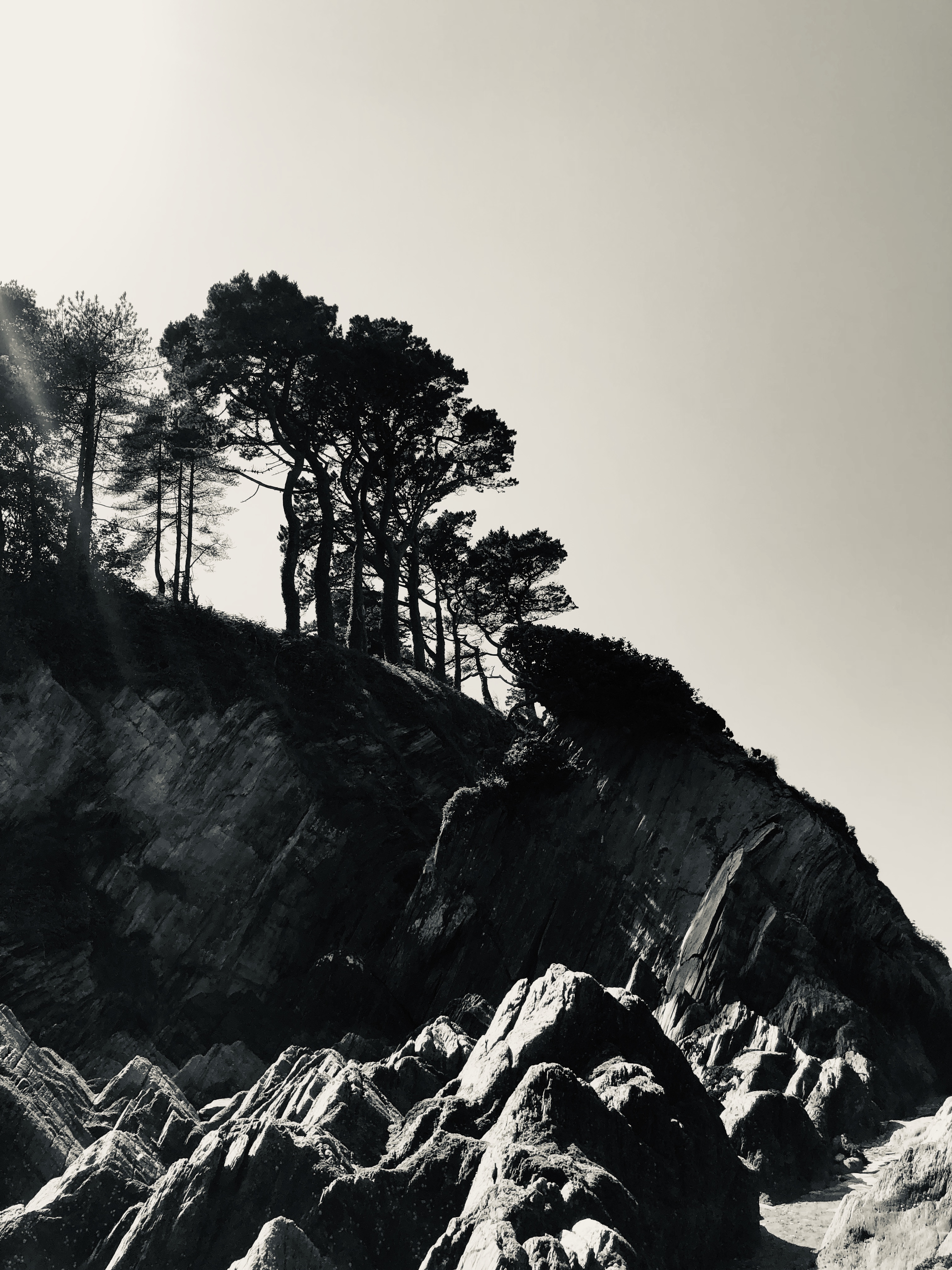
The cliffs in these parts have something about them that I’ve not felt before. All cliffs are huge and inspiring of course, that is their nature. These ones though have a jagged angular violence has been imprinted deep into the shape of the rock. There are dragons teeth that emerge dark and wet from the foam of the sea. Broken slate shards pile up under the crags as though they had come raining down in sheets. Dark fissures split open the cliff face. We saw a cove where rock ridges ran in lines across the shingle, like the black spines of some reptile that slept beneath.

Within the sedimentary rock there is colour and texture. A corduroy layering emerges in bold lines from the sea. The stripes rise up in diagonals that echo in successive and opposing cliff faces. Slate, granite and quartz are compressed into lines of pink and black and glittering crystal. But then the symmetry ripples and buckles, and you know that this stone mass was once spun and twisted in some huge pressure furnace like hot glass. There is suppressed energy throughout this landscape. Immense elemental pressures have played out here, and antagonistic forces remain locked in counterpoint, frozen within those misshapen bubbles of stone. There is a feeling of interrupted motion. At some point the rocks will surge upwards again. They will grind and thunder as they erupt: ripping out tree roots; showering boulders like rain; throwing nesting sea birds screaming into the air.

We leave the National Trust pathways wherever possible and slip onto the sheep paths that undulate through the gorse and ferns. Sometimes it works, sometimes it doesn’t. The tracks take you back and forth, criss-crossing through wind-stunted greenery, lulling you with smooth lines that rise and fall with the topography of the headlands. False trails peter out deep in the gorse, or lead you suddenly out onto limestone overhangs that could erode at any point. You wander how many sheep ambled along this path at night to suddenly find themselves on the edge of the precipice. Does some instinct pull them back? Or do those woolly coats sometimes catch a gust of wind, and then they are tumbling through black space, bleating wildly? You shiver and pull back from the edge.

I find that my thinking slows on these walks. I listen to my breath. I catch myself trudging up the escarpment muttering out simple rhyming word associations to myself, senseless poems to punctuate my footfall. Jurassic, bombastic, we lack it, eclectic (disrespecting), drastic, classic, smash it! Be enthusiastic!

We climb down to an empty beach where the surf beats onto the boulders. The low thunder sends us all gradually into a frenzy and we shout and run. We throw stones and jump off boulders and splash our way blindly through rock pools. We hold crab claw tokens and cowrie shells in our sweaty hands as we climb back up the rocky path again.

Sometimes you emerge over a hill top to find yourself unexpectedly on a vantage point where you can see the full line of cliffs undulating away into the distance like a folded ribbon of dirty grey. Perhaps there is a lighthouse in the distance, certainly there are birds wheeling in the sky. The sea is bottle green, flecked with sunlight and white horses. The wind whistles around, buffeting you back away from the edge.

Boulder, golder? (more gold?), hold her, quiet smoulder, cold shoulder, eye of the beholder.

Up on these massive granite slabs you can get hit by a sudden sense of your own smallness. A squall of futility blows up around you, borne on the sea wind. What are your puny ambitions and dreams lined up against the permanence, the gravitational mass, the sheer indifference of the rock? What flicker of time can you offer up against his eons? We pilot these towers of bone and muscle forwards over the headlands, spindle legs scissoring, furiously pumping blood down through branching tubes, breaking down matter deep in our guts. This pulsating mess of us all wrapped up in downy veined skin. We totter our towers onwards as though we will topple when we stop. We cover them around with bright materials and we shout out from the top: about our plans and schemes, and what we feel, and what we will do with life. As though it mattered.

Granite, tannic, magnetic, peripatetic! We say. Dead gannet, red planet, dormant, titanic.

As is the way of all small beasts, we disdain even smaller creatures, we care nothing for their worries. The world belongs to us alone. We are unaware that we are just mites creeping unnoticed along the shoulder of a sleeping giant.

But then I suppose he is unaware that in his way he too is small; that he lies on a larger rock which swings silently through space, circling an insignificant star that is hidden somewhere out on the far-flung spiral arm of a galaxy. One single galaxy among many.

Gorse Babies

We were walking up on the headlands and it was late. The wind had picked up, and out to sea there was an ominous black cloud line running right along the darkening sky. We were far from home.

Then I heard it, as the wind dropped for a moment, a little high pitched snicker, then a skittering sound of tiny feet scrabbling on dry earth. Arthur picked it up too. He has magnificent ears.
“What was that Dad?”
“It’s nothing” I say, “probably just a weasel in the undergrowth”. He moved in closer to me and we pressed forward in silence. I picked up the pace and hurried the family along.

We both knew that sound though.

The kids are familiar with gorse babies ever since that run-in we had with them in Dorset some years back. And now as we walk hurriedly back home, the rising panic of that sultry evening comes flooding back to me. I curse myself for not learning the lesson then. That too was a summer’s walk, only it turned into a nightmare as we gradually grew aware of their presence. First a sly rustling and snickering deep in the sea of gorse. Then a building storm, the foliage sighing and trembling all around us, as if the rooted foundations beneath stirred and seethed. Tiny hands pulling at the fronds, brown limbs entwined like snakes around the branches, yellow eyes glinting out at us from between the yellow furze flowers. There must have been hundreds of them. It was only through a commotion of shouting, stamping and hammering the path with a heavy stick that I was able to force us a route out of there. We shuffled homewards along the pathway for an age, clustered close together, the kids tightly guarded, Menna snarling and bringing up the rear.

I had never heard of the little creatures being so brazen before. It was simply not known for them to approach while adults were present. Usually it would be just an unattended child who might quietly disappear on the cliff top. Clearly we had run into a tribe that day, one that was powerful enough, or desperate enough, to attack a full family.

I would like to know more about gorse babies, those vile little creatures that fascinate and disturb me in equal measure. I’ve heard the stories, of course, vague and speculative as they are. That the first colony was started in Victorian times, somewhere in the south country, seems realistic. It was most likely a pair of very small children that were either deliberately abandoned on the moors, or became lost somehow. I always imagine a couple of smudged little tots, wide-eyed, tearful, holding hands as the dark closes in; their voices undetectable over the howling wind. They would have sheltered under those wide robust banks of gorse I guess, burrowing in deep to avoid the needles, cushioning themselves in the dry scree underneath. Perhaps they found rabbit or badger holes there. Perhaps they scraped away the earth with their own little fingers. Did the yellow beams of gas lamps flicker distantly in the night? Did the wind carry far off voices shouting their names with increasing desperation? Or were those first nights uninterrupted but for the slithering and scratching of wild creatures making their winding tracks under the fern and gorse?

Whether they were looked for or not, they weren’t ever found. Neither alive, nor as frozen bodies curled tight around the gorse roots. Instead somehow, against all odds, they survived. Some say the founders of the first great colony are still down there somewhere, enthroned in galleries of clay; an ancient and twisted little king and queen of the gorse world, surrounded by the wild civilisation they have created. I don’t believe this myself. That would make them well over a hundred years old. And to survive so long, in a life so harsh…

Our children didn’t sleep well for ages after that first Dorset encounter. They knew that they had had a very close escape. They were still small and malleable and could have so easily been snatched away and pressed down through dark holes into a new life under the earth. A life of slithering through tunnels, eyes straining and swelling in the darkness, bodies never to grow again, skin hardening, fat melting away, tendons, ligaments and bone gaining prominence. How long would it take them to forget their parents and their old soft lives in that subterranean world? Their backs would curve and knot under new muscle growth, their limbs contort to facilitate a life of scrabbling on all fours. Small naked bodies taking the colour of clay, covered in scar tissue and course matted hair. Teeth filed into little points; hardened claw fingers; flesh pierced with thorns and gorsewood. A life driven by instinct and tribal duty, squirming around the gorse roots, sleeping piled up with other small bodies in musky, airless underground chambers, nourished by the blood of rodents and who knows what else? They would have spoken that reedy, chirruping language, full of the anger and violence of wild moorland creatures. Many children have been lost this way.

Now though it’s different, Arthur is nearly ten and Matilda a plump eight year old. They would never flit through the tunnels that honeycomb the headland. Their bones have set, their haunches are soft and they have no value as conscripts to the tribe. Now they are simply prey.

The mist was rising as we hurried on into that yellow dusk. Around us the rustling and chittering slowly intensified like a locust storm approaching. I looked for a stout stick.

Why We Ride

I got pulled into surfing because it felt cool and alternative, shallow though that sounds. Menna grew up in Cornwall where the surf culture permeates, so she had an excuse. I still don’t know how an obsession with waves grew so voracious in a lad who grew up in landlocked Hereford and couldn’t even swim that well. Certainly it had something to do with Point Break, a film that detonated deep in my adolescent psyche and left some pretty deep marks. I had an image of surfers as a bunch of carefree, muscled, tanned, laid-back Gods of the Sea. And who doesn’t want to be in that gang? It’s anti-establishment but it’s not nihilist. There are associations of punk and skater culture on the one side, and a spiritual, at-one-with-nature, mysterious soul-surfer ethos on the other – but there’s a stick-it-to-the-man kind of vibe that bridges both camps. It’s aspirational, particularly to anyone who believes themselves to be liberal and non-conformist. We know of course that many elements of surf culture today are as manufactured and infiltrated by big business as any of the tribal demographics that are packaged up and marketed to us, but even so, it came from something pure and simple and the value-set feels good.

The reputation and culture is enough to get you out there into the ocean (probably on a foamtop). You want to give it a try. You’re ready to rip! Then you get to find out the first hidden truth at the heart of surfing: for something that is predicated around such a simple ideal – to stand up and glide for some seconds on the unbroken face of a wave – it is astonishingly difficult. There are levels of complexity that hide behind that simple premise, and once you start breaking down the constituent parts, then they quickly become complicated and technical. Position on the board, paddle techniques, getting out back (over waves, turtle-roll, duck-dive), reading sets, understanding wave shape, anticipating the break point, the paddle-in, the pop-up, stance and positioning, turning and moving on the wave face, power zones, when to bail, wave priority and etiquette.

When you start out it seems like a trick has been played on you. Something you assumed would be so straightforward is in fact fiendish and full of hidden artforms. But whenever you watch anyone who is half-decent, their movement on the wave is so graceful and elegant it strips away the complexity. A great surfer seems to embody a mental and physical sense of flow that seems otherworldly and very connected in form to the ebb and swell of the sea.

So you have a choice. Either you realise it is too hard and will take too long to master, and so you give it up and maybe turn to golf. Or you are fired up by the challenge, your desire to be a zen master of the waveform is strong enough for you to take the first steps on a long winding road where progress is measured against a far off horizon that never seems to get any closer. You must learn to take beatings, that are many and varied, yet specific enough to have names – the Hold-Down, the Spin Cycle, Caught Inside, On the Head and the worst one, that sinking feeling when you think you’ve just made it over a large breaking wave, only for it to suck you back over the crest to topple down the face with the full force of the wave (and maybe your board) landing on top of you. We call that Over the Falls.

You have proper realisations of ‘this is it. I’m actually about to DIE!’, not just once or twice, but tens of times: moments when you are thrashing blindly in deep water, having been spun viciously, now swimming towards the surface in desperation, lungs empty, only to realise your leash is tugging you the other way and in fact you’re swimming downwards. But as the beatings get worse (you’re progressing to bigger waves) so do the moments of victory get more intense. You catch a wave right in the sweet spot and suddenly you’re there, in a moment of sunlight and silence, the universe crystallised down to a single point of time and emotion, as you scream down a wall of water, knees compressing with the g-force as you bottom-turn into the wave and see it stretched out in front of you like an emerald highway, and you ride it for perhaps five seconds, maybe even eight. Two or three waves like that in a session will sustain you for weeks. You’ll talk at length about them to anyone who’ll listen.

Over time you get to understand another of the dichotomies of surfing. The emotional intensity is driven on one side by the feeling of flow, elevation and ‘oneness’’ with nature when you catch a wave. On the other side it is pushed by adrenaline and pure fear when the wave catches you. Above and below. Fear and joy. Effort and grace. You’re never quite sure which side of the game is responsible for that aching, shaking, drained feeling you get once you finally climb out of the surf.

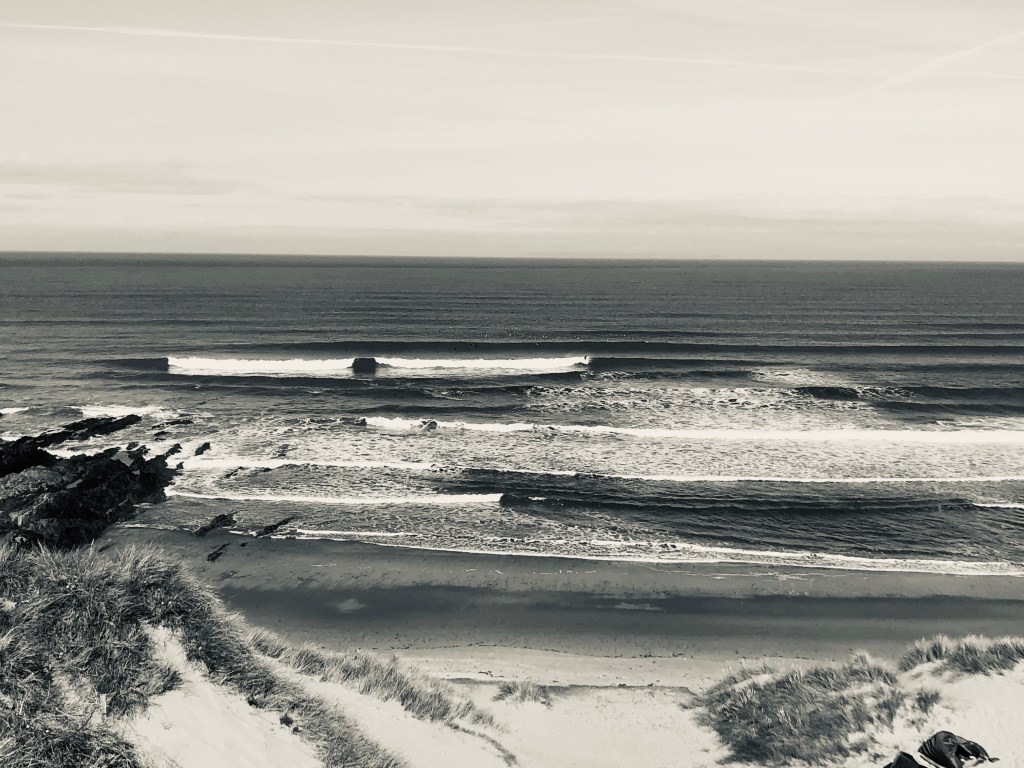
Your mindset changes over time of course. A large part of any surf session involves sitting out on your board beyond the break, examining the topography of the ocean. You’re trying to anticipate wave size, speed and peak from a distant bump on the sea’s face. Is this set spaced out? Are they clustered? Doubled-up? Where will they spike? Can I catch this? Am I in danger? You need to calculate all of this before the wave reaches you in order to select the right waves and get in position to catch them, or identify the ‘clean-up’ sets and get safely over them. So you sit watching the ocean with single-minded focus. For long stretches. In silence. Floating. It’s a lot like meditation really and it’s an addictive part of the game. You see a lot of surfers off-session just sitting on beaches, cliffs, dunes, zoning out and watching the waves build and crash. I’m writing this now in a notebook, sitting high up on a dune, watching the waves peal in between sentences. They look sweet today, coming through in well ordered lines with a slight offshore breeze glassing up the faces.

A moment of honesty here. Even after a year of surfing in Central America, trips to Bali, Sri Lanka, Hawaii and various European sessions here and there over the following fifteen years, I am still not a good surfer. Not close. I don’t catch lots of the waves that I paddle for. I don’t link beautiful turns on the face and I can’t do a snappy cutback. I have been deep inside a few barrels, but flailing around, off my board and preparing for an almighty beating. But I love it and I want it always to be a part of my life. “The best surfer out there is the one who’s having most fun” as the zen master once said. So I try always to smile as I get sucked back once more over the falls.

Surfing is such an amazing concept. You’re taking on Nature with a little stick and saying, ‘I’m gonna ride you!’ And a lot of times Nature says, ‘No you’re not!’ and crashes you to the bottom

Jolene Blalock

Covid Don’t Surf

What drew us to North Devon, other than having nowhere else to go, was the surf.

Since our year in Central America we still think of ourselves as surfers. Yes, it’s true that barring a couple of weeks in Bali in 2008 and a very occasional session here and there in Cornwall or Portugal, we haven’t really surfed properly in 15 years. But it’s like riding a bike right? And so, once we get down to Devon, boards loaded on the top of the car, many readings of the swell reports en route, heated discussions about pressure systems and fin types, we are ready to wind back the clock and dive back into a life on the waves.

A storm system battered the South West on the Friday a few days before our arrival and our go-to forecaster Magic Seaweed is showing that there is still going to be some solid swell on on our first morning. It’s a little big for Menna’s first day, but I’m itching to paddle out.

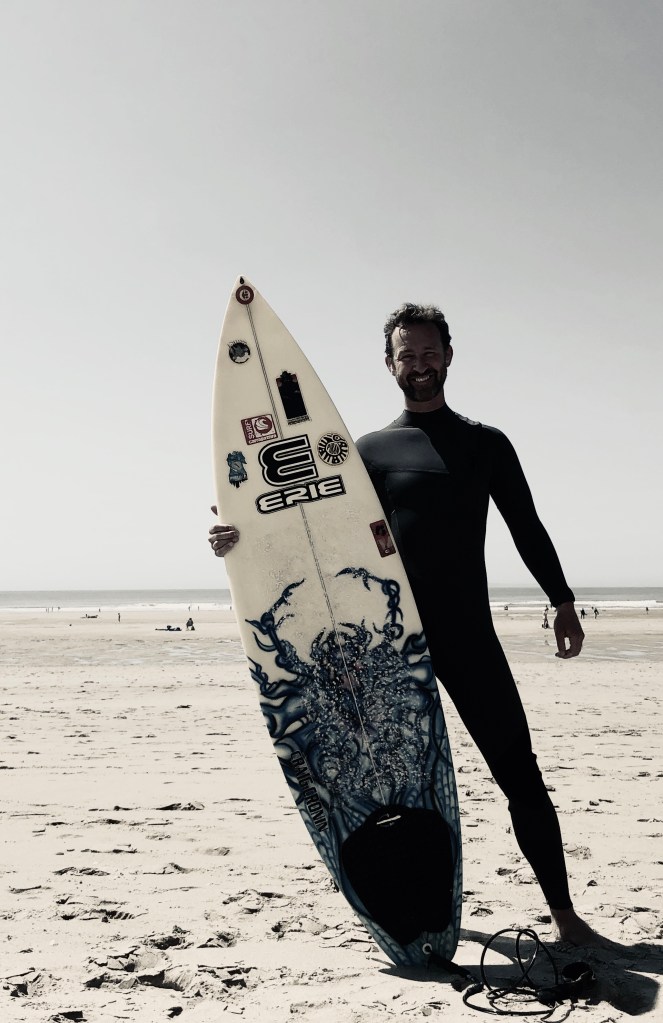
The sun’s shining. I wax up my trusty 6’4” squash tail thruster, attach the leash and walk into the sea. I bob over the first few lines of white water then start to paddle out to the line-up with strong powerful strokes. My shoulders wake up, instantly responding to the demands with some innate muscle memory. I navigate a large incoming set without too much difficulty, timing my duck dives to slip smoothly beneath the breaks. The cold water hits my face like an invigorating tonic. The waves are coming in neat clean lines, about six feet high and barrelling slightly. It‘s big, but nothing compared to Puerto Escondido in 2005 – or that gnarly reef break we surfed in Panama. Getting out back, I feel my heart rate is nicely elevated, lungs are working well, there is blood coursing through my muscles. There are about 15 surfers clustered around the peak. Fellow pros. They look at me and recognise one of their kind.

I float on my board and wait. It’s not long until the next set, and I watch the guys position themselves and then drop in smoothly on wave after wave. It’s clear they know this break well. Then my chance comes. The last wave of the set breaks late and the peak has shifted slightly to the left, catching everyone out of position, except for me out on the edge of the pack. I paddle hard for it, feeling the tail of my surfboard lift, getting my chest down and accelerating my strokes just as the wave ramps. Then there it is: the glide, that most amazing sensation as my speed matches the wave speed and then we are planing together. I am high on the face of the wave and bang in the pocket, the wave face is crumbling right next to me. I explode to my feet and I’m off, left rail wedged into a green wall that swells and builds in front of my board. The ride picks up in pace as I take a sharp diagonal down the wave face and then a sweeping bottom turn. Up to the top and it’s time for a cutback. My board carves a tight S shape to turn back towards the break and refind the pocket, which I’ve now outpaced.

On and on the wave runs and I’m drawing beautiful lines. My fins carve a white signature into the green face for all to see. It’s a moment of pure harmony between man and ocean. The tears in my eyes are only half from the wind.

And then a soft fade back to reality. This is a composite of several daydreams I’ve been having on the way to Devon, and they have carried me happily right up to this moment. This moment now. My surfboard under my arm, a hero’s pose, standing calm and ready at the water’s edge

The sun’s shining. I wax up my trusty 6’4” squash tail thruster, attach the leash and walk into the sea. I bob over the first few lines of white water then start to paddle out to the line-up with strokes that feel rather laboured and ineffective. A big set comes in and I remember the adrenaline shot of fear as a huge slab rumbles towards you. I remember how huge a wave looks from your low vantage point at its base. I remember the feeling of impact that resembles nothing so much as a ton of liquid cement being poured on your back from height. There are relentless white walls lined up angrily in front of you, and you need to pass through them all before you find yourself in deep calm waters. Inefficient duck-dives rob you of air and leave you floundering in foam before the next wave crashes right on top of you. Poor paddle technique means you lose meters of progress with every wave you pass.

And so it happens today. I get caught in the impact zone for a long time, shoulders quickly weakened, lungs on fire, salt water in my stomach. For several waves I have to ditch my board entirely and just dive under, feeling the leash on my ankle yanking frantically as my abandoned board gets smashed around on the surface. Finally there’s a gap between sets and I’m able to limp my way out back, gasping and red faced.

I float on my board and wait. It’s not long until the next set, and I watch the guys position themselves and then drop in smoothly on wave after wave. It’s clear they know this break well. I’ve no heart to go after anything myself, I’m exhausted already. I try to get my breathing back to acceptable levels and slip into a reverie. I don’t notice that everyone has suddenly started paddling fast for the horizon. The clean-up set has arrived, a group of monster waves that are far larger and therefore break far deeper than the rest. One by one everyone makes it over the crest of the first roller, but I’m caught inside again and I take the full impact of the first big wave and then its companions. I am dragged deep under and spun around flailing, emerging for a frantic breath before getting hit by the next. And the next. I get swept far enough towards shore that once the super set has finished, I’m way out of place again and have to do another weary paddle back out.

As I reach the line up again I see a beautiful wave coming through. The peak has shifted slightly to the left, catching everyone out of position, except one lad. He paddles hard for it, feeling the tail of his surfboard lift, getting his chest down and accelerating his strokes just as the wave ramps. I am totally in his way. He is forced to pull out at the last moment and he mouths something at me which I can’t hear. I limp my way to the edge of the pack. There are about 15 surfers clustered around the peak and they look like pros. When they look at me it is clear that I am not one of their kind.

But I will be.

The Devonian Era

We arrived once night had fallen.

We had made a strategic stop for fish and chips on the beach at the next town down the coast, ostensibly to stretch our legs and give the kids a run on the dunes, but really to wait for sunset so we could sneak into our new accommodation undetected. We had felt self-conscious enough driving across country during lockdown. Non-essential travel was strictly vetoed, and nothing about our car, loaded as it was with surfboards, luggage and bikes, indicated that this journey was in any way essential.

(“It is essential though isn’t it, right?” we reassured each other periodically).

The roads had been impressively empty throughout the five hour journey. I had known that a police cavalcade could materialise at any moment and I was mentally committed to the high speed chase, screeching off the motorway to fish-tail our way down miles of dirt roads (those poorly-fastened bikes would come cartwheeling off around a bend and take out at least two of the pursuing patrol cars), along to the inevitable finale where cornered and desperate, I would be forced to drive the car off the Dorset cliffs into a technicolour sunset, with Camilla Caballo playing full volume on the radio.

I hadn’t fully gone through this plan with the family, but I felt they would be supportive. It didn’t come to pass though, and as we pulled up to pick up our pre-ordered takeaway, I felt kind of disappointed. Where was the challenge? The confrontation? The clever wordplay with the forces of the law? (“Well, why don’t you define ‘essential’ to me officer? I believe it derives from the Latin essentia meaning the essence of the thing. Well, stick your nose in here officer and smell my essence of musk car freshener! Yes, thank you. We will be on our way”) It almost felt like the journey had been too easy, like we had been lured into a trap.

This is just the start though, I told myself grimly. We would certainly face a difficult reception in the little Devon town that was to be our first stop. Up until this point, our destination had been completely untainted by the mark of corona, and so they would inevitably be resistant to strangers from the big city, potentially bearing plague and notions of an integrated European market.

I knew pretty broadly how this script would play. We’ve all seen the movies. It would start fairly subtly, perhaps a slight turn away whenever we met anyone on the street, maybe a refusal to meet my eye as I piped out a cheery good morning to a cloaked fellow walker in the mist. Conversation at the Post Office would suddenly halt as we walked up, and the participants would disperse silently in different directions. The door would bang shut and the sign flip over to ‘Back Soon!’ In handwritten gothic script, the cheery exclamation mark giving just enough encouragement to sustain a two hour wait in the drizzle before we would finally give up and go home. The Post Office would be the only source of food in the village of course, so we would be forced to live off chewing gum, wasabi peas and that melted box of Celebrations for the first few days before we could get an Ocado slot.

We would decide to ignore the provocations though and keep on making friendly overtures, still believing that we could overcome the hostility with dignity and good nature. That’s the Nicholls for you.

By the second week it would become apparent that this strategy wasn’t going to work. The locals would start crossing themselves as we came into view. I would be barged off my surfboard in the line-up by a man whose features would be hidden by a black neoprene hood. One morning we would awake to find dead seagulls had been hung from our car wing mirrors. We would find strange wicker tokens placed in the recycling bins outside. The wind would reveal crude desecrated likenesses of ourselves, made of driftwood and whalebone, half-buried in the sand dunes behind the beach. Arthur would go down to the local skatepark and return covered in tar, with a mess of feathers and crisp wrappers stuck to his head. He wouldn’t ever speak about what had happened.

It would be when they broke into our house in the early hours, masked and carrying flaming torches, to put a noose around my neck that I would finally have had enough.
“My wife is a fucking key worker!” I would shout, “She’s NHS for Christ’s sake, a doctor. Front line!”
The chanting would stop.
“Hospital or GP?” Would come a cautious voice.
“Hospital! She saves lives man. Now we’re homeless. We’re supposed to be travelling around the world but it’s all fallen through because of the virus. We’ve got nowhere else to go. We should be in Cape Town doing a wine tour in the Garden valley or a shark dive or something. But this… this… this is all we have now.” I would be sobbing pretty hard at this point.
“Hear that lads? We’ve got a bloody doctor in town! God save the NHS! Sorry mate, thought you were second homers, just down for half term like. We’ll tidy up after ourselves shall we?”

That was what we expected.

So once we had got to our new home, unloaded the car in the darkness, quickly swallowed a bottle of Cabernet Sauvignon, then found the oblivion of sleep for a few hours, I wasn’t surprise to hear a heavy knock on the door at 8am. I arose to meet the lynch mob in my boxer shorts, my hair defiantly un-styled.

It turned out to be the police. Or rather, a policeman. A fresh-faced honest-looking lad of a copper with straw coloured hair. The sun shone brightly behind him.
“I have been led to understand that this isn’t your primary residence,” he offered by way of an opening gambit.
I took a measured breath.
“My wife, officer, is a key worker…”