The Serra de São Mamede is a spur of the Toledo mountain range, sitting high above the Alentejo, dividing countries and climates. On the eastern side you have Portugal and the Atlantic terrains, and on the west is Spain and the Mediterranean. We are staying deep in the protected national park that nestles on the Portuguese side of the mountains, and it takes us five hours driving cross-country to get there.
There is a symbolic aspect to the journey as we gradually leave civilisation behind us and wind our way up mountain roads into the wilderness. Towns become villages, vegetation thins out, roads get pocked and increasingly rutted until finally the asphalt ends and we bump the last few miles down a red dirt track, squeezing between rocks. Then we have arrived – that is to say there comes a point where we can’t drive any further and we abandon our car in a scorched sandy clearing and proceed on foot as the sun begins to set.
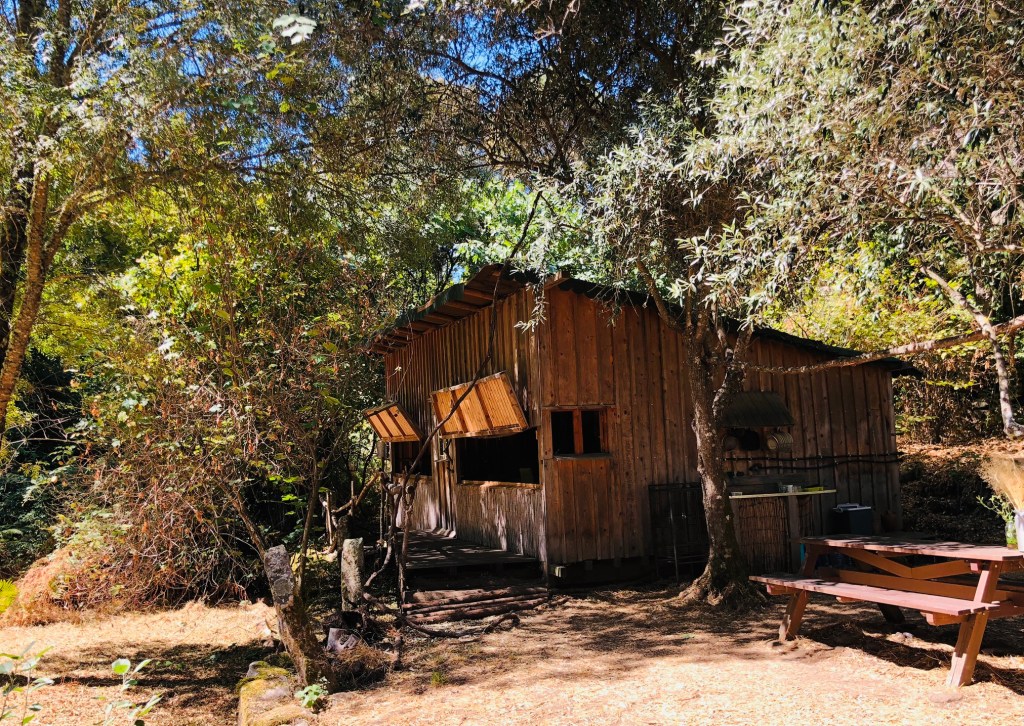
The domain of Terra Sangha stretches out over the hillside like a dusty crumpled blanket, seamed with dry stone walls and scored by a river’s crease. There is an simple farmhouse in the middle of it all and that is where Ben resides, cooking on wood and lit by candles. He has no power at the moment, the solar panels have been out of action ‘for a few weeks now’, but Ben does not let such worldly matters affect him. It won’t affect us either, he tells us as he takes us to our cabin, we didn’t have solar panels to start with.
After some months of relatively civilised living on the Iberian littoral, we are now going totally off-grid. That means living with no electricity, drinking water, flushing toilet, oven, shower, tv, window-glass, wifi, phone signal or refrigeration. “There’s a cool box somewhere if you need it. I can bring you ice.” Says Ben vaguely and disappears off into the dusk, leaving us alone in our glade.
Our car, full of the heat-sensitive provisions that we have purchased for this week, is about a kilometre away and darkness is falling fast. The evening is dry and windless, the temperature still sits obstinately in the low thirties. We have some work to do. “Does anyone know where the head torch is?” Asks Menna pointlessly.
We toil backwards and forwards to the car, laden with many (un-eco) bags full of (non-vegan) provisions, (unsuitable) clothes and (unchargeable) electrical items. We leave surfboards and bikes dumped on scrubland by the car. We climb walls, stumble over hidden obstacles, get scratched by tree branches and curse a lot. The night falls quickly once the sun has dipped behind the mountains and the darkness is complete and unequivocal.
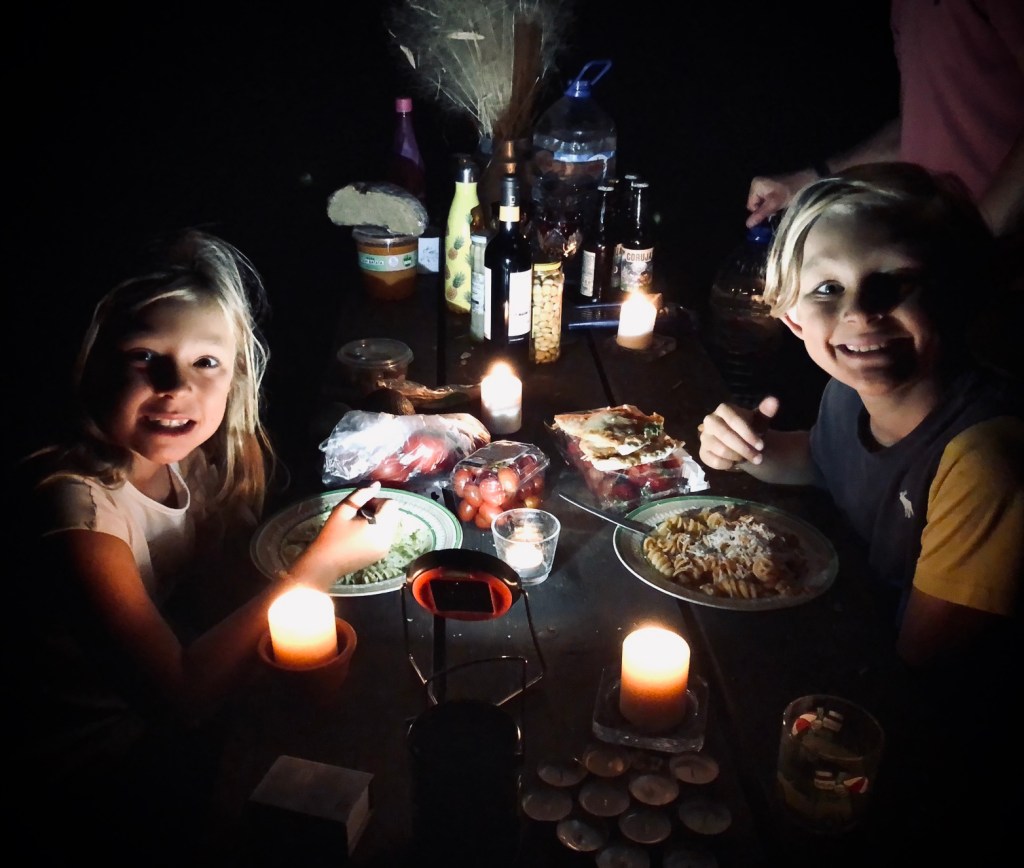
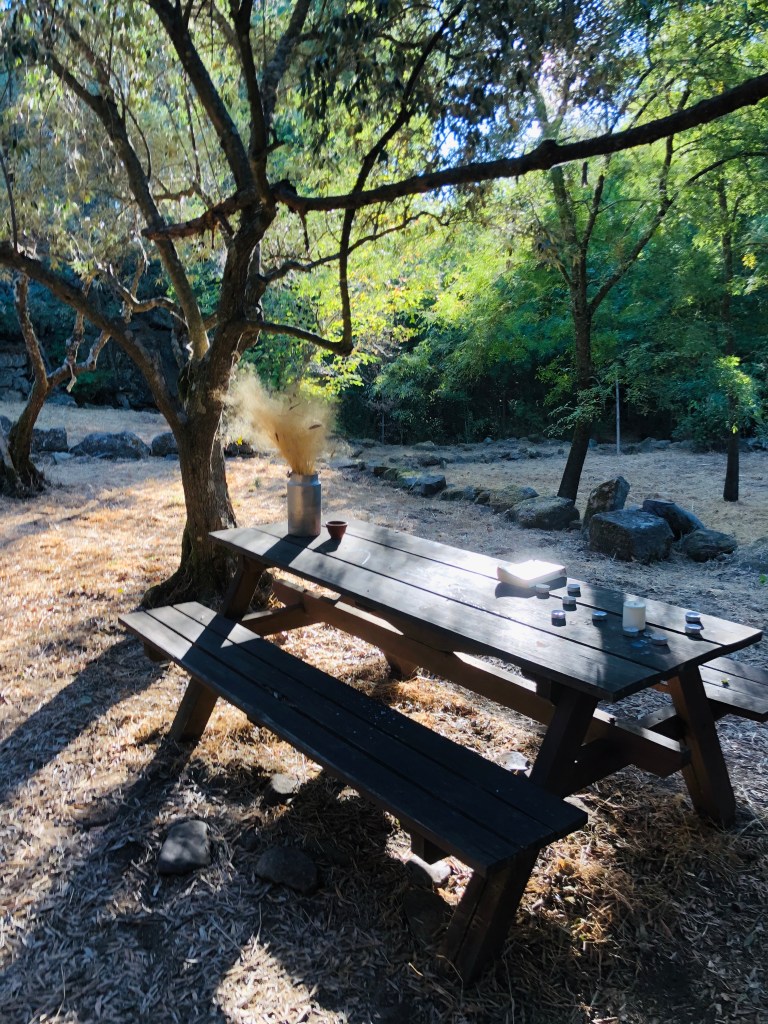
Dinner is a basic pasta, cooked by torchlight outside on a rusty two-ring gas stove. Around us the night comes alive with wild calls and rustling that may be leaves in the breeze but may equally be prowling paws. The Iberian lynx still lives in these remote mountains I tell the kids, maybe bears too, certainly wild boar. They have both gone very quiet and don’t venture outside the safe sphere of light that the solar lamp throws over our trestle table. Matilda screams occasionally as flying creatures suddenly zoom past her head. This is a sanctuary for bats as well we remember, and our cabin has no window panes. They will come in and sleep in the rafters.
By ten o clock we are all tucked up in our single room, wide eyed in the darkness, listening to the forest breathing around us.
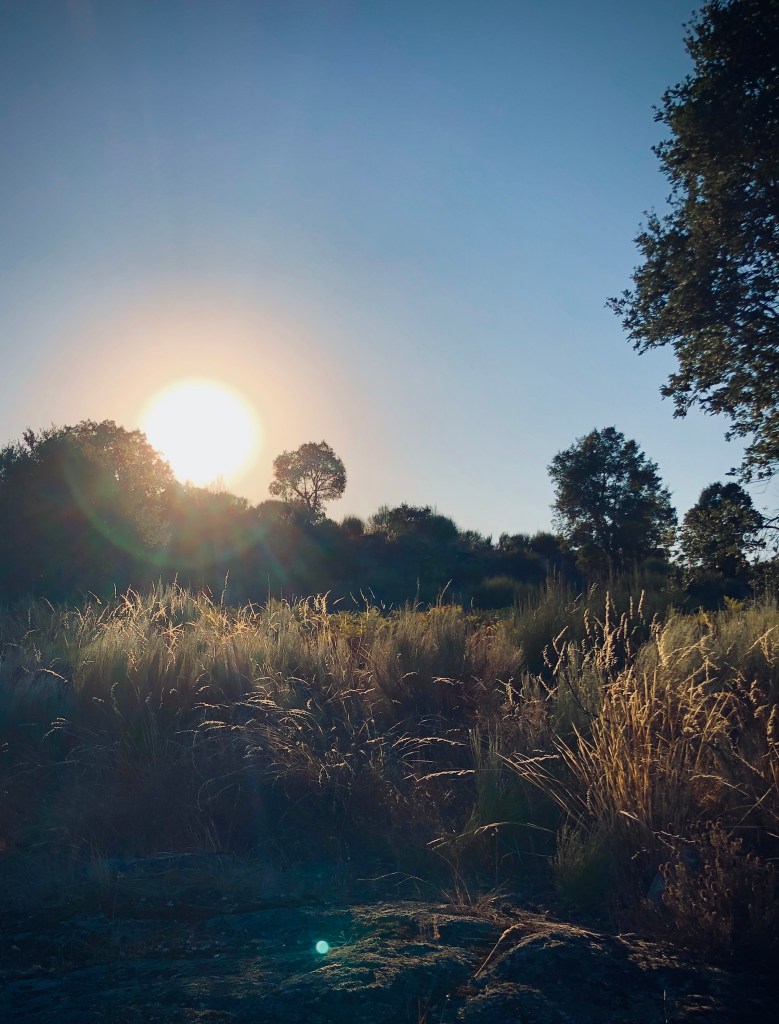
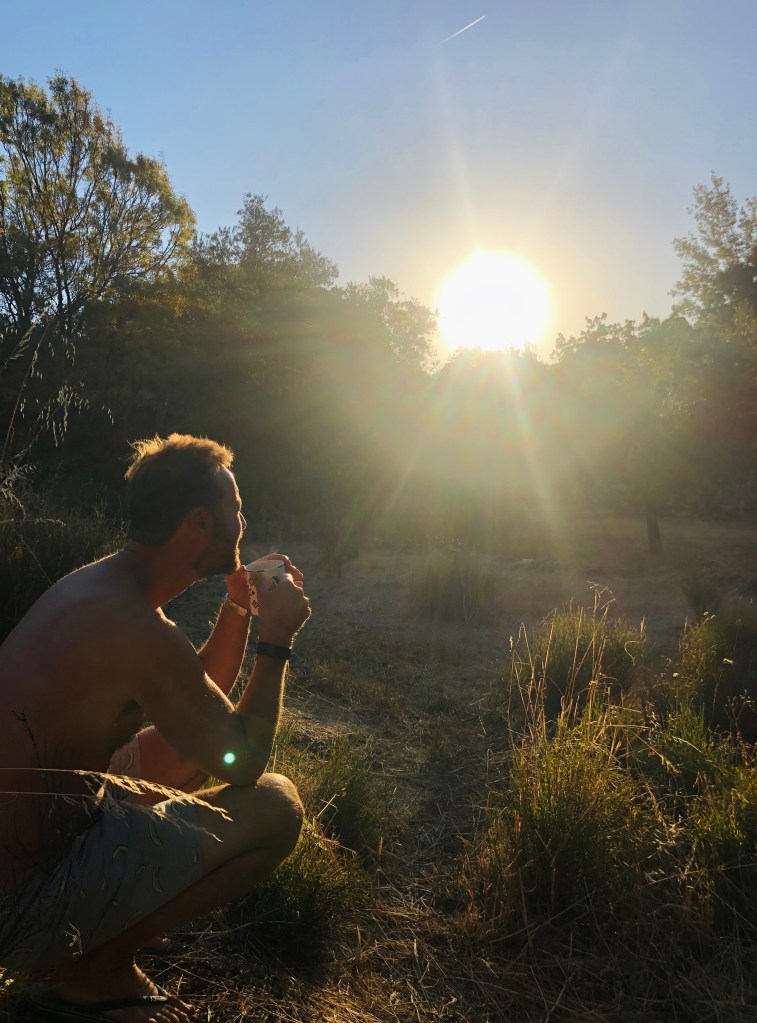
The best thing about arriving somewhere after dark is that you get to arrive all over again in the morning. Our cabin sits up on a flat terrace and when the dawn sun emerges over the shoulder of the mountain opposite, it throws beams between the tree tops and through our windows. The light illuminates the dust motes floating in our dark wooden room and falls across our faces of our sleeping children in their driftwood beds, making them look unwashed and strangely angelic. I stumble to the window and stick out a squinting sun-scrunched face to take in our new world. A glade of yellow grasses, a wall of poplar, cork and lime trees, the mercury flash of running water glittering in the shadows, mountains ahead and behind, forest all around us. Birds flitter through the foliage.
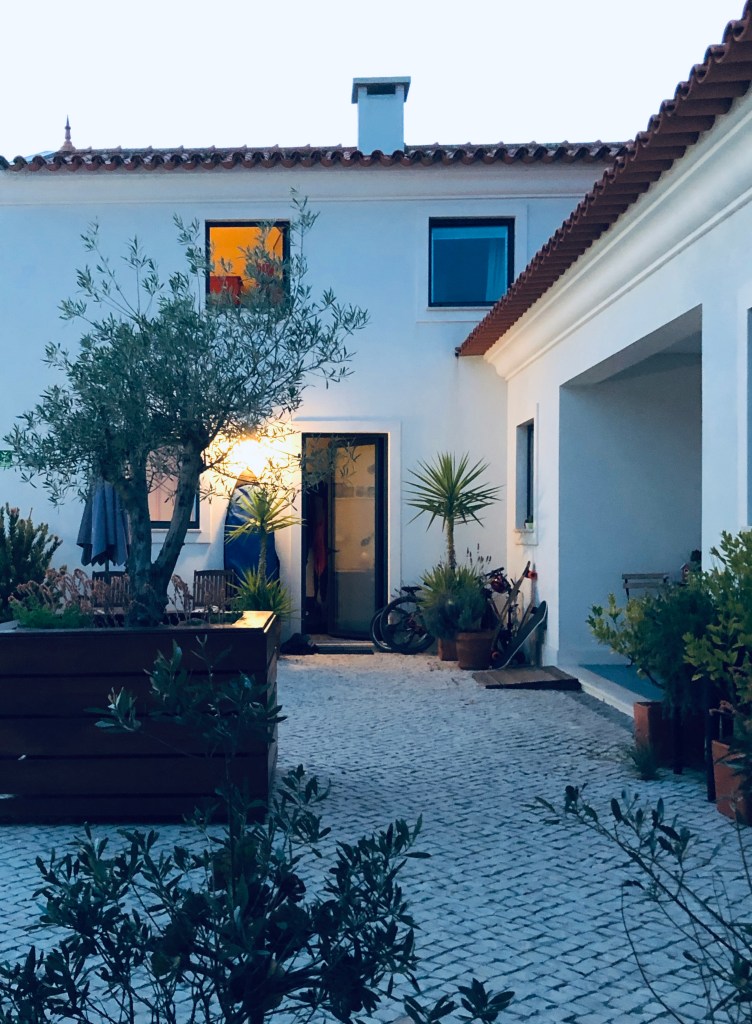
Casa Da Lagoa is hidden away behind a high gate on a nondescript side street. We wait in the road for a quarter of an hour, unable to get a response from the bell, our fat Audi squatting menacingly like a black toad, blocking the narrow, walled street. Then the gates swing silently open, and the proprietor is there to greet us, beaming and gesturing us in theatrically to hidden inner courtyards that are full of shade and olive trees, like a Moroccan riad.
Joao is effusive and clearly very proud of his place. With rights too – he and his wife have created a little eco-agri-boutique-guesthouse of great style and calm vibes. The house was his grandfather’s, he tells us, but they have now remodelled it all. The yards are cobbled with cream coloured limestone, the walls gleam brilliant white inlaid with traditional blue Portuguese tiles, and there has been a lot of careful artisanal work with hard-woods throughout. We’re sleeping in a little annex that used to be the granary, where a system of small windows and channels direct a cool airflow though the building.
On our first night Joao and his wife cook for us. We got a feast: homemade chouriço, ham, tomatoes and olives from their local farm, little grilled sardines, whole dorado in lemon and butter, courgettes and carrots. Steaks for the kids.
Clearly Joao does front-of-house duties while his wife does the real work behind the scenes. He talks us through the menu, still sweating from the grill, savouring the details. “This is the ham of porco preto, the black pig” he says with a flourish, “they are only allowed to eat the acorn or the seed of the cork tree. It is also a kind of oak actually.” “Kind of like the Spanish Pata Negra ham?” I offer. “No! No! This is the better ham. Most Spanish ham actually comes from Portugal anyway. We have more of the oak trees so we export the ham to them and they call it Jamón iberico – we are all Ibericos it is true! But the best, we save for ourselves.”
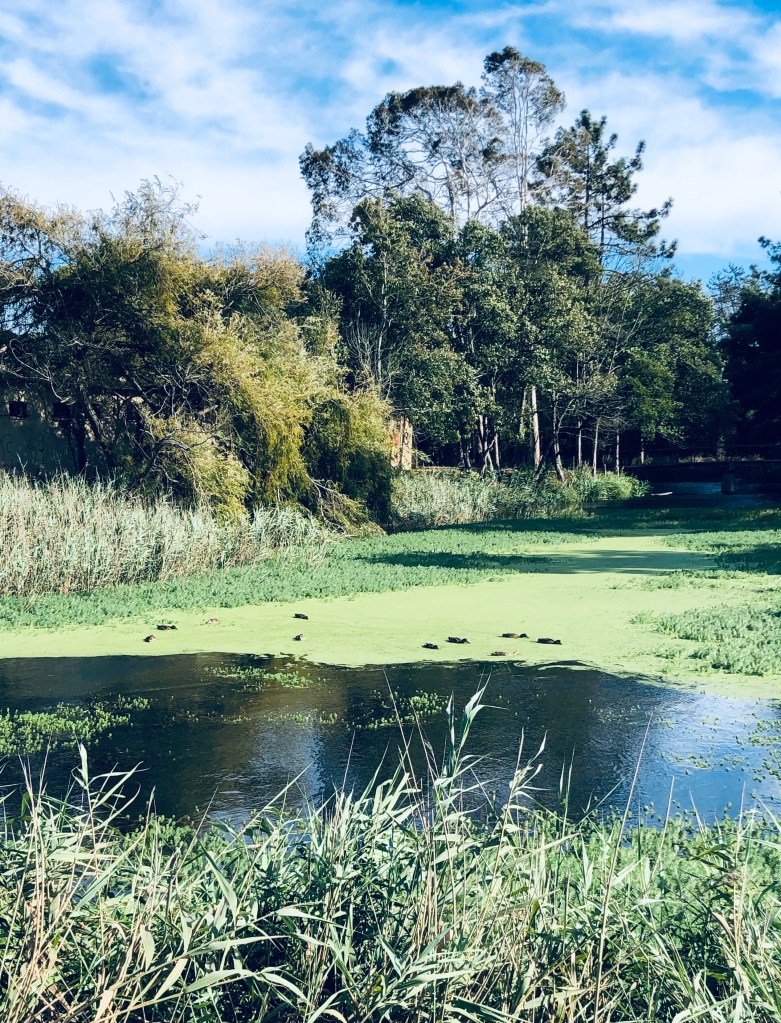
We are starved of good conversation and Joao certainly likes to chat. Furthermore he is knowledgeable and cultural and his English is great. He tells us about the farming, local history, the wine, the wildlife. We are surrounded by lagoons and marshlands so I am keen to see some birds. Joao is insistent that the birds here are very special, only his knowledge of bird names in English is a limiting factor, so we go down several cul de sacs. “There is a beautiful small bird. Red, very intelligent. I see him when I am reading in the forest. He always wants to understand who I am.” A Pipit, Redwing, Redstart? Surely they don’t have Cardinals here do they? “We call him the Passaros, I like him a lot”. Google calls him the Robin. “Yeah, we have him at home too. Anything more exciting? Maybe a Hoopoe – orange colour, crazy big crest, stripy wings…” “No.” “What about the kingfisher? The Rei Pescador?” I love kingfishers, but it is something of a sore point that despite growing up beside a river, I have never actually seen one. Menna and the kids spotted a docile king fisher in our local park in London (annoying!) and it sat on the branch for ages, being all picturesque, accepting photos, then gliding off on its way. It was literally the only Sunday morning walk I had missed. “No, there is not this one any more. Maybe when I was a kid but now it is too rare. But there is another blue bird, larger, always he would come to the farm in my childhood, and we love him. Very graceful. He would take away the acorns to hide”. This eventually turns out not to be a Roller or a Bee-eater, but a Jay, also fairly common. “And there are ducks! Many ducks!” The kids are squirming in their seats by now and it is time to go to bed.
The next day we visit the beach, we shop for sandles for Matilda and we consume lots more ham. Menna takes the kids on a bike ride around the lagoon in the afternoon while I write, but they get lost, cycle 15km further than planned and arrive back hot, thirsty and full of harsh words. Arthur is adamant that he has seen a kingfisher when he had cycled ahead alone. There is an undercurrent of skepticism in our response to this revelation. He picks up on this and it further sours the mood. I feel guilty – everyone seems to see kingfishers all the time except me. Why shouldn’t his sighting be true?
We set off the following morning on a proper expedition around the waterways. I bring my binoculars, penknife, birdguide and feel quite the ornithologist. Arthur leads us proudly to his kingfisher spot, telling the story of his sighting many times over, adding in various details with each telling. We stay for a long while but there is an extensive lumberjack operation in full motion nearby and they are converting large tree trunks into wood chips, generating a huge amount of diesel smoke and noise in the process. It is not the peaceful birdspotting environment we had hoped for and eventually we walk on discouraged.
It is a fairly uneventful trip, but a few kilometres later we do indeed see many ducks.
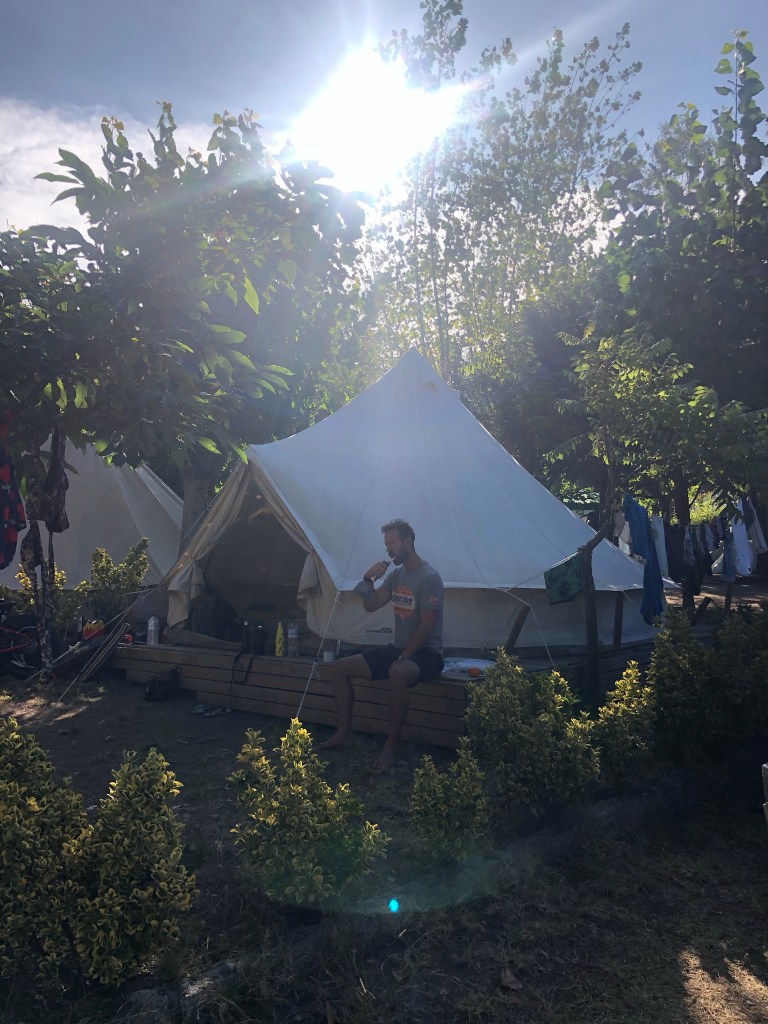
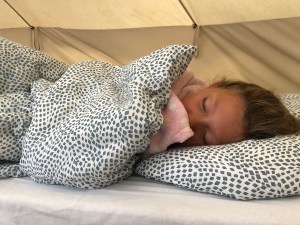
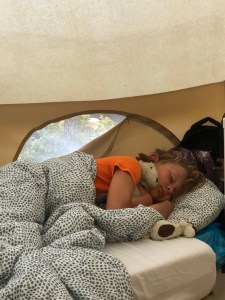
We spent a week camping in Galicia, right up in top left Spain, but round the corner now, staring westwards out into the Atlantic. Our campsite was pretty in a dusty, sun-dappled sort of way. We had a tent under the pine trees with four beds, a lamp and a fridge. It seemed to be a short stay campsite, all around us tents popped up and disappeared daily and a bubbling soundtrack of excited Spanish coursed around us like a stream around a rock. At the weekend highly dressed girls would emerge out of tiny tents to go and party, but they would be gone by 10am the next morning. We lived in the middle of all this movement and chatter in our own peaceful little world.
Apart from one night on the ferry, this was the first time that all four of us had all slept next to each other. There was a whole new range of nighttime whistles, snuffles and whispers to get used to: Matilda sitting up and giggling mid-dream, Arthur rolling out of bed for a pee in the early hours, breathing rhythms that rose and fell through the sleep cycles. The kids claimed that I snored terribly and did many lurid impressions, but I never sleep on my back so I found this unlikely.
The campsite was run by a father-son combination. There was also a mistreated old lady who did the cleaning, who might well have been mother. The son had big dark eyes like a water rat, and the same wild flickering gaze when he rattled through the camp commandments on our check-in. You notice eyes so much more now everyone is wearing masks. He scurried around the campsite, in a tight Homer Simpson t-shirt and short yellow trunks, conducting a fruitless war against the ants. Arthur found him hilarious.
“Dad, I just busted him crouching down behind our car. He looked at me and said ‘Ants you are too many. Die now’ and then he did this kind of dance and sprayed poison all over the floor. He’s so weird!”
The father ran the camp café. He didn’t like us and showed it by charging us a different price every morning for the same four croissants, two coffees and a loaf of bread. He only dropped his scowl once when Menna took him a red wine to uncork for us, and on seeing the label his eyes widened and he talked urgently and at length about its unique properties and then shuffled off to his living quarters to show her that he had this exact bottle himself. It was a very average wine that we had grabbed at the supermarket in town, but we sipped it carefully, trying to understand the hidden qualities that inspired such passion in the granite-faced old miser.
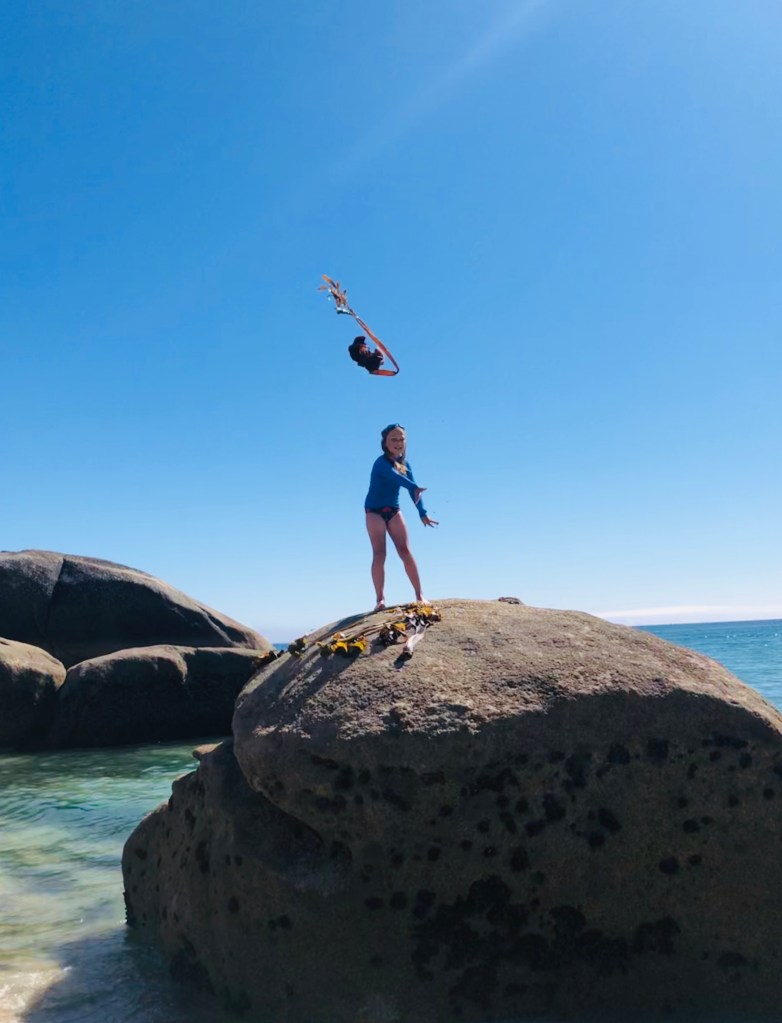
Our campsite gave straight out onto the beach. There was a large turtle shaped rock which the kids dived from and also used as a good vantage point from which to hurl seaweed grenades at their parents and other passers-by. Better still though was the next bay south, Playa Lanzada, a long beautiful beach which curved obliquely to the prevailing wind and swell. At the near end it was sheltered and calm as a millpond, but at the far end we discovered a break with beautifully spaced lines of waves that the offshore wind made steep and glassy. We surfed a couple of sessions there every day. I paddled so much that I tore the rotator cuff muscle in my left shoulder.
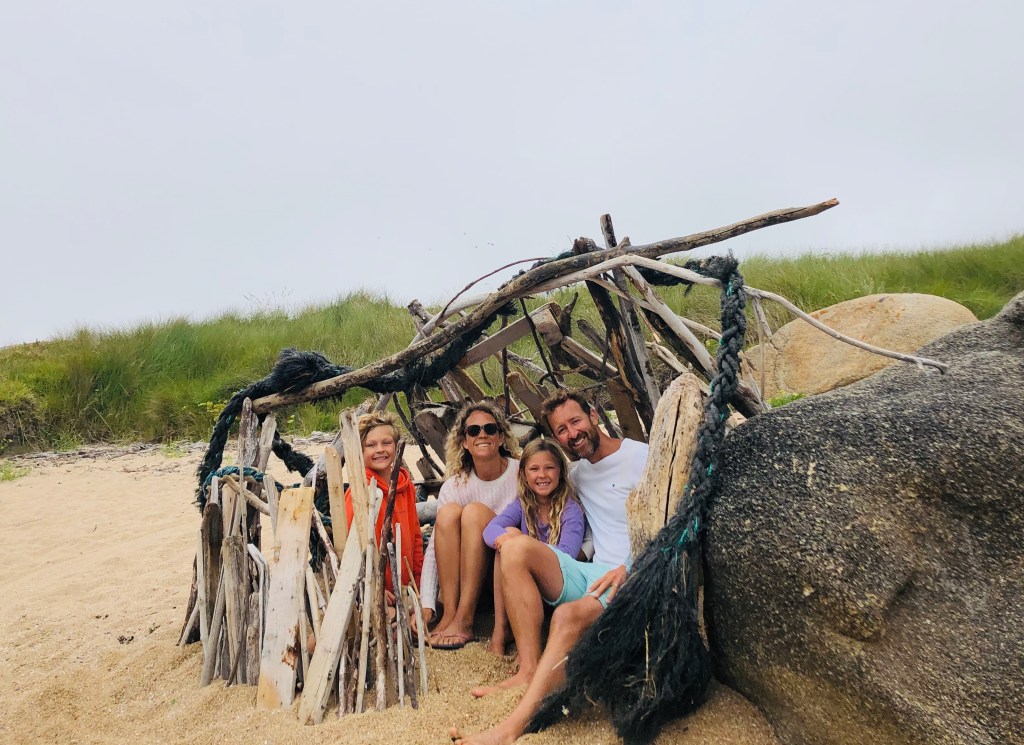
North of the campsite, after the end of the urban drift, there was a worn old boardwalk that wound its way out of town. We took this one day and wandered some miles through a series of deserted bays, through a landscape of evocative rock formations where sly faces and stray creatures loomed up in our peripheral vision. We came upon an old military site where artillery emplacements still pointed blindly out to the Atlantic. We ended up having our picnic down in a cove, right under the shadow of one of these rusted cannons. As we ate a sea mist rolled in around us and we were cold for the first time since arriving in Spain. We built a driftwood shelter and there we huddled together to warm ourselves awhile before wandering on our way.
“What does it say Dad” asks Arthur in a quivering little voice. The sign was nailed to a tree right in the middle of the woods. We could just about make out the writing in the faint torchlight of my phone. It was in an old and ornate script.
“Well, it’s in Spanish of course, but I would translate it like this:
We the dead lie under your feet. Like you we roamed the forest at night, Then they came, they caught us, as we ran. Listen and you will hear them now. They are coming, coming, coming!
You walk on the path of death. You walk on the path of pain. You walk on the path of torment. They are coming, coming, coming!
You must run.”
We stop still and listen for a long moment in the darkness. The forest around us groans and creaks and whispers. I jump. “I think I can hear something!” I grip Arthur’s arm. He lets out a kind of moan “No Daddy, no. It’s not real right? You’re being stupid” “I think they’re coming…”
We run to catch up the girls. Arthur is in quite a state. I get badly told off by Menna but, flushed with wine and encouraged by the excellent reaction I have managed to get, I can’t help periodically creeping up to Arthur in the darkness and whispering “They’re coming, coming, coming!”
I do this all the way home.
This is how I ruin the night walk back from the restaurant in Boal. By the time we arrive back to Hotel Solanda, our farmhouse up in the mountains, both kids are in a real panic and Menna is absolutely furious with me. The silly ghost story has overshadowed the bats we saw, the hissing snake that crossed our path, the fine dinner down in town, the woodland path that we thought it would be romantic to take in the moonlight. My proposal to Menna that we might sit up and chat about life, drink whisky and look at the stars, is shot down angrily. I am sent out alone while she tries to restore calm.
“What did that sign really say?” ask the kids once they have been finally cajoled into bed. It is a chance at redemption, but I just can’t bring myself to say that it was only something dull about hunting restrictions. “It said that they’re coming, coming, coming. I would be very careful tonight if I were you.”
And this is why I spend an extremely uncomfortable night on the sofa bed while Matilda takes my place next door in the master bedroom.
The fever came on and off for a couple of days, mainly spiking in the evening. It wasn’t particularly bad – some hot and cold periods, never more than 39˚, some sweats, stomach cramps, a bit of a headache.
Menna was worried though she wouldn’t say so. She is the family doctor and all responsibility for anything medical is immediately outsourced to her. I sit passively like a pudding (tiramisu!) while she sticks thermometers in my armpit, changes my dressings, prods my appendix, tells me to shower and opportunistically cuts my toenails.
While she discounts options, calculates probabilities and works on her diagnosis, I meander through a lazy series of scenarios and questions. What if it was coronavirus? Would I have to go to hospital? Here? Salinas? Would we be deported from Spain altogether? How would we even get back home? You can’t fly or take the ferry when you’re infectious. Drive then? I have a nice daydream about the insurance company springing for a private jet to repatriate us, realising we have no house to go back to and being forced to put us up in a nice hotel to recuperate. Then I remember about the pandemic exclusion clause that I found in the small print which pretty much renders our expensive travel policy totally invalid.
Is the whole family about to fall ill with this? Will the incubation period mean that our infections are staggered, each one of us falling sick two weeks apart, drawing the whole thing out for a couple of months? What if Menna herself gets ill? Then we would be really screwed. She is the one who really keeps this leaky vessel fuelled and floating.
We would have to do contact tracing too, that would be fun. I think about trying to identify and reach out to everyone who was in Dreamsea, everyone in the ferry too. All those hundreds of intersections and interactions over the last weeks, like a game of tag where each touch leaves a radioactive afterglow. I visualise a wispy cobweb stretching across Europe, stretching and pulsating, the lines lengthening, splitting, unravelling, reforming; viral particles flowing through the strands as a sinister green illumination; nodes glowing; breakaway elements floating off to spawn new clusters that then grow and bond and strengthen and then radiate further, carrying the viral load out into the world. And imagine this new green network of ours transposed over thousands of other existing viral webs, in all the colours of the spectrum, together forming a deep-rooted, multi-layered tangle that grips and chokes the whole globe. Surely mankind is doomed.
I wake. What if we needed to go into quarantine and isolate, then where would we go? Can we stay here in this tiny apartment? Could I bear a wall of Brad Pitt staring at me for two weeks? (Sure I could! He’s an extraordinarily good-looking guy). But it’s probably already booked out to someone else next week and it’s going to be very difficult to find any new accommodation as a confirmed covid case. I would be a social pariah! I suppose I could manage a couple of weeks sweating the fever out in a little tent alone up in the dunes. The family could leave me messages and packages of food outside. I would talk with the gulls, monitor the environmental impact of the Avilés factory emissions, carve strange evocative sculptures from driftwood. Is the booking deposit on our next camp refundable?
Menna discounted coronavirus. The fever pattern wasn’t right. The abdominal pains weren’t consistent with Covid. There was no cough or secondary symptoms.
Was it a recurrence of endocarditis then? I had gone through some weeks of fevers a few years ago before finally getting diagnosed with bacterial infection – right in my frickin heart. On that occasion I spent seven weeks on a drip in the Royal Brompton hospital. That would be way worse than coronavirus! I imagined seven weeks in a Salinas hospital. I’d definitely improve my Spanish and the kids would be very accomplished surfers by the time I got out. Menna may well have run off with a salsa instructor or something by then though. The suspicion of another complicated illness sends her a little wild-eyed and manic. She was the one who really took the brunt of my last illness with all the daily hospital visits, looking after both kids solo, managing her work shifts and giving constant updates to a wide community of panicked friends and family. No way she’s sticking around for another one.
Menna eventually reaches a diagnosis: “You have some non-specific virus that isn’t endocarditis and isn’t coronavirus. It doesn’t seem particularly bad.” I am crushed.
I have forgotten that the world is still full of the same old nondescript illnesses that were always there. They still come and go with the same frequency, they have the same impact, they’ve just been pushed out of the limelight. They aren’t interesting.
I feel totally fine by Wednesday. The fever is gone but the questions remain. I realise that life out on the road leaves us in more of a precarious position than I had believed. It is disconcerting. This is a time where there are no clear answers, the old protocols have eroded and with them the security of delegated responsibility. The rule book is being redrafted and in the meantime we will just need to figure things out as we go along.
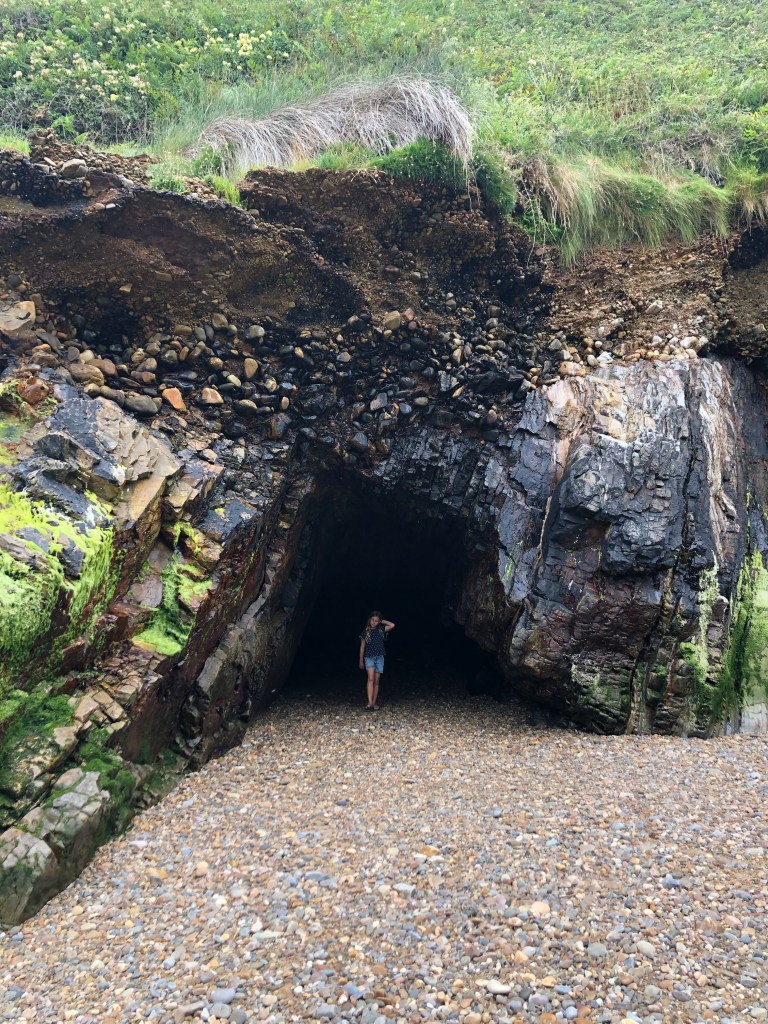
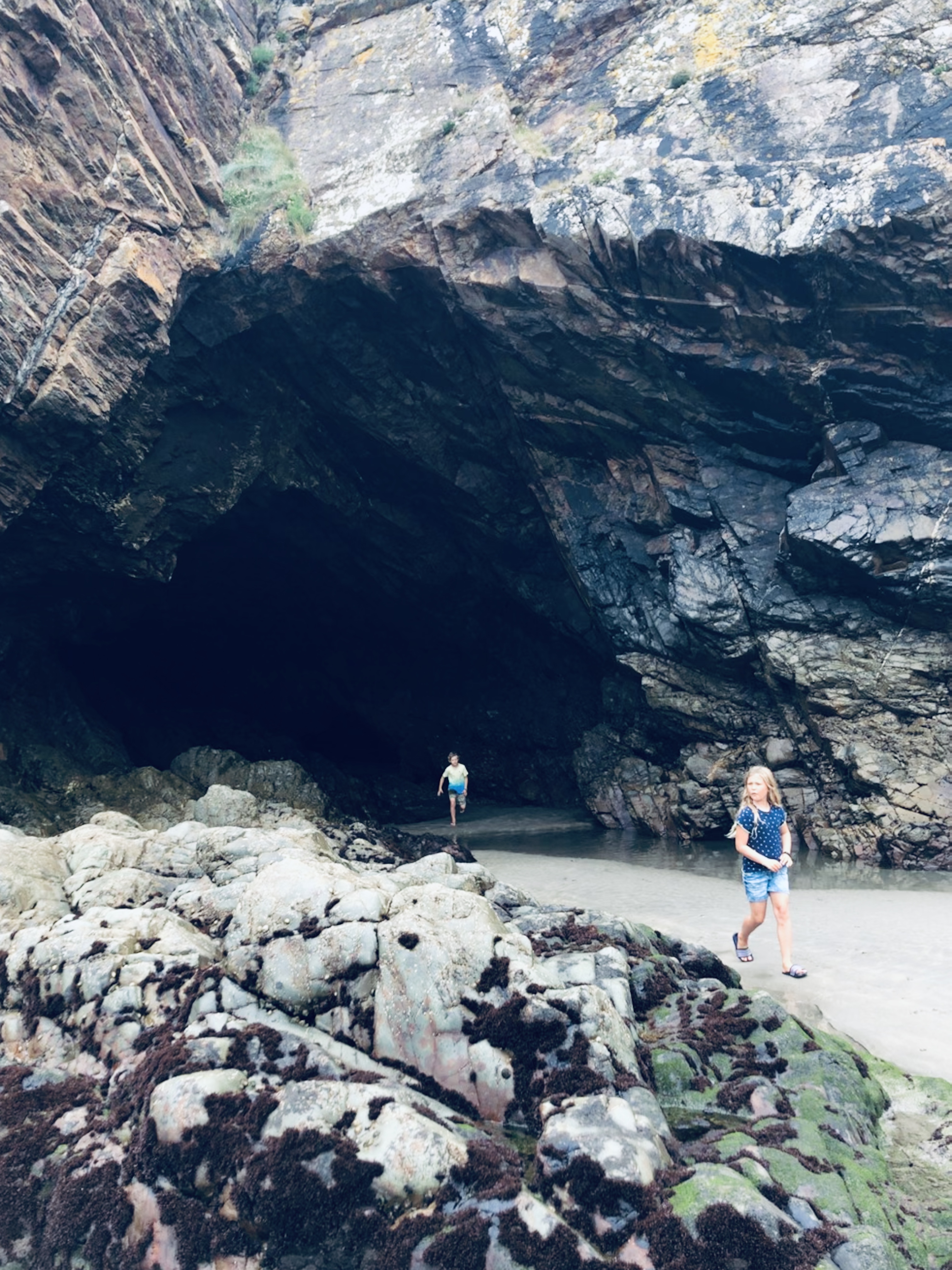
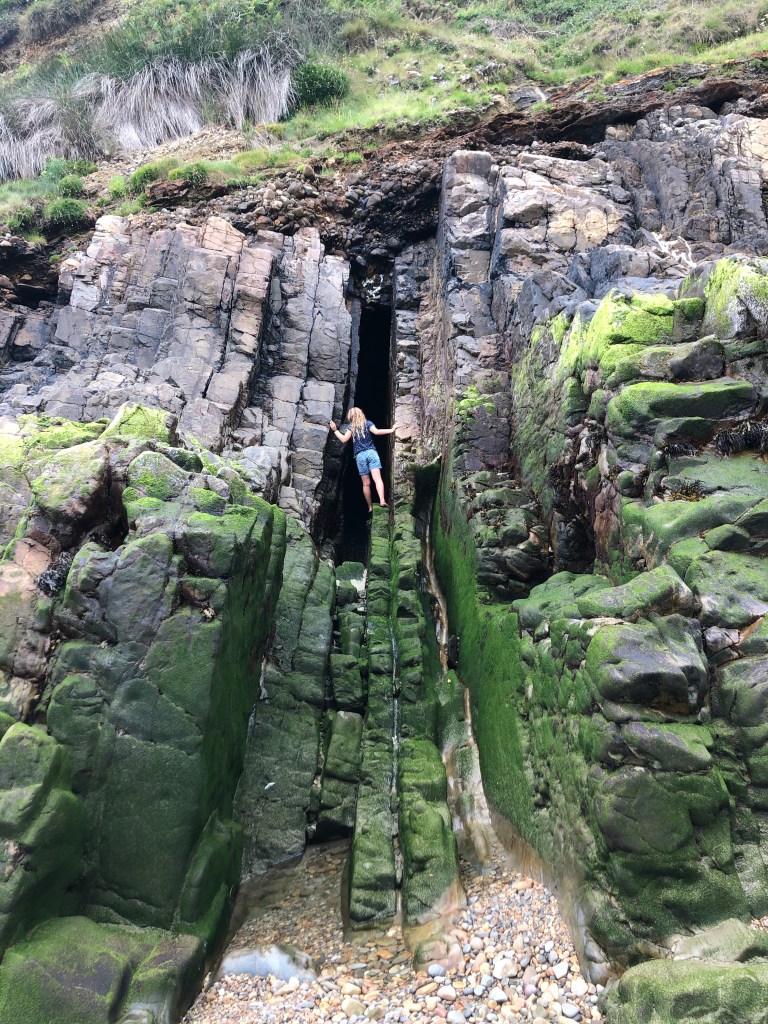
We all go to a remote beach and explore some spectacular caves. From a responsible distance, we talk to an old fisherman gathering limpets out on the rocks. “Everything has changed now” He tells us, “the seas were full of life before, but now you see nothing. It is very hard. In twenty years it has all gone” He waves expansively at a black smudge that runs across the cliff face. “That is oil pollution there.”
Once humankind has been decimated by coronavirus perhaps the limpets will all come back, I think. And if we need to isolate in the meantime, those caves will do nicely.
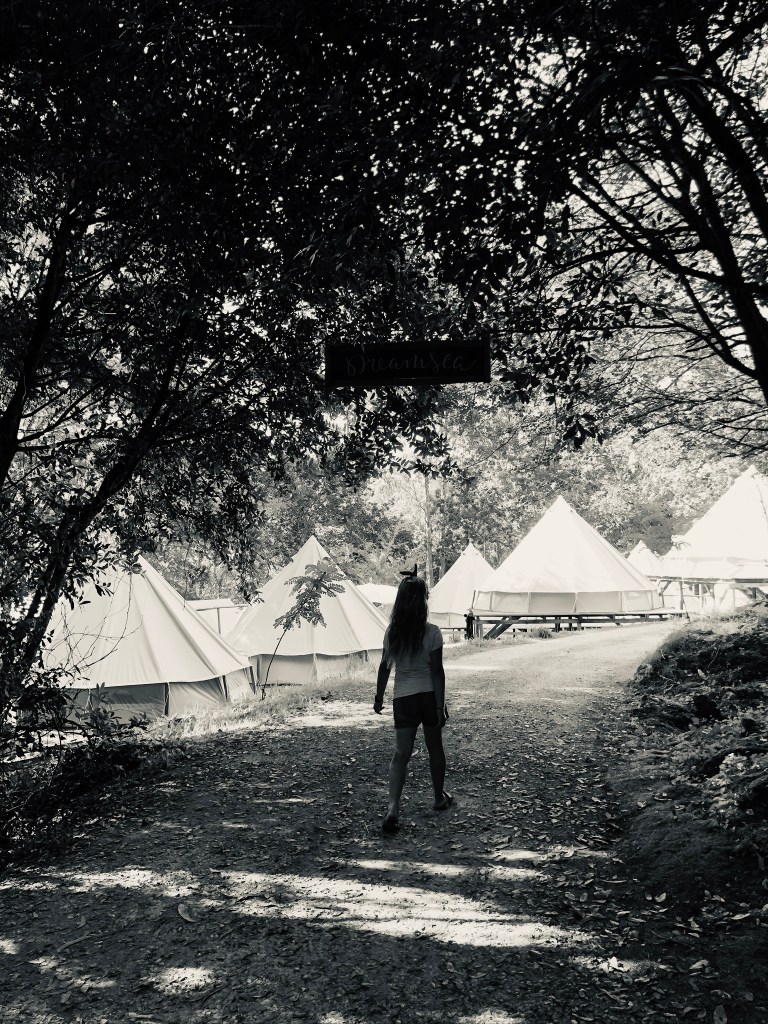
In the foothills of the Cantabrian Cordillera, somewhere between Santander and the baroque palaces of Comillas, we found Camping Huelguero, a neat little spot, fringed with flags and pine trees. As we drove through the site, wondering if those regimented rows really captured the true spirit of camping, we found a smaller hill right at its centre, deeply wooded with oak and eucalyptus, where a steep winding access road was marked out in chalk. We took this track upwards and there, nestled in clearings between the trees, were the tents and rolling walkways of Dreamsea Surf Camp.
It was perched there like a crusader encampment above enemy lines; all bamboo structures, white bell tents emerging from the vegetation, fluttering banners and downtempo beats.
We arrived in this serene oasis and promptly vomited the contents of our car out onto the decking, under the bemused gaze of a handful of surf-bums drinking daiquris at the bar. Bikes, surfboards, skateboards and yoga mats are piled up, wetsuits, backpacks, bags overflowing with laundry (we only left Plymouth two days ago – how is this possible?), electrical wires, a box of school books, half a bottle of Llaphroaig, a badminton set.
We were urged to chill. Just let the luggage sit there, someone will probably deal with it. Come and take a tour…
There was a central living area with a canteen, bar, chill-out zone and some kind of Swiss Family Robinson bamboo shower block. A teak yoga platform juts out over a gorge, then down a twisted path is an elemental dance floor, sunken in a hidden glade where tree roots tangled with lighting cables and lizards danced in the sunbeams. There was a skateboard ramp and a rack full of bikes and longboards and surfboards for you to help yourself to.
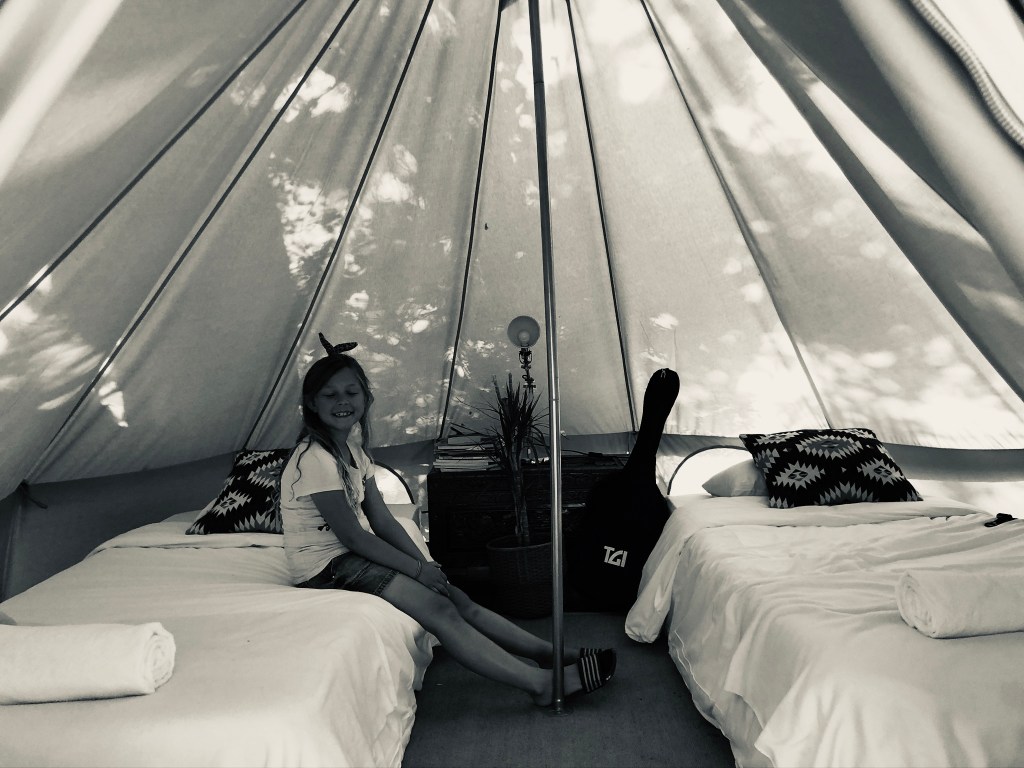
Our bell tents sat on a raised wood decking and they had carpets, beds made of authentic looking coffee pallets with proper linen and there was some kind of antique chest there under the yucca plant. For pampered city folk easing into a life under canvas, this seems like a pretty good start.
There was an ethno-organic-Bali-soulsurf kind of vibe that permeated Dreamsea. It was super chilled and a consequently a little chaotic. The showers didn’t have hot water; someone was going to get around to it but they’re probably off surfing right now. You wandered to the bar to order your sunset mojito to find that bartender, manager, and pretty much everyone really, had downed tools for an impromptu group session on the skate ramp and they’re really into it, and pulling some pretty gnarly moves, and it was probably better not to disturb them.
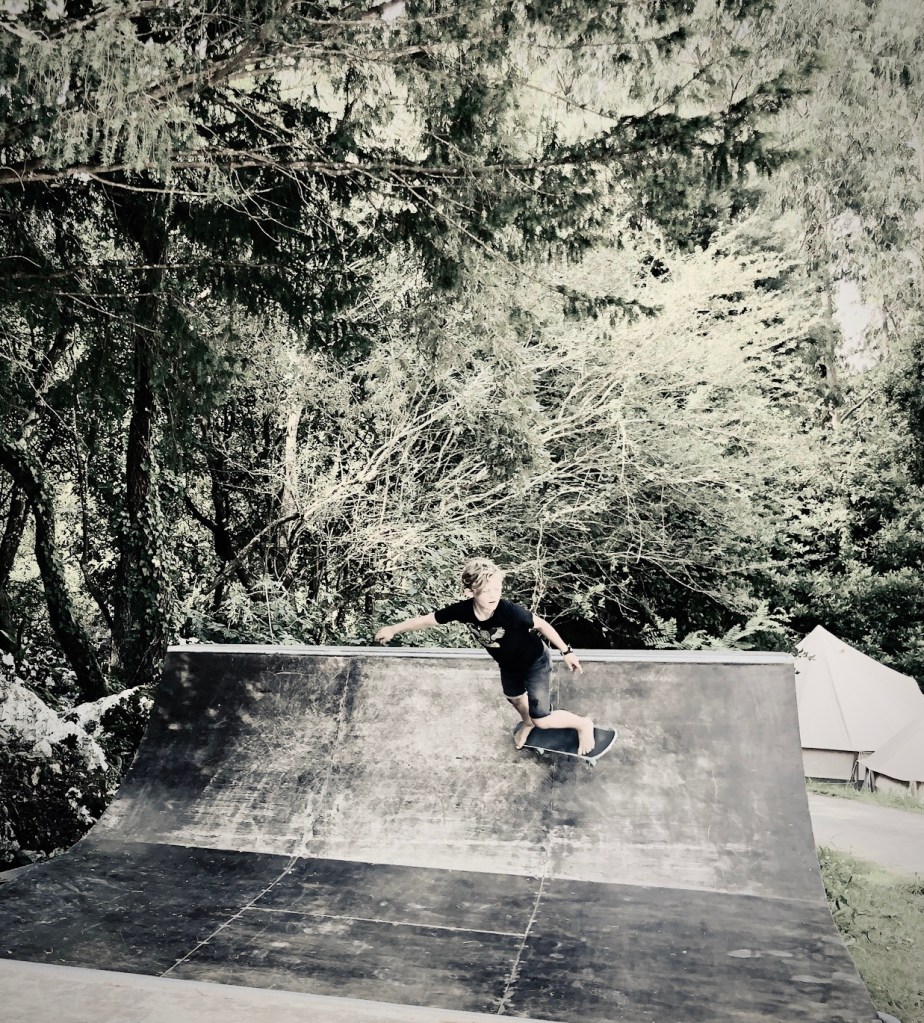
The camp was staffed by a tribe of young beautiful people with floppy hair and great tattoos, usually with a beer in hand. They loved to chat. It seemed to be a mandatory requirement that all personnel not only surf, but skate as well, and they were keen to prove their credentials on the ramp that is conveniently right by the bar. Arthur, with his new birthday skateboard barely out of his wrapper, was in total awe. Within three days he had been fully assimilated into the crew and was taking his turns on the ramp and being earnestly coached on how to throw a healside turn. Despite being a longboarder myself (read middle-aged sedate cruiser), this scene was seductive enough that I wanted in. I gave it a few goes and predictably I wiped out hard each time, and soon had cuts all over my feet and elbows. Everyone was so encouraging though, I wanted to nail a big move just to please them.
These were the Lost Boys and Wild Gals of Surf. Chasing the next big wave and some impossible dream, unable or unwilling to put down roots, talking animatedly about what adventures they might find next season (I have a friend in California! I hear the surf in Bali is going off! Head for Sri Lanka dude!). Always looking for something around the next corner: girls, boys, waves, enlightenment, but never having quite found it yet. I liked them a lot. Come and have a mojito! Let’s go and have a dance! Hey Steve, get the BMX onto the skate ramp! They inhabit a celebratory live-for-the-moment kind of world. I think that’s what we’re looking for too.
It became apparent there is a bit of a cult thing about Dreamsea. The Cantabrian location isn’t a one-off, there is a list of sites that reads like a roll call of the surfer heartlands – Bali, Sri Lanka, Nicaragua, Portugal. The staff drift between them, and the more avid guests challenge you for prior visits, before listing the four or five that they’ve stayed at, with their relative merits. We wondered if we were in a subtle indoctrination program. Perhaps we would wake up hungover one day in Bali with Dreamsea hoodies, a collection of tattoos and a rinsed-out bank account.
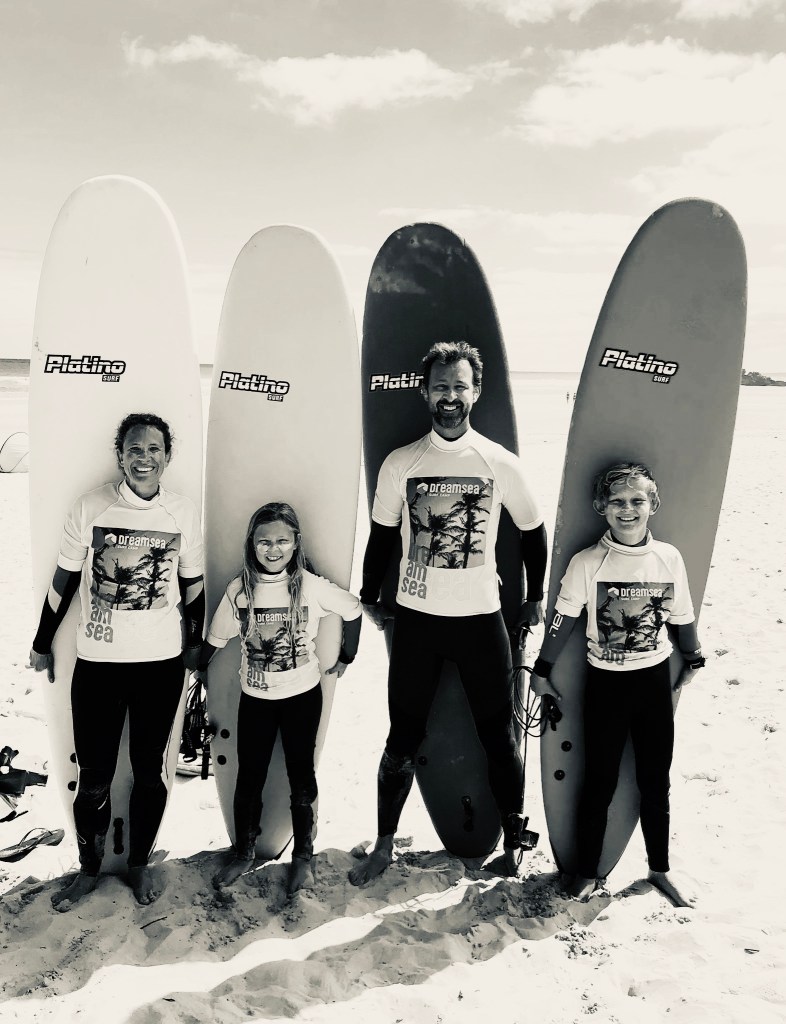
Victor, our surf instructor was from the Canary Islands. He had a moustache, zinc warpaint and melancholy eyes. His passion for surfing was huge and the kids absolutely loved him. We got a family coaching session on day one: drills and technical instruction on the beach then out together into the breakers where Victor pushed the kids into the smaller shore waves while shouting instructions at me and Menna as we surfed further out at the back.
“No Weeliam, in the bottom turn you must look for your line, then lead with the hands. Shoulder and hips will follow… It’s like salsa! You dance salsa right” Wrong Victor, I dance a kind of jerky techno.
“No Manna, two step pop-up only! Why your knees?”
Our days quickly settle into a pattern that looked something like this: wake, sunrise yoga session, breakfast. Arthur and Matilda do some reluctant school work in the central living area. Morning surf coaching. Picnic lunch on the beach. Afternoon surf coaching. Beach chill, visit local town, eat ice creams. Menna tries to make us all go for a run and sometimes we give in. Skate ramp. Ping pong. Cocktails. Dinner in the dining area. Party / salsa dancing / quiz / concert. Bed. Repeat.
It’s exhausting, but we all made good progress at surfing. The waves were big but mellow. I had my pop up totally re-engineered. The kids are very enthused and would do anything that Victor says. All of us feel our shoulder strength building: we can paddle for longer, catch bigger waves. Arthur is getting the parallels between surfing and skating, it is not long before he starts to put together some fairly slick looking turns on the skate ramp.
We talk to Victor about his tattoos and he weaves a life story around them.
“This one has the lion waving the Rasta flag. People all say it looks like the gay flag but it is not. And ok, so what, I still like it. It was done on a beach in Thailand. This one is the mermaid firstly because of the sea but also because of what she symbolises about love, you know, it never works out and it’s all like an illusion really. You think you’ve found the one but then something always goes wrong. It disappears.” Shrug. “These ones on my shins are High Tide, Low Tide, very common. This one here, ‘Be Everything You Can Be’, was from an advert, a big sign outside the house when I was staying all alone in Canada. It gave me big motivation…” He stops and sighs, something of that lonely Canadian winter flickers across his eyes. “So anyway, the tattoos are my history. Now let’s go surf!”
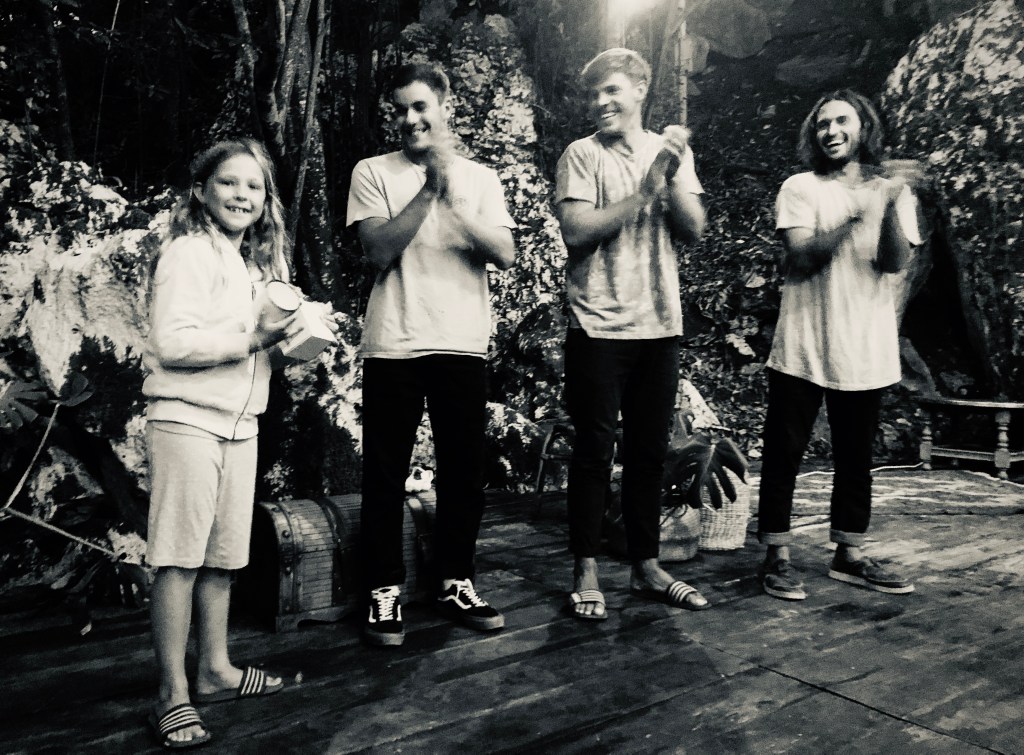
Matilda won Wave of the Week in a campwide prize ceremony. There was some confusion when she wasn’t there to receive it and we had to drag her out of bed at 11pm in her pyjamas. She was all sleepy and confused but very proud. So were we. So was Victor.
We went for a coastal hike yesterday on the northern face of the headlands. This completes a linking series of cliff walks that we have done over some weeks, taking us right around the North Devon peninsula from Saunton Sands to Ilfracombe, some 100km or so.
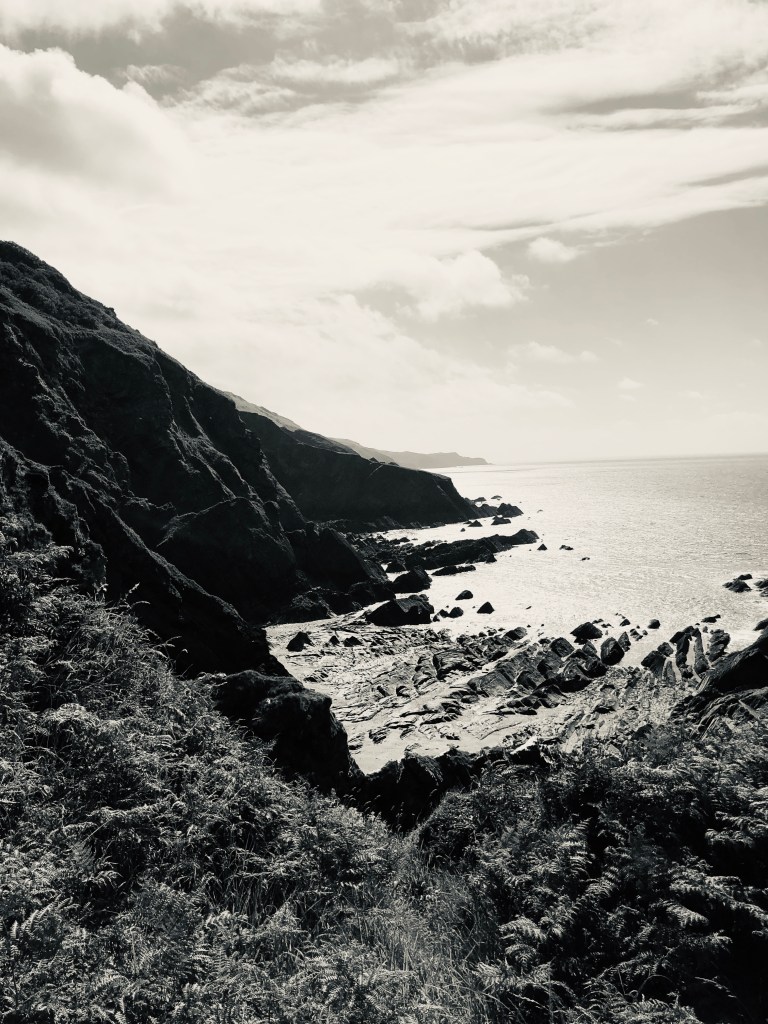
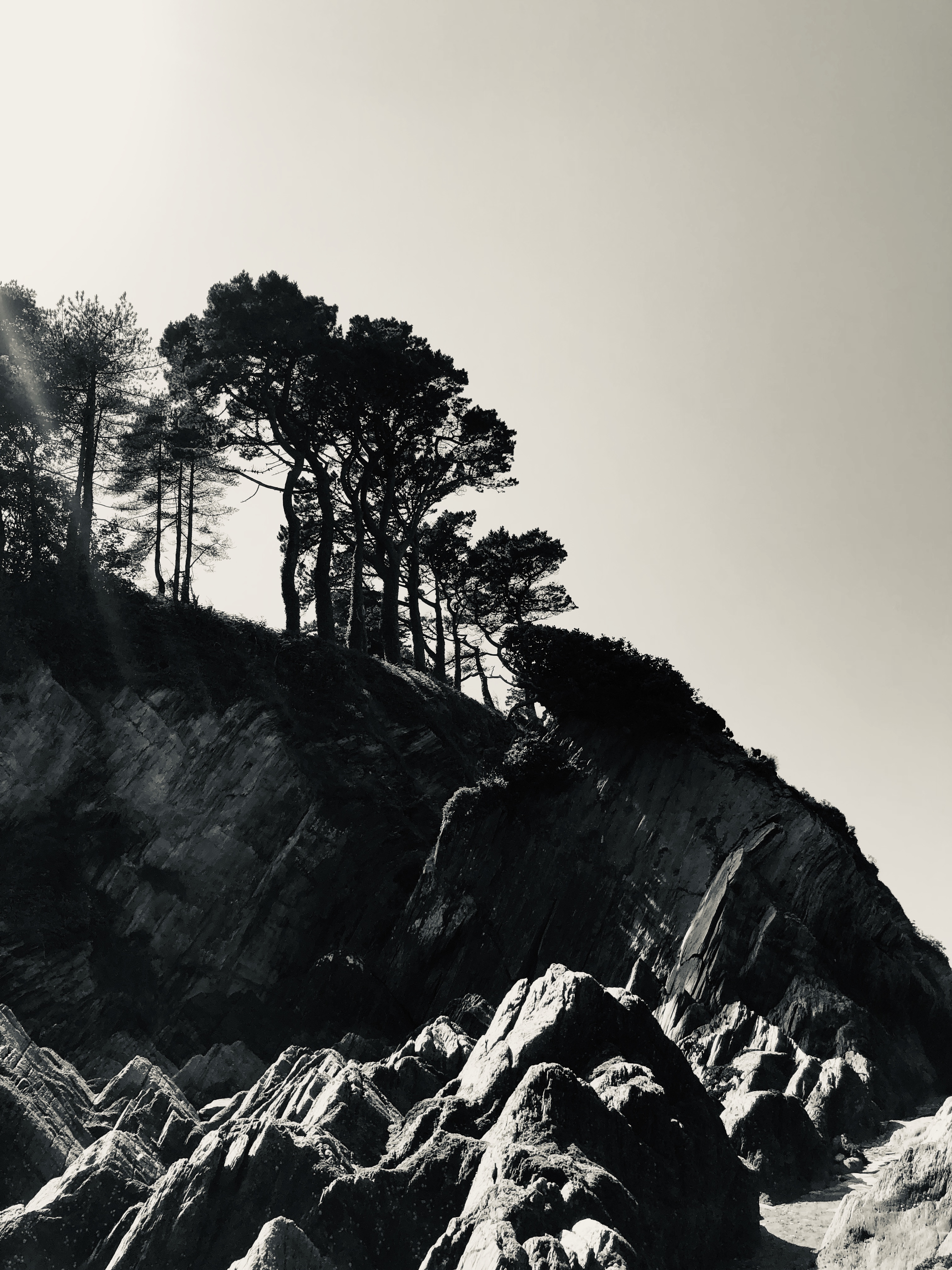
The cliffs in these parts have something about them that I’ve not felt before. All cliffs are huge and inspiring of course, that is their nature. These ones though have a jagged angular violence has been imprinted deep into the shape of the rock. There are dragons teeth that emerge dark and wet from the foam of the sea. Broken slate shards pile up under the crags as though they had come raining down in sheets. Dark fissures split open the cliff face. We saw a cove where rock ridges ran in lines across the shingle, like the black spines of some reptile that slept beneath.
Within the sedimentary rock there is colour and texture. A corduroy layering emerges in bold lines from the sea. The stripes rise up in diagonals that echo in successive and opposing cliff faces. Slate, granite and quartz are compressed into lines of pink and black and glittering crystal. But then the symmetry ripples and buckles, and you know that this stone mass was once spun and twisted in some huge pressure furnace like hot glass. There is suppressed energy throughout this landscape. Immense elemental pressures have played out here, and antagonistic forces remain locked in counterpoint, frozen within those misshapen bubbles of stone. There is a feeling of interrupted motion. At some point the rocks will surge upwards again. They will grind and thunder as they erupt: ripping out tree roots; showering boulders like rain; throwing nesting sea birds screaming into the air.
We leave the National Trust pathways wherever possible and slip onto the sheep paths that undulate through the gorse and ferns. Sometimes it works, sometimes it doesn’t. The tracks take you back and forth, criss-crossing through wind-stunted greenery, lulling you with smooth lines that rise and fall with the topography of the headlands. False trails peter out deep in the gorse, or lead you suddenly out onto limestone overhangs that could erode at any point. You wander how many sheep ambled along this path at night to suddenly find themselves on the edge of the precipice. Does some instinct pull them back? Or do those woolly coats sometimes catch a gust of wind, and then they are tumbling through black space, bleating wildly? You shiver and pull back from the edge.
I find that my thinking slows on these walks. I listen to my breath. I catch myself trudging up the escarpment muttering out simple rhyming word associations to myself, senseless poems to punctuate my footfall. Jurassic, bombastic, we lack it, eclectic (disrespecting), drastic, classic, smash it! Be enthusiastic!
We climb down to an empty beach where the surf beats onto the boulders. The low thunder sends us all gradually into a frenzy and we shout and run. We throw stones and jump off boulders and splash our way blindly through rock pools. We hold crab claw tokens and cowrie shells in our sweaty hands as we climb back up the rocky path again.
Sometimes you emerge over a hill top to find yourself unexpectedly on a vantage point where you can see the full line of cliffs undulating away into the distance like a folded ribbon of dirty grey. Perhaps there is a lighthouse in the distance, certainly there are birds wheeling in the sky. The sea is bottle green, flecked with sunlight and white horses. The wind whistles around, buffeting you back away from the edge.
Boulder, golder? (more gold?), hold her, quiet smoulder, cold shoulder, eye of the beholder.
Up on these massive granite slabs you can get hit by a sudden sense of your own smallness. A squall of futility blows up around you, borne on the sea wind. What are your puny ambitions and dreams lined up against the permanence, the gravitational mass, the sheer indifference of the rock? What flicker of time can you offer up against his eons? We pilot these towers of bone and muscle forwards over the headlands, spindle legs scissoring, furiously pumping blood down through branching tubes, breaking down matter deep in our guts. This pulsating mess of us all wrapped up in downy veined skin. We totter our towers onwards as though we will topple when we stop. We cover them around with bright materials and we shout out from the top: about our plans and schemes, and what we feel, and what we will do with life. As though it mattered.
Granite, tannic, magnetic, peripatetic! We say. Dead gannet, red planet, dormant, titanic.
As is the way of all small beasts, we disdain even smaller creatures, we care nothing for their worries. The world belongs to us alone. We are unaware that we are just mites creeping unnoticed along the shoulder of a sleeping giant.
But then I suppose he is unaware that in his way he too is small; that he lies on a larger rock which swings silently through space, circling an insignificant star that is hidden somewhere out on the far-flung spiral arm of a galaxy. One single galaxy among many.
We were walking up on the headlands and it was late. The wind had picked up, and out to sea there was an ominous black cloud line running right along the darkening sky. We were far from home.
Then I heard it, as the wind dropped for a moment, a little high pitched snicker, then a skittering sound of tiny feet scrabbling on dry earth. Arthur picked it up too. He has magnificent ears. “What was that Dad?” “It’s nothing” I say, “probably just a weasel in the undergrowth”. He moved in closer to me and we pressed forward in silence. I picked up the pace and hurried the family along.
We both knew that sound though.
The kids are familiar with gorse babies ever since that run-in we had with them in Dorset some years back. And now as we walk hurriedly back home, the rising panic of that sultry evening comes flooding back to me. I curse myself for not learning the lesson then. That too was a summer’s walk, only it turned into a nightmare as we gradually grew aware of their presence. First a sly rustling and snickering deep in the sea of gorse. Then a building storm, the foliage sighing and trembling all around us, as if the rooted foundations beneath stirred and seethed. Tiny hands pulling at the fronds, brown limbs entwined like snakes around the branches, yellow eyes glinting out at us from between the yellow furze flowers. There must have been hundreds of them. It was only through a commotion of shouting, stamping and hammering the path with a heavy stick that I was able to force us a route out of there. We shuffled homewards along the pathway for an age, clustered close together, the kids tightly guarded, Menna snarling and bringing up the rear.
I had never heard of the little creatures being so brazen before. It was simply not known for them to approach while adults were present. Usually it would be just an unattended child who might quietly disappear on the cliff top. Clearly we had run into a tribe that day, one that was powerful enough, or desperate enough, to attack a full family.
I would like to know more about gorse babies, those vile little creatures that fascinate and disturb me in equal measure. I’ve heard the stories, of course, vague and speculative as they are. That the first colony was started in Victorian times, somewhere in the south country, seems realistic. It was most likely a pair of very small children that were either deliberately abandoned on the moors, or became lost somehow. I always imagine a couple of smudged little tots, wide-eyed, tearful, holding hands as the dark closes in; their voices undetectable over the howling wind. They would have sheltered under those wide robust banks of gorse I guess, burrowing in deep to avoid the needles, cushioning themselves in the dry scree underneath. Perhaps they found rabbit or badger holes there. Perhaps they scraped away the earth with their own little fingers. Did the yellow beams of gas lamps flicker distantly in the night? Did the wind carry far off voices shouting their names with increasing desperation? Or were those first nights uninterrupted but for the slithering and scratching of wild creatures making their winding tracks under the fern and gorse?
Whether they were looked for or not, they weren’t ever found. Neither alive, nor as frozen bodies curled tight around the gorse roots. Instead somehow, against all odds, they survived. Some say the founders of the first great colony are still down there somewhere, enthroned in galleries of clay; an ancient and twisted little king and queen of the gorse world, surrounded by the wild civilisation they have created. I don’t believe this myself. That would make them well over a hundred years old. And to survive so long, in a life so harsh…
Our children didn’t sleep well for ages after that first Dorset encounter. They knew that they had had a very close escape. They were still small and malleable and could have so easily been snatched away and pressed down through dark holes into a new life under the earth. A life of slithering through tunnels, eyes straining and swelling in the darkness, bodies never to grow again, skin hardening, fat melting away, tendons, ligaments and bone gaining prominence. How long would it take them to forget their parents and their old soft lives in that subterranean world? Their backs would curve and knot under new muscle growth, their limbs contort to facilitate a life of scrabbling on all fours. Small naked bodies taking the colour of clay, covered in scar tissue and course matted hair. Teeth filed into little points; hardened claw fingers; flesh pierced with thorns and gorsewood. A life driven by instinct and tribal duty, squirming around the gorse roots, sleeping piled up with other small bodies in musky, airless underground chambers, nourished by the blood of rodents and who knows what else? They would have spoken that reedy, chirruping language, full of the anger and violence of wild moorland creatures. Many children have been lost this way.
Now though it’s different, Arthur is nearly ten and Matilda a plump eight year old. They would never flit through the tunnels that honeycomb the headland. Their bones have set, their haunches are soft and they have no value as conscripts to the tribe. Now they are simply prey.
The mist was rising as we hurried on into that yellow dusk. Around us the rustling and chittering slowly intensified like a locust storm approaching. I looked for a stout stick.
Since we escaped London some weeks ago now, we have been going through a mental shift.
It is something to do with moving into a very rural area, having lots of free time and being outside for most of the day. There is a different set of signals we pick up now. New priorities steal our attention. People talk a lot these days about re-wilding gardens and outdoor spaces; allowing nature to reclaim manicured lawns and geometric lines. In a way it feels like we are rewilding too.
We came here from the city. That means we came from a place where energy and determination are revered and prioritised above all else. We measured efficiency and productivity at work. We obsessed about ways to improve metrics and smash our targets. At home we charted our step count, heart rate and sleep time, sharing them with communities who would then push us to improve. We tacitly competed with our friends on the quality of our dinner parties. We tried to improve our running speed and build our pushup count. Life moved fast and all moments were accounted for.
Once you step out of all that and dial down the speed of life, it takes a while to reprogram the system. The first week or two down here you could see Menna or I suddenly stiffen up like prairie dogs at a given moment, as our minds threw up random worries to try and get the panic systems rebooted. (NO! I forgot to put light fittings on the inventory! Coffee cup slips out of numb fingers to smash on the floor.) We would ping awake in the night, grasping for something to get all twisted up about. (What if we need to vote in a snap general election? We have no current residency! Heart thumps madly in the darkness). We’d check social media surreptitiously on family walks. We would obsess about the news.
Then slowly it slips away. The interruptions become less frequent, then disappear. The nights become longer and fuller. We wake slowly with strange tastes in our mouths and the lingering aftermath of heavy dreams. Focus builds and small tasks absorb us. Sometimes we find ourselves just sitting and thinking for a while, doing nothing really.
Busy minds, deprived of action plans and to-do lists, start to open up other enquires. They turn outwards towards the world. The wind is strong today and it’s shifted to behind the dunes. I’ve never seen clouds twisted up into a vertical column like that. Who is that small bird who trills between the sea gulls’ screams? It feels somehow like it’s going to rain later.
Once you recognise this shift, and you open yourself to it, then the world suddenly seems full of signals and patterns that were hidden to you before. It feels big. You can turn it into a huge spiritual revelation and believe that the universe is whispering in your ear. Three cormorants heading east before summer’s dusk? Winds are coming I tell you! Or maybe it just makes you feel content and a little more connected to this new landscape around you. You might feel that yes, you did make the right move coming down here.
A kestrel hovers on the headland almost every evening now hunting his prey. Little pulses of his wings keep him motionless above the gorse even as the wind blows everything else around.
The fields near us hide a subterranean population of rabbits who emerge out for a cautious sniff early mornings and at dusk. A slight noise and they will all skitter away, a tumble of white feathery tails disappearing into the hedgerow.
A pungent weed permeates the hedgerows and dune flowers. It is called Houndstongue but known locally as Rats and Mice because of its musky damp rodent smell. We all found it disgusting the first time we smelt it. Now it’s like a soggy friend that comes to greet you as you walk down the sandy lane to the beach.
Foxgloves are everywhere this month, priapic purple stalagmites rising out of the gorse. There is a similar-looking but more reserved blue flower in the dunes which I prefer. It’s got the awesome name of Viper’s Bugloss.
The tides reshape the beach and headlands every hour. We’re getting to know the timings more intuitively now, and more importantly to recognise the confluence of wind, tide and swell that makes the best waves.
A flock of goldfinches (sorry, a charm of goldfinches) surprise us with sudden flashes of red and yellow as they flitter past like leaves in a gale.
You come to see how the prevailing westerly wind has comprehensively sculpted the landscape around us. You realise how relentlessly it bends and pushes everything away eastwards, and then then you start to see its mark everywhere; triangles and wedges sculpted into dunes, gorse, trees, hills and even the limestone cliff faces. The hypotenuse always points down to the most westerly point.
I saw a single dolphin far out at sea one evening, a leaping shape midway to the horizon. I was alone in the surf as the sun was setting and to be honest it was something of an epiphany.
Arthur and I went out to do some starwatching in the dunes. We found The Pointer stars at the end of the plough and they directed us to Polaris, then on to Deneb which, together with Vega and Altair, make up the Navigator’s Triangle. This always points you southwards I lectured Arthur (well ok, an iPhone is easier but that’s not the point).
On a Sunday cliff walk we saw a family of seals far below in the rockpools. Their whiskery heads bobbed up for a quick a chat before they slipped down again below the dark green swelling waters.
There is a good but infrequent wind that comes from the east and makes the waves clean and glassy.
I want to develop a subconscious sense of where the cardinal points are, even in cloud cover or deep in a forest (Arthur can already do this but I can’t. I’ve always had a rubbish sense of direction).
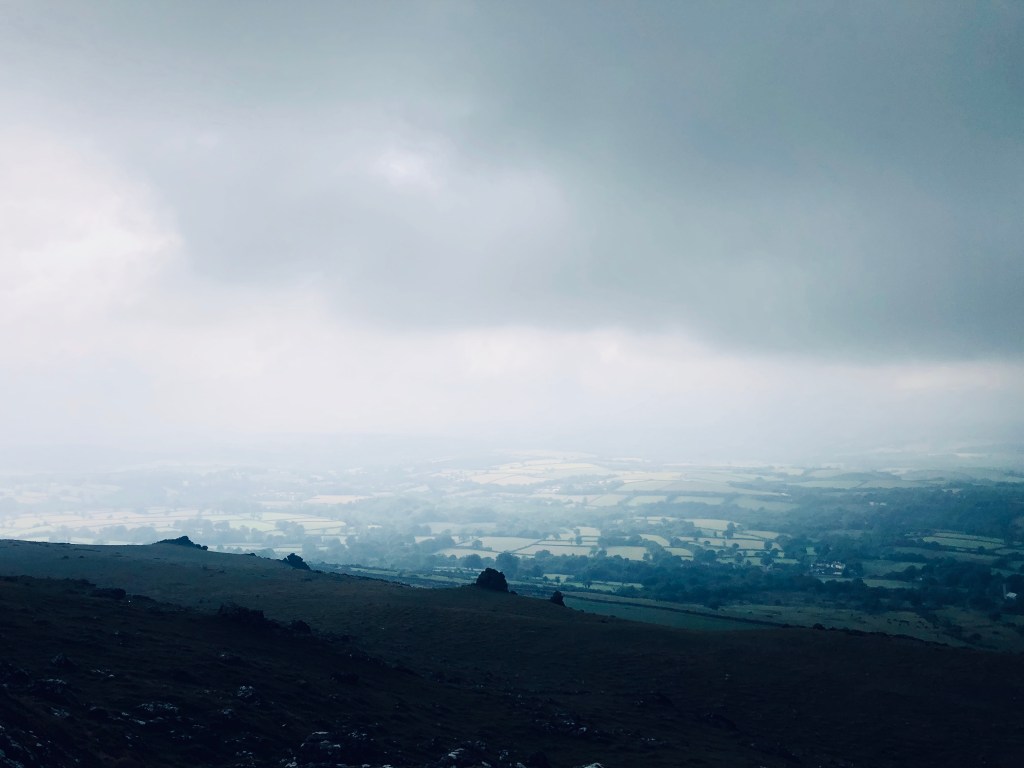
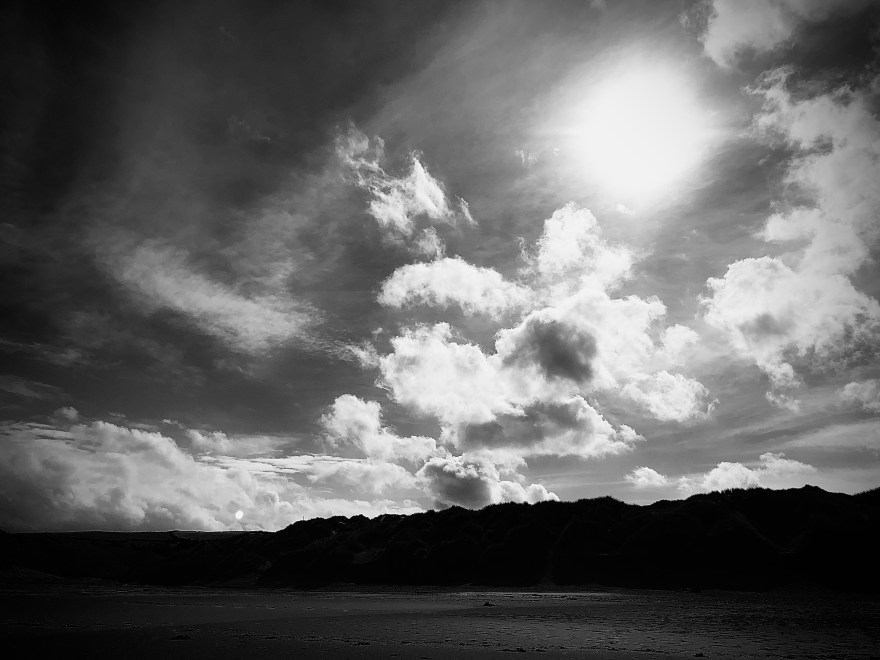
We arrived into two straight weeks of atmospheric high pressure, so hard blue skies and sun. Now the system has moved on and we feel smaller beneath a huge expansive cloud world whose architectures show various distinct textures and densities in different strata above us.
For many days last week there was an ominous storm cloud which stretched squat and black right down to the horizon. It seemed to trap light beneath it, so that the hills and cliffs seemed strangely illuminated and you could see for miles. We spent our days outside slightly on edge, feeling that the storm might vent down upon us at any point. The air was so thick and charged with electricity. All that tension and power just hung there in stasis though, hovering above us for days. It barely even rained. I don’t know why.
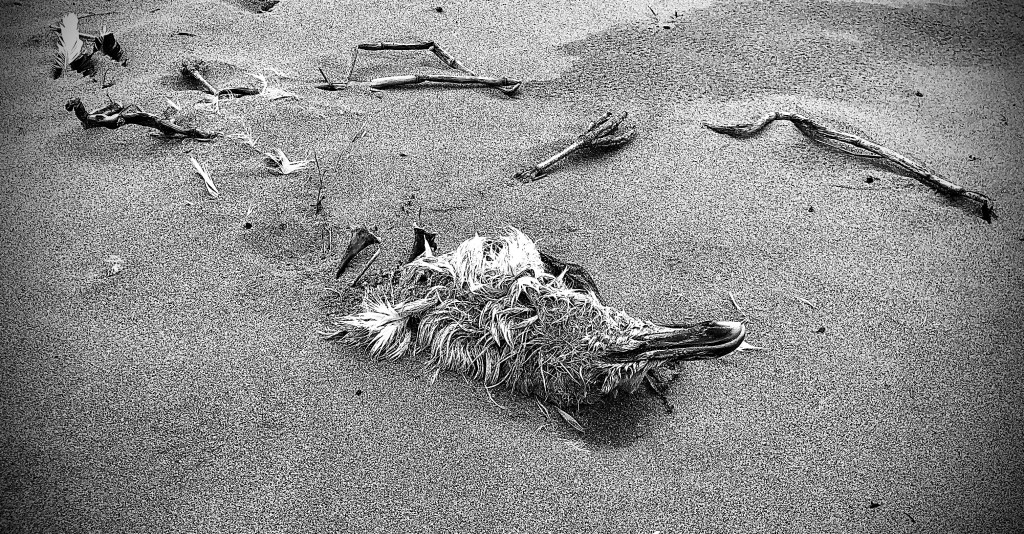
A dead gannet waited on the beach the other day. It was on its back, half submerged, neck thrust up as if its last moments were spent trying to force its way up from its sandy tomb for one final flight. We gathered in a semi circle around it, the kids silent and solemn. It was a sober moment, like finding a whale’s carcass in the desert, or a frozen hand reaching up out of the glacier. I was going to give some homily about the circle of life and how death comes to all things, but in the end I just kept quiet.
There are books that help decipher these messages. On my bedside table right now I have Wild Signs and Star Paths by Tristan Gooley. It’s a lucid exploration of hidden keys and signals in nature and how to determine their significance. Can we recapture such a sense of awareness of our environment that we read signs and link patterns instinctively, generating subconscious insights on weather, direction, animal behaviour that feel something like sixth sense? (Pretty cool). Then, as a counterpoint, Carl Sagan’s Cosmos lifts your gaze away, up to the most distant horizons, for a universal context. Great travellers lead the way – Redmond O’Hanlan, Bruce Chatwin, Ryszard Kapuściński. They talk about leaving behind the impediments of your former life and going through a kind of rebirth on the road. We have guides to animals, flowers, geology, trees, stars. On my phone I have downloaded the Collins Birds app.
It feels like there is a lot to learn.
I had long felt in my gut that the world was extravagantly rich with signs… Many thousands of hours outdoors had led to my spotting patterns, asymmetries and trends; they were beautiful but often hard to explain.
Tristan Gooley. Wild Signs and Star Paths
Finally, at the end of our wandering, we return to our tiny, fragile, blue and white world, lost in a cosmic ocean vast beyond our most courageous imaginings. It is a world among an immensity of others. It may be significant only for us… It is on this world that we developed our passion for exploring the Cosmos, and it is here that we are, in some pain and with no guarantees, working out our destiny.

 Mutant Skies