Pont Aven

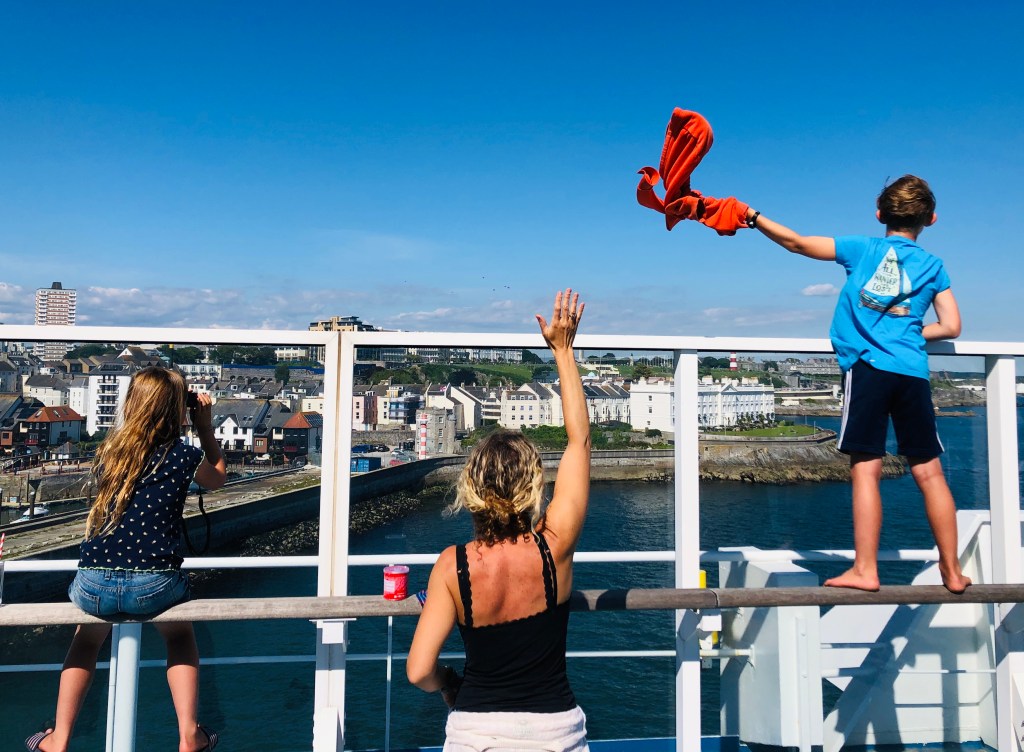
We are on a ferry! Going to Spain! Escaping Covid, Brexit and the peculiar malaise of being British in the summer. We have slipped the surly bonds of home. Windblown and barefoot, small Nicholls flit across the sundeck like sparrows. We have all of our travel essentials ready: Pringles, beer, a G&T in a plastic cup; binoculars, a picnic and an orange hoodie to wave at tiny far-off Grandma on Plymouth dockside, who cheerily returns our farewell using a Sainsbury’s plastic bag.
We were leaving England on a magnificent adventure, only three months later than planned, and it was Spain of all places that was to be our first overseas destination. Spain I tell you! A country of lemons and olives, jamón, paella, Rioja; with matadors strutting around in their finery like a relics of a bygone age. There would be lush coastlines and parched desert interiors, granite massifs peppered with vineyards, olive groves and precarious adobe villages clinging to the rock face. We would follow the footsteps of George Orwell, Laurie Lee, Ernest Hemingway. The Spanish are a dark-eyed sinuous race, ever laughing and twirling, impervious to the heat of the day. Their glossy hair is always groomed. Some of this flamboyance and self-belief will rub off on us surely. Not for us the Mediterranean sun traps of Malaga and Marbella though – claro que no! We are going to surf our way around the Atlantic coast. Live on pan y chorizo and apricots picked from the tree, fall asleep to a soundtrack of flamenco guitars and Balearic beats. We would camp in the clifftop wildlands of Cantabria, Asturias, Galicia – and just how satisfying are those names as they bubble through your mouth, with their deep Spanish assonance, strange feminine ‘c’s, vibrant fricatives and trilled rhotives (rolled ‘r’s right?)? The Iberian peninsula is the only place to be in summer 2020.

And the ferry was awesome! Huge and new, proudly proclaiming herself the flagship of the Brittany Fleet. The Pont Aven, God Bless her! Or rather que Dieu la bénisse! as onboard there was an charming francophone insistence, which meant all signs, announcements and crew interactions should be initiated in French, despite the fact that the boat was heading between Plymouth and Santander and had nothing to do with France whatsoever. Magnifique!

Our cabin was a triumph in ergonomics. It had a sofa that flipped into a bed and three further bunks that pulled magically down from wall and ceiling panels. There was a bathroom the size of a phonebox full of clever folding gizmos. The kids nearly exploded with excitement, but given the lack of space they could only squeak and bounce furiously for a while before creating a game where you had to hop from bunk to bunk in a certain sequence. I tried it, but was disadvantaged by my size and then Menna told us all off before I could really nail it. We stayed up long into the night, piled on one bunk ,watching Jurassic Park on my iPad, then we slept in very late, confused by the total darkness of our internal berth.

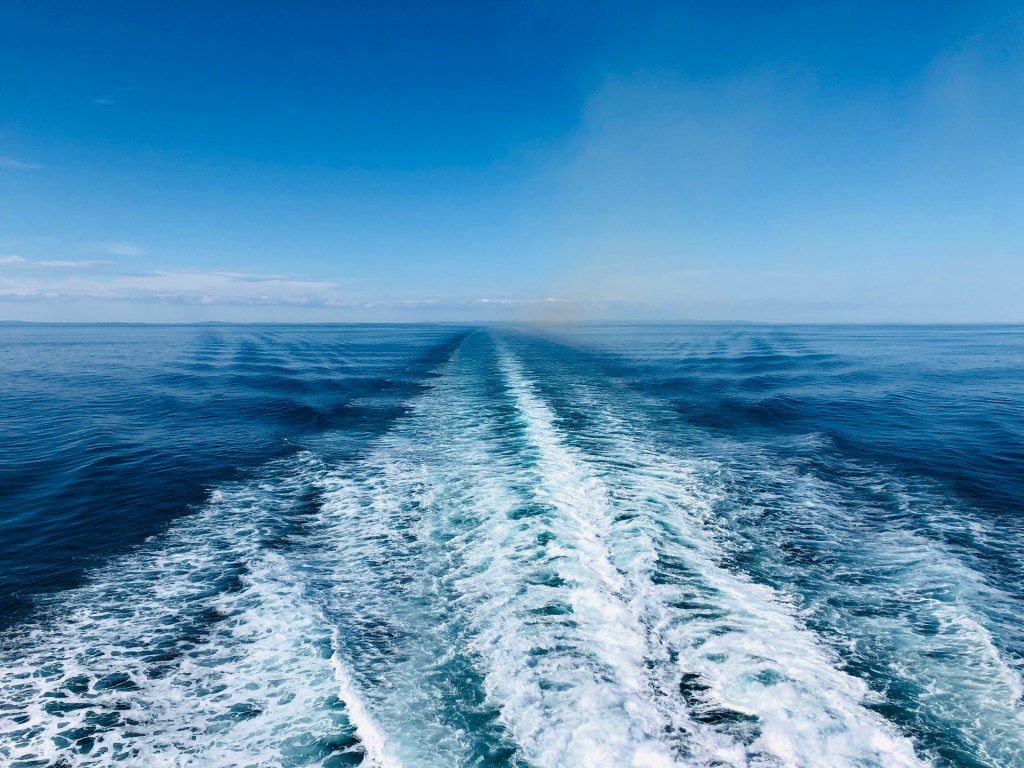
The best thing about the ferry was the wake. A churning highway that stretched straight and true for miles behind us, gleaming foamy white against the dark bottle green sea. I sat on the top deck and watched it for hours with Menna as the kids scampered between decks. At one point we saw a commotion of gulls and dolphins in a feeding frenzy and later there was a lone tern that seemed to navigate along its line for some hours (I wished it had been an Albatross!). We passed the lonely Edistone lighthouse, far out at sea, a navigation milestone that unleashed many nostalgic tales of Menna’s childhood cross-channel voyages.

That wake was a road that connected us to our home port, but it was also a symbol of progress. We were surging forwards on the unmarked face of the ocean, blazing a new path where there was none before.

We have a one-way ticket outbound and who knows when we will be home again.
We Are Sailing

We filtered off the A386 and Plymouth wrapped its stony arms around us. We all felt the change. We had only been out of London for six weeks, but living in open space and sunlight and in some way we now felt accustomed (entitled!) to wider horizons. Our car was loaded down with possessions, we were chattering and windswept after a long moor walk and now we arrived to roadworks, roundabouts and the relentless swell of urban movement. Plymouth is draped across many hills with rows of slate grey roof-lines that stretch as fingers down to a storm grey sea. The domes of the naval boatyards sit like oil drums in the harbour, half-submerged among a silt boneyard of masts, cables and cranes. The seagulls seem angry. The signs tell us that this is Britain’s Ocean City. It is a serious seafaring place.

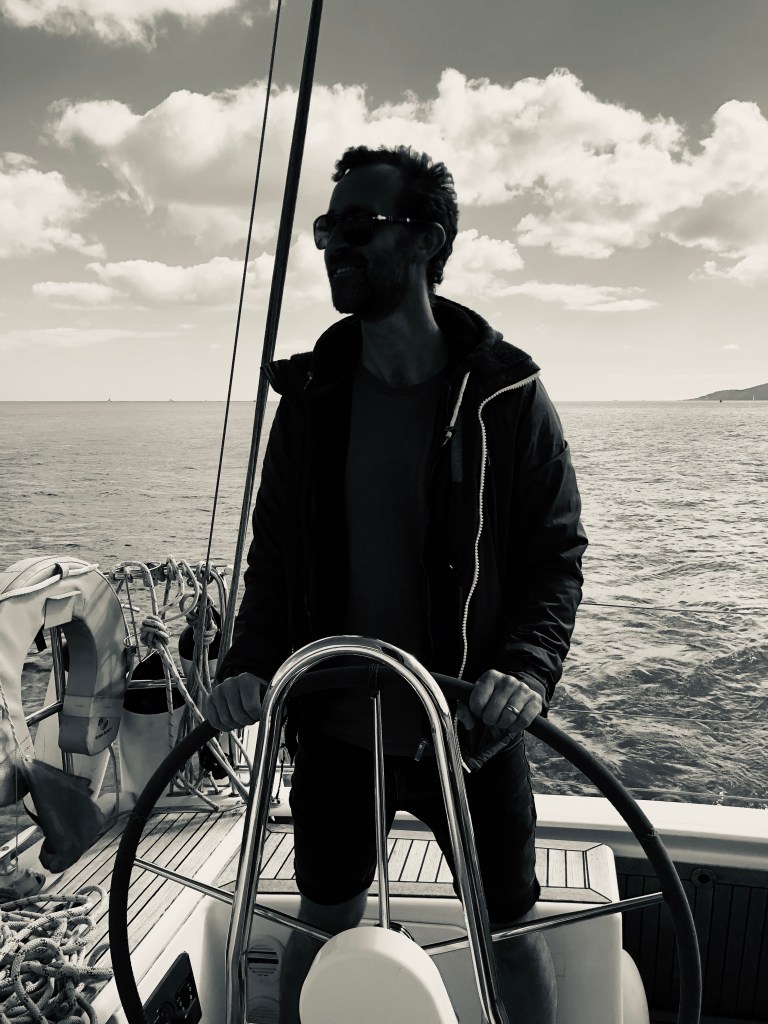
We were there to see Menna’s parents and throw ourselves onto their hospitality. It was our first social visit after three months of lockdown. We were also booked in to do a yacht course. The Hodins are a sailing family and Menna herself was brought up racing yachts, though now she has softened and been made less confident by some decades inland. I am pretty inept on a boat but always keen to widen my relationship with the sea. We need options too: there might be points in our travels where the road will end and we will need to take to the sea. My aim was to become an able crew member under Menna’s captaincy.

In sailing you have to get comfortable with ambiguous movement. You set off for a fixed destination but your progress is always indirect. You must tack and jibe to reconcile your destination with the wind direction, but even within these supposedly linear movements your boat is constantly sliding, drifting and curving obliquely; making hidden runs that are hard to spot against the changing face of the ocean. The sea is wrapped all around you, and it twists your vessel and plays with it. Tides and currents pull on the keel as the wind fills the sail and pushes at the hull. The line of your progress, if plotted over the sea bed, would be meandering and full of lateral drifts, even as the bow points always forwards. The boat responds to your commands in it’s own time, often unwillingly. There are no brakes.

Perhaps sea voyages aren’t so much about functional travel as about reversing perspectives. You leave solid land of fixed horizons to find a fluid and unstable world. Vistas shift and tilt. A new set of options open up though: you have different lines of approach; you can reach coves and bays that are inaccessible from the land; you can drop anchor in the waves. Out on the deck you get to see what your country looks like from the sea. Plymouth relaxes. It sweeps back statesmanlike from the shoreline, the slate roof lines now gleam like sliver hair swept back with pomade. The boatyards open up to show their secret workings. The Hoe promenade drives grandly up to the lighthouse. The seagulls are still angry.

There is a Frank O’Hara poem, To the Harbormaster, that I think of sometimes when I am at sea. It speaks of battling tides and insurmountable distances to reach an ideal. There is a tone of hopeless optimism that occasionally falters, and it strikes a deep chord with me. Brave resistance turns to submission, blind hope gives way to the sinking feeling of realisation. The poet uses a sea voyage as a analogy to explore how heroic ideals are derailed by life, but I prefer to stay in the metaphor, that is to stay with the sea. My relationship with the ocean is a hopeful attempt to find solidarity with something infinitely vast and strong, where too often my small advances are suddenly reversed and I am left with the realisation that I am small, scared and insignificant. I make excuses: I was caught in some moorings; my indecisions and vanities subvert me; the waves hold me back. But still I naively trust in the sanity of my vessel, despite it all. I will make my port.

I crashed the boat on the third day. It was in the terrible channels of the Queen Anne Battery Marina. Slowly heeling round from my mooring to find the line to open sea, I too was driven by the wind, but rather than finding the seductive brown lips of the reeds, it was the hard claw of a superyacht’s anchor that tattered the cordage of our boat (stanchions and guard rail twisted, winch scored deeply). The hull luckily remained intact.

We had already had two magnificent days of sailing. We had learnt mooring, helming, navigating, anchoring. We had charted and completed a complex river journey, tied onto a pontoon in very challenging conditions, skimmed over the waves under full sail in a force seven. We had simulated disasters at sea and rescued men overboard. And then came this horrible slow-motion collision in the morning rain. We disentangled ourselves and limped out of the harbour, our instructor grim-faced, calculating the damage that had been done to his boat. In the silence of my disgrace I thought again about my subservient relationship with the sea. Faltering strokes forwards, hard-won triumphs that last for moments, with the knowledge that at any point I may be pushed back, beaten, submerged at the ocean’s whim. Is it the difficulty that makes it all worthwhile? Is it the heroics of chasing an impossible dream? I am always tying up and then deciding to depart, In storms and at sunset, with the metallic coils of the tides around my fathomless arms.

To The Harbormaster

I wanted to be sure to reach you;
though my ship was on the way it got caught
in some moorings. I am always tying up
and then deciding to depart. In storms and
at sunset, with the metallic coils of the tide
around my fathomless arms, I am unable
to understand the forms of my vanity
or I am hard alee with my Polish rudder
in my hand and the sun sinking. To
you I offer my hull and the tattered cordage
of my will. The terrible channels where
the wind drives me against the brown lips
of the reeds are not all behind me. Yet
I trust the sanity of my vessel; and
if it sinks it may well be in answer
to the reasoning of the eternal voices,
the waves which have kept me from reaching you.

Frank O’Hara